Torlon Set Screws
Last updated
Metal-like performance from a light weight plastic

Need help choosing a material?
- Exceptional strength and stiffness up to 275°C (525°F)
- Outstanding wear resistance
- Superior toughness from cryogenic up to 275°C
- Resistant to strong acids and most organics
- Inherent flame resistance
- Metal-like coefficient of linear thermal expansion
- Torlon set screw features and benefits
Polyamide-imide or Torlon® set screws are one of the strongest and toughest polymer screws available. Having the highest strength and stiffness of any pure thermoplastic up to 275°C (525°F), Torlon set screws are geared for the most demanding mechanical and high temperature applications. Torlon screws also have outstanding resistance to wear, creep and most chemicals.
Torlon set screws are available in a glass fiber reinforced grade which improves the strength, modulus and creep resistance. Because of the outstanding mechanical properties of Torlon screws, they can be used as a replacement for metal screws some applications.
Torlon set screws are available in both metric and standard sizes. Please contact us if you have any questions about Torlon screws, their characteristics and their availability.
Screws made from customer specified polyamide-imide grades are available upon request.
Screw Types: Flat Head Screws, Hex Cap Screws, Pan Head Screws, Set Screws, Socket Head Cap Screws
Torlon Set Screw Features & Benefits
Torlon set screws are unique in that they have no screw head, meaning that they have no protruding part past the threaded shaft. They are thread only and are available with a socket or slotted driver insert at one end. Set screws are used to secure an object within or against another object. Typically they secure a rotating part such as a gear or shaft. Torlon set screws are driven through a threaded hole in the rotating part until it is tight against the inner object, preventing from moving relative to the outer object. Set screws are available with various points depending on the application.
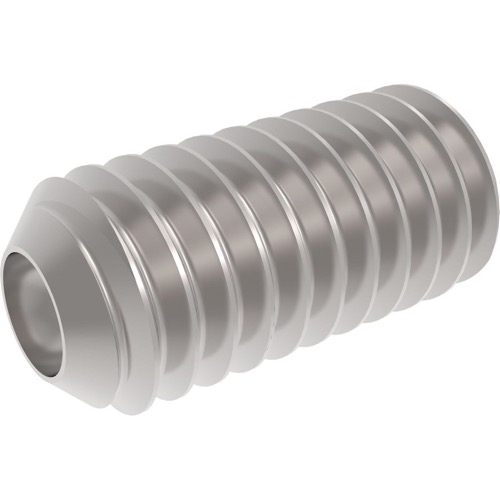
Cup Point
This is the most commonly used set screw and is identified by a cup-shaped indentation on one end. Torlon cup points are typically used for a quick, semi-permanent or permanent applications where it is acceptable to cut the cup point edge of the screw.
Cone Point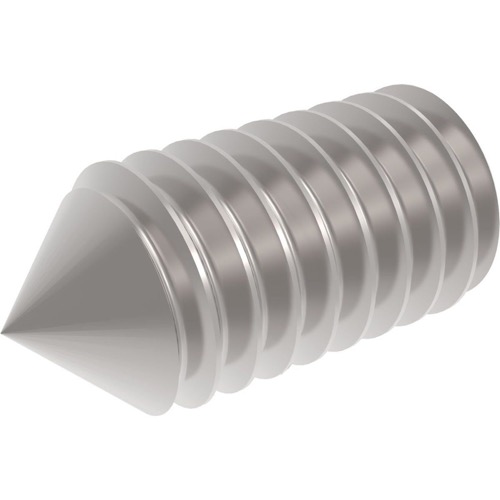
A cone point is easily identifiable by its sharp cone-shaped point – just like an ice cream cone. Torlon cone point set screws deliver the strongest clamping force due to the deep penetration of the point. As a result they are used for permanent assembly.
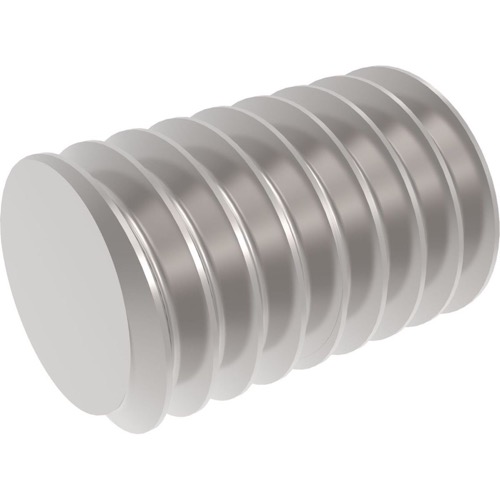
Flat Point
The cheapest and simplest of the set screw point styles, this screw has a flat surface on the bottom of the screw. This type is used when you need the ability to frequently change parts and require minimal shaft deformation.
Torlon Properties
Torlon Mechanical Properties
| Material | Ultimate Tensile (psi) | Yield Strength (psi) |
|---|---|---|
| Torlon Unfilled | 22,000 | - |
| Property | ASTM / UL Test | Torlon® PAI 4203 |
|---|---|---|
| PHYSICAL | ||
| Density (lb/in³) (g/cm³) | D792 | 0.051 (1.41) |
| Water Absorption, 24 hrs (%) | D570 | 0.33 |
| MECHANICAL | ||
| Strength/Weight Ratio | Tensile Strength / | 15600 |
| Tensile Strength (psi) | D638 | 22,000 |
| Tensile Modulus (psi) | D638 | 650,000 |
| Tensile Elongation at Break (%) | D638 | 7.6 |
| Flexural Strength (psi) | D790 | 41,000 |
| Flexural Modulus (psi) | D790 | 1,140,000 |
| Hardness, Rockwell, R/M Scale | D785 | M120 |
| IZOD Impact Notched (ft-lb/in) | D256 | 2.7 |
| THERMAL | ||
| Coefficient of Linear Thermal Expansion (x 10-5 in./in./°F) | D696 | 3.1 |
| Heat Deflection Temp (°F / °C) at 264 psi | D648 | 532 / 278 |
| Melting Temp (°F / °C) | D3418 | none (degrades ~500 °C |
| Max Operating Temp (°F / °C) | - | 525/ 275 |
| Thermal Conductivity (BTU-in/ft²-hr-°F) | C177 | 1.8 |
| ELECTRICAL | ||
| Dielectric Strength (V/mil) short time, 1/8" thick | D149 | 580 |
| Dielectric Constant at 1 MHz | D150 | 3.9 |
| Dissipation Factor at 1 MHz | D150 | 0.026 |
| Volume Resistivity (ohm-cm) at 50% RH | D257 | > 1016 |
| APPROVALS | ||
| Approval | FDA | NO |
| Approval | USDA | NO |
| Approval | NSF | NO |
| Approval | 3A DAIRY | NO |
| Approval | USP CLASS VI | NO |
TORLON CHEMICAL RESISTANCE
| Chemical | Tensile Strength % Retained |
|---|---|
| Acids | |
| Acetic (10%) | 100 |
| Glacial Acetic | 100 |
| Acetic Anhydride` | 100 |
| Lactic | 100 |
| Benzene Sulfonic | 28 |
| Chromic (10%) | 100 |
| Formic (88%) | 66 |
| Hydrochloric (10%) | 100 |
| Hydrochloric (37%) | 95 |
| Phosphoric (35%) | 100 |
| Sulfuric (30%) | 100 |
| Bases | |
| Ammonium Hydroxide (28%) | 81 |
| Sodium Hydroxide (15%) | 43 |
| Sodium Hydroxide (30%) | 7 |
| Aqueous Solutions (10%) | |
| Aluminum Sulfate | 100 |
| Ammonium Chloride | 100 |
| Ammonium Nitrate | 98 |
| Barium Chloride | 100 |
| Bromin (saturated solution, 120 °F) | 100 |
| Calcium Chloride | 100 |
| Calcium Nitrate | 96 |
| Ferric Chloride | 99 |
| Magnesium Chloride | 100 |
| Potassium Permanganate | 100 |
| Silver Chloride | 100 |
| Sodium Bicarbonate | 100 |
| Sodium Carbonate | 100 |
| Sodium Chloride | 100 |
| Sodium Chromate | 100 |
| Sodium Hypochlorite | 100 |
| Sodium Sulfate | 100 |
| Sodium Sulfide | 100 |
| Sodium Sultite | 100 |
| Alcohols | |
| 2-Aminoethanol | 9 |
| n-Amyl Alcohol | 100 |
| n-Butyl Alcohol | 100 |
| Cyclohexanol | 100 |
| Ethylene Glycol | 100 |
| Amines | |
| Aniline | 97 |
| n-Butyl Amine | 100 |
| Dimethylaniline | 100 |
| Thylene Diamine | 7 |
| Morpholine | 100 |
| Pyridine | 43 |
| Chemical | Tensile Strength % Retained |
|---|---|
| Aldehydes & Ketones | |
| Acetophenone | 100 |
| Benzaldehyde | 100 |
| Cyclohexanone | 100 |
| Formaldehyde (37%) | 100 |
| Furfural | 84 |
| Methyl Ethyl Ketone | 100 |
| Chlorinated Organics | 100 |
| Acetyl Chloride (120 °F) | 100 |
| Benzyl Chloride (120 °F) | 100 |
| Carbon Tetrachloride | 100 |
| Chlorobenzene | 100 |
| 2-Chloroethanol | 100 |
| Chloroform (120 °F) | 100 |
| Epichloroydrin | 100 |
| Ethylene Chloride | 100 |
| Esters | |
| Amyl Acetate | 100 |
| Butyl Acetate | 100 |
| Butyl Phihalate | 100 |
| Ethyl Acetate | 100 |
| Ethers | |
| Butyl Ether | 100 |
| Cellosolve | 100 |
| P-Dioxane (120 °F) | 100 |
| Tetrahydroturan | 100 |
| Hydrocarbons | |
| Cyclohexane | 100 |
| Diesel fuel | 99 |
| Gasoline (120 °F) | 100 |
| Heptane | 100 |
| Mineral Oil | 100 |
| Motor Oil | 100 |
| Stoddard Solvent | 100 |
| Toluene | 100 |
| Nitriles | |
| Acetonitrile | 100 |
| Benzonitrile | 100 |
| Nitro Compounds | |
| Nitrobenzene | 100 |
| Nitromethane | 100 |
| Miscellaneous | |
| Cresyldiphenyl Phosphate | 100 |
| Sulfolane | 100 |
| Triphenylphosphite | 100 |