Alloy 20 Fasteners - Bolts, Screws & Nuts
Last updated
Good mid-range corrosion resistant alloy

Need help choosing a material?

- Mid-range corrosion resistant alloy
- Decent mechanical strength to 1000°F
- Alloy 20 chemistry and specifications
- Alloy 20 sulfric acid performance
- Datasheet for Alloy 20 fasteners
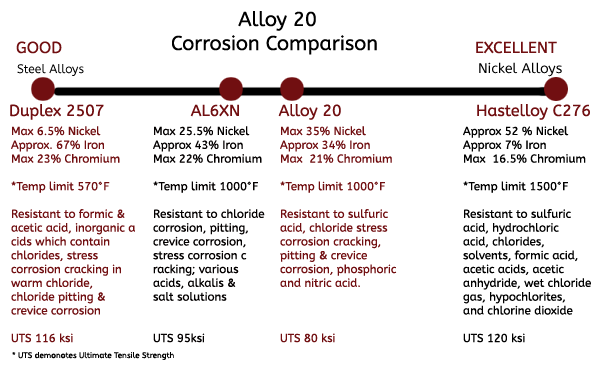
Alloy 20 fasteners, also known as Carpenter 20 and 20CB-3, offers a combination of nickel, chromium, molybdenum, and copper which provides good general corrosion resistance. Alloy 20 (2.4660) fasteners are best suited for mid-range corrosion use – better than steel alloys but not at the level of high performance nickel based alloys like Hastelloy C276. Alloy 20 is a nickel alloy that was specifically designed to withstand the harsh environment of hot sulfuric acid but also performs well in a variety of other acids. Alloy 20 fasteners are an ideal choice when you don’t need the corrosion resistance power and price-tag of high performance nickel alloys like Hastelloy C276; but you need something that will give you more protection than 316 stainless steel or even a Super Duplex 2507 stainless steel.
Corrosion Resistance
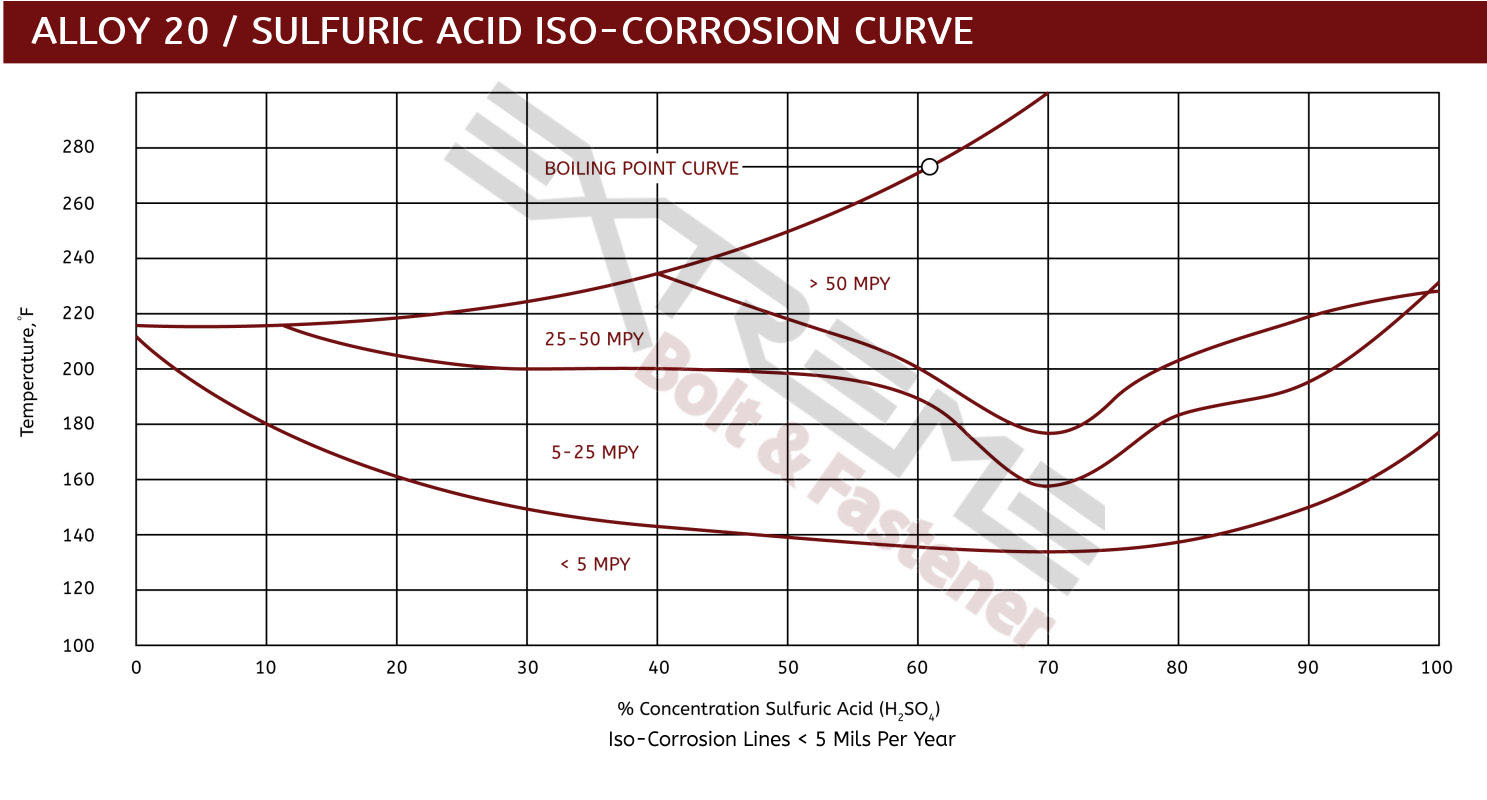
Alloy 20 fasteners provide good performance in hot sulfuric acid, specifically they offer good resistance to stress-corrosion cracking in boiling sulfuric acid at specific range of 20% to 40% concentration, as well as general sulfuric acid resistance. Alloy 20 (2.4660) fasteners offer solid acid protection and will perform better than Duplex or even Monel, but for high temperature and high concentration acids, you may need to look to Inconel or Hastelloy fasteners. In addition Alloy 20 fasteners also show useful resistance to phosphoric acid and nitric acid.
Key Corrosion Resistant Features:
- Good sulfuric acid protection at 20% - 40%
- Decent stress corrosion cracking, pitting and crevice corrosion resistance in chloride
- Resonable general corrosion protection
- Good intergranular corrosion resistance in the as-welded condition
Mechanical Properties
- Ultimate tensile strength: 80 ksi
- Yield strength: 35 ksi
- Density: 0.292 lb/in.3
- Electrical Resistivity (RT) 651 ohm-cir mil/ft
- Elongation: 30%
Temperature
In addition to their corrosion resistance, Alloy 20 fasteners also perform well at moderately high temperatures, with the ability to maintain their mechanical strength up to 1000°F.
Welding
Alloy 20 fasteners are stabilized with Columbium to minimize carbide precipitation during welding. In addition it offers intergranular corrosion resistance in the as-welded condition.
Applications
- Power plants rely on alloy 20 fasteners for flue-gas desulfurization
- Alloy 20 fasteners are used to connect heat exchangers, mixing tanks, metal cleaning equipment, pickling tanks and racks, and piping in mid-range corrosive chemcial processing environments.
- Alloy 20 fasteners help solve corrosion issues in food and dye production.
- Manufacturers of plastics and synthetic rubber also utilize alloy 20 fasteners.
Alloy 20 Chemistry & Specifications (2.4660)
Alloy 20 Specifications: UNS N08020, ASME SA240, , ASME SB366, ASME SB462, ASME SB463, ASME SB464, ASME SB473, ASME SB729, ASTM A240, ASTM B366, ASTM B463, ASTM B464, ASTM B473, ASTM B729, ASTM BB462, ANSI/ASTM A555-79, EN 2.4660, , Werkstoff 2.4660, CN7M, DIN 2.4660
| Alloy 20 | Ni | Cr | Mo | Mn | Cu | Si | C | S | P | Cb+Ta | Fe |
|---|---|---|---|---|---|---|---|---|---|---|---|
| Min | 32.5 | 19.0 | 2.0 | - | 3.0 | - | - | - | - | 8.0 x C 1.0 | - |
| Max | 35.0 | 21.0 | 3.0 | 2.0 | 4.0 | 1.0 | 0.1 | 0.0 | 0.0 | - | Balance |
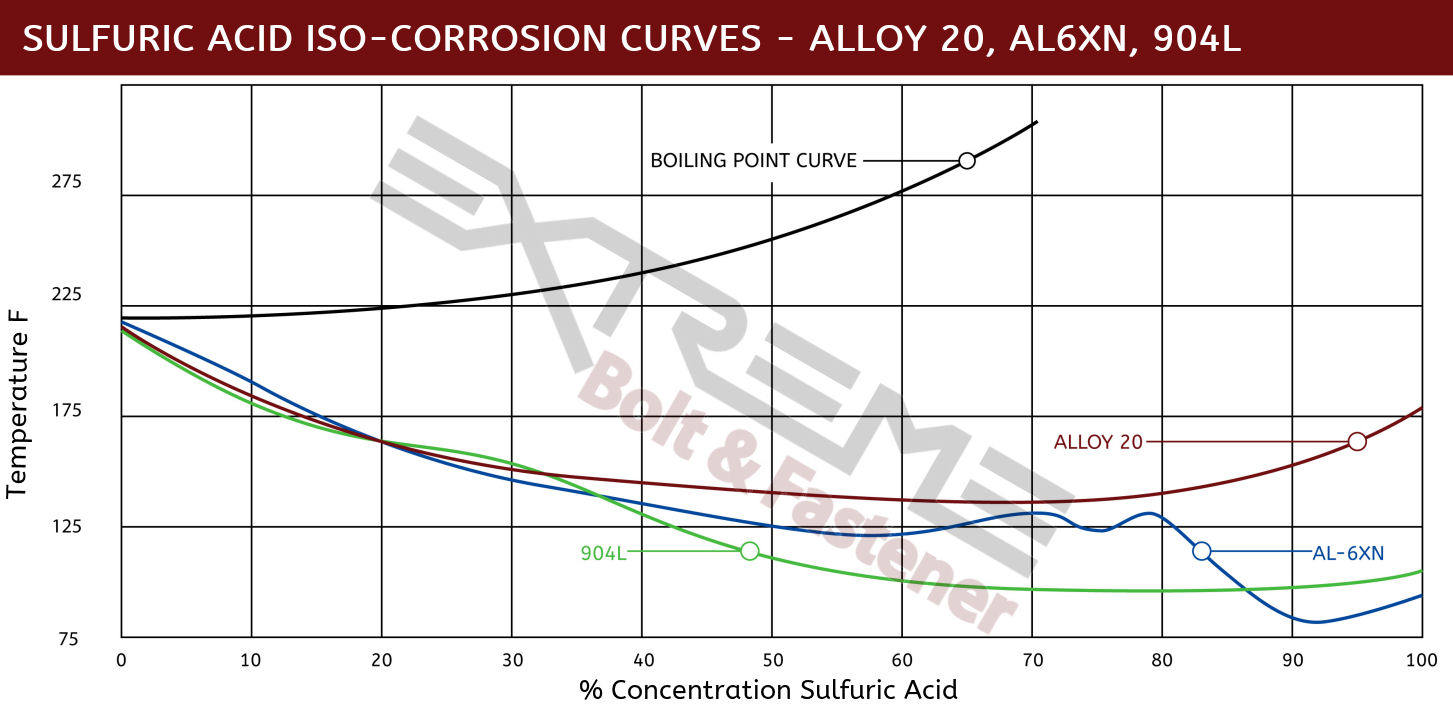
Alloy 20 Sulfuric Acid Comparison
Alloy 20 fastener styles
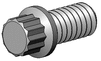
Alloy 20 Screws


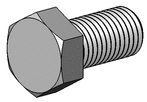
Alloy 20 Bolts
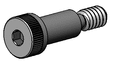


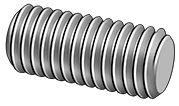
Alloy 20 Studs & Threaded Rods

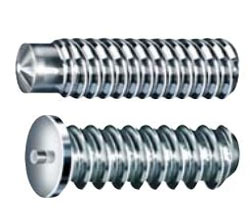
Alloy 20 Washers


Alloy 20 - Frequently Asked Questions
Answers from our engineers, drawn from the Alloy 20 technical questions we're asked most.
Sulfuric Acid: Which Fastener Material is Best?
Sulfuric Acid ( H2SO4 ) is one of the most widely used and important acids, being an essential component to many industries. Equally as important is selecting the right material to survive this environment. This newsletter will provide options.
WHICH IS BEST? That depends on BOTH concentration and temperature – TOGETHER
When looking at corrosion, the temperature of an application and chemical concentration are interconnected – always. You cannot consider one without the other. If the concentration of a chemical is high, typically the temperature at which a material can handle the acid will be lower, and vice versa – for applications that run at a higher temperature, the concentration will generally need to be lower to prevent corrosion. That said there are still many materials that can handle hot sulfuric acid:
Alloy 20 bolts deserve a first look for basic high temperature resistance. It works well in 20-40% boiling sulfuric acid.
Hastelloycannot work in boiling H2SO4, but it can service high concentrations sulfuric acid to high temperatures typically below 135°F.
Zirconium is excellent for high temperature sulfuric acid up to 300°F and 70% concentration. But beware. Zirconium bolts can readily corrode if exposed to any oxidizers – even trace amounts. (see chart below)
Tantalum is the ultimate protection from H2SO<sub 4 </sub but comes at very high price. Therefore it is reserved for the most severe services. For ALL concentrations up to 98% at any temperature up to 350°F tantalum bolts will have virtually no corrosion rate.
• Hastelloy screws will not only perform excellent in high temperatures and concentrations, but also offers up to 100ksi of tensile strength.
• For higher strength, you can look at Inconel 625. Inconel bolts offer slightly less corrosion resistance than Hastelloy but can provide 144ksi of strength.
POLYMERS FOR H<sub 2</sub SO<sub 4</sub
• PTFE and PFA offer the highest level of corrosion resistance for polymers. The only drawback is they lack in strength.
• For high strength corrosion resistance to sulfuric acid, PEEK screws can offer good corrosion resistance and are the highest strength polymer available.
AND CERAMICS?
Yes, of course we always forget to mention these. Ceramics are usable to 4000°F and are almost inert to most chemicals including sulfuric acid. So they can handle both high temperatures and high concentrations – but not strength. Though ceramic screws are the right material for many applications, they lack yield strength and can be brittle – so they are an option under certain circumstances.
What fastener material is best for boiling sulfuric acid?
Generally speaking, for 20-40% concentrations, Alloy 20 bolts will be the best bet for an economic solution. For all other concentrations in boiling H2SO4 you would have to use tantalumbolts, which can be costly. Though Hastelloybolts work in sulfuric acid, they can’t handle boiling conditions.
Remember, corrosion can be tricky because there are many factors that can make a
material successful. Its best to review to our sulfuric acidcorrosion curves on this page:
How does 316 Stainless Compares to Specialty Steel Alloys
316 stainless is a familiar alloy to many of us and perhaps one of the most widely used fastening materials. Though it serves a critical function for industry, 316 can often fall short in servicing challenging high strength, temperature and corrosion resistant applications. Here is how it measures up in these areas against some of the more specialty stainless steel alloys.
Strength
Compared to many specialty alloyed steels, 316 stainless falls short in terms of strength. Beyond moderate strength options such as duplex steel, extreme steel alloys such as A286 and 17-4PH bolts can provide up to 210ksi of ultimate tensile strength – almost 3x that of a 316 bolt.
316 stainless steel bolts can be used from subzero to temperatures up to about 800F. Past this limit the mechanical properti
es of the alloy fails and the material can oxidize more rapidly. This falls around the middle of the temperature range of stainless steels, as there are some specialty stainless steels that are temperature sensitive, like duplex steels and 17-4PH, where going beyond 570F or 600F changes the materials characteristics. However, there are a handful heat / oxidation resistant stainless alloys like A286, alloy 310 and alloy 330 provide excellent protection high temperatures up to 2100F. These stainless steels are designed to be temperature stable and oxidation resistant.
Corrosion
Though 316 doesn’t have the corrosion resistance of a nickel alloy it can perform reasonably well in mild corrosive situations. It is often used for mild resistance to sulfur compounds, acetic acid and phosphoric acid. In contrast, Alloy 20 is a stainless-steel alloy that is designed for corrosion protection and can offer significantly improved corrosive resistance to acids like, acidic acid, sulfuric acid and hydrochloric acid.
316 Hydrochloric Acid Corrosion 316 Phosphoric Acid Corrosion
316 Sulfuric Acid Corrosion 316 Nitric Acid Corrosion
316 Acetic Acid Corrosion
Chart Source: North American Stainless
AL6XN (6 Moly Alloy) is another stainless steel alloy developed for salt water environments and is ideal for marine corrosion – a vast improvement in these conditions over 316 bolts. For chlorides and mild saltwater corrosion, duplex and super duplex stainless steel bolts provide significant corrosion performance over 316 bolts. As always, it depends on the exact corrosion environment to determine which stainless steel is best, but for sure, Alloy 20, AL6XN (6 Moly Alloy) and the Duplex steels are optimized for improved corrosion performance over 316 stainless steel.
Chloride Stress Corrosion Cracking: 316 Stainless Steel vs. Duplex 2205
Chart Source: North American Stainless
I was thinking of ordering some Duplex Zeron 100 bolts for some mild sulfuric acid. How does that compare to Alloy 20? My alloy 20 bolts are suffering some mild corrosion.
Zeron bolts do offer a higher level of general resistance to corrosive environments compared to grades 2205 and 2507. Yet a Duplex bolt in grade Zeron 100will not really offer more corrosion resistance compared to Alloy 20 in a sulfuric acid environment (of course this depends on your exact corrosive environment). Since you are having issues with the Alloy 20 fasteners moving to Duplex Zeron would not be recommended. We would suggest considering a higher level of protection from sulfuric acid, and to try a Hastelloy C276 bolt which offers excellent resistance to sulfuric acid even in hot conditions.
Please recommend a material for use in 80 deg C oxalic acid solution. The titanium I’m using suffers, and dissolves. My hope is that C276 may work. We do not need high mechanical strength. I’m looking to order M4 and M6 socket head cap screws.
Probably the best material for Oxalic Acid at 80C is Alloy 20 screws. An alloy 20 screw will have no corrosion rate up to about 70C at any concentration and is good up to 50%concentration at boiling temperatures. This will fare much better than titanium screws. They will also be more economical than Hastelloy C276.
Hi there! I have a set screw in a downhole Oil and Gas application that is experiencing cam out/stripping and seeking a recommendation for a drop in replacement. With 17-4 and stainless steel, galling is a real issue for us. Also with the application being down-hole, if the screw is exposed to any kind of acid gases, sour gas, high levels of CO2 or well stimulation fluids for acidation, this could be causing corrosion as well.
If you are sure corrosion is not the issue and we focus on galling, the simplest thing to do would be to utilize a high performance anti-seize lubricant. A moly-disulphide based lubricant could really help with galling. See the following link for more info (https://www.extreme-bolt.com/extreme-anti-seize-lubricant.html). If you are looking for a more robust solution, an upgrade in the metallurgy to a dissimilar material will minimize galling as well.
If corrosion is an issue, it may be best to upgrade to a material that is more stable in those acid conditions and less likely to gall. Depending on your strength requirements and conditions, a light nickel alloy like Alloy 20may be suitable to a more engineering nickel alloy like Inconel 625. An Alloy 20 boltis good for mild acids and salt water, can be used to 1000F and offers about 80 ksi of tensile strength. For a more robust materials you may want to look at an Inconel 625 bolt. These Inconel bolts will offer resistance to hot, strong acids. An Inconel 625 screwcan be used to 1800F and offer about 144 ksi of tensile strength.
More on Alloy 20
What our customers say
More customer feedback“I purchased from you specifically because of Jon’s expertise and professionalism.”
“Very impressed; good prices and delivered earlier than lead time given, which was a real bonus.”
“Extreme Bolt is definitely on my go-to list.”