
Alloy 230 Fasteners - Bolts, Screws & Nuts
Last updated
One of the most stable & creep resistant alloys at high temperature

Need help choosing a material?

- Extremely oxidation & nitriding resistant
- Ideal material for the highest creep resistance at high temperature
- Great mechanical strength at elevated temperatures
- Stabile up to 2100°F (1149°C)
- Alloy 230 chemistry & specifications
- Rupture strength and mechanical strength charts
- Datasheet for alloy 230
Haynes® 230 fasteners such as bolts, screws, nuts and threaded rods are ideally suited for high temperature environments where creep strength and oxidation resistance are the primary concern. This material really stands out when your operating at temperature is above 1200°F (650°C). Alloy 230 bolts are even capable of surviving at temperatures up to 2100°F (1150°C). These unique capabilities are due to its chemical make up as a nickel-chromium-tungsten-molybdenum alloy.
When comparing the stress-rupture strength of alloy 230 to other high temperature materials, like Inconel 625, Hastelloy X, Incoloy 800H or RA330, Alloy 230 bolts exceed them all when operating at temperatures above 1600F. Click here for a material comparison of Alloy 230's high temperature, stress-rupture strength.
Furthermore, alloy 230 screws can maintain their ductility after long exposures to high temperatures. This demonstrates that this material retains it elongation and does not become brittle, which is a common mode of failure for other alloys when exposed to the effects of high temperature oxidation. Click here to learn more about ductility retention after long term exposure to high temperature.
Alloy 230 Chemistry & Specifications
Specifications: UNS N06230, AMS 5891, SB 572/B 572 B, AMS5878, SB 435/B
| Alloy 230 | Ni | Cr | W | Mo | Fe | C | Mn | Si | Nb | Al | Ti | C | La | B |
|---|---|---|---|---|---|---|---|---|---|---|---|---|---|---|
| Min % | 57 Balance | 22 | 14 | 2.0 | - | - | 0.5 | 0.4 | - | 0.3 | - | 0.1 | 0.02 | - |
| Max % | - | - | - | 3.0 | 5.0 | - | - | 0.5 | - | 0.1 | - | - | 0.015 |
| Hours to Rupture | |||
|---|---|---|---|
| 1400°F (760°C) | 1600°F (871°C) | 1800°F (982°C) | |
| 15.0 ksi (103 MPa) | 4.1 ksi (31 Mpa) | 2.0 ksi (14 Mpa) | |
| Alloy 230 | 8,200 | 65,000 | 5,000 |
| Inconel 625 | 19,000 | 14,000 | 2,400 |
| Hastelloy X | 900 | 5,000 | 2,100 |
| Incoloy 800H | 130 | 1,200 | 920 |
| Inconel 601 | 50 | 1,200 | 1,000 |
| 253 MA | 140 | 900 | 720 |
| Inconel 600 | 15 | 280 | 580 |
| 316 Stainless Steel | 100 | 240 | 130 |
| Alloy 330 | 30 | 230 | 130 |
| 304 Stainless Steel | 10 | 100 | 72 |
1: Measured at fixed conditions (bar and plate) 2: Source: Haynes 230 Brochure | |||
| Test Temperature | 0.2% Yield Strength | Ultimate Tensile Strength | Elogation | |||
|---|---|---|---|---|---|---|
| °F | °C | ksi | Mpa | ksi | Mpa | % |
| 70 | 21 | 55.5 | 383 | 123.6 | 852 | 46.0 |
| 1000 | 538 | 38.1 | 263 | 102.5 | 706 | 53.2 |
| 1200 | 649 | 38.7 | 267 | 98.2 | 677 | 53.0 |
| 1400 | 760 | 37.7 | 260 | 77.2 | 533 | 68.0 |
| 1600 | 871 | 33.9 | 234 | 45.1 | 311 | 94.0 |
| 1800 | 982 | 16.8 | 116 | 24.3 | 168 | 91.2 |
| 2000 | 1093 | 9.1 | 63 | 13.2 | 91 | 92.1 |
1: Tensile measure on plate 2: Source: Haynes 230 brochure | ||||||
| Room Temperature Elongation | ||||
|---|---|---|---|---|
| Alloy 230 | Alloy 188 | Inconel 625 | Hastelloy X | |
| °F | % | % | % | % |
| 1200 | 36.4 | 29.1 | 18 | 19 |
| 1400 | 32 | 10.8 | 13 | 19 |
| 1600 | 36.2 | 22.2 | 26 | 30 |
1: Measured at room temperature after 8000 hour exposure at designated temperature 2: Source: Haynes 230 brochure | ||||
| Alloy | 1800°F (982°C) | 2000°F (1093°C) | 2100°F (1149°C) | 2200°F (1204°C) |
|---|---|---|---|---|
| Metal Loss* (µm) | Metal Loss* (µm) | Metal Loss* (µm) | Metal Loss* (µm) | |
| Alloy 230 | 5 | 13 | 30 | 119 |
| Alloy 188 | 3 | 13 | 218 | 132 |
| Inconel 601 | 10 | 33 | 71 | 112 |
| Alloy 617 | 8 | 15 | 25 | 272 |
| Hastelloy X | 5 | 33 | 91 | - |
| Incoloy 800HT | 13 | 193 | 315 | - |
| 446 Stainless Steel | - | 330 | - | - |
| 316 Stainless Steel | 312 | - | - | - |
* Metal Loss + Average Internal Penetration 1: Measured in in Flowing Air, 1008 Hours 2: Source: Haynes 230 brochure | ||||


Alloy 230 fastener styles
Alloy 230 Screws
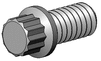


Alloy 230 Bolts
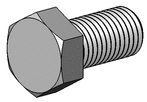
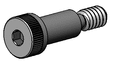


Alloy 230 Studs & Threaded Rods
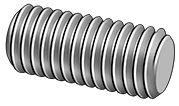

Alloy 230 Washers


Alloy 230 - Frequently Asked Questions
Answers from our engineers, drawn from the Alloy 230 technical questions we're asked most.
Need advice on bolts to hold together a heat treat rack made up of RA330. The strength of the bolts is not really an issue. The primary concern is creep and degradation in the heat. These bolts will be cycled on average 1800ºF and 2250ºF in extreme cases very often. Between the two alloys (625 & 718) which would be your recommendation? Or is there another material altogether that would better fit these requirements.
When considering Inconel 625 versus Inconel 718 bolts for your application at high temperatures that are cycling, Inconel 625 would be the much better choice. As Inconel 718 fasteners are precipitation hardened at the temperatures you are operating at, 1800F, you would solution anneal Inconel 718, which would effectively undo the age hardening process. As a result, Inconel 625 bolts would be much more stable than 718 in this environment.While Inconel 625 fasteners are better than 718, the best material for bolting at these high temperatures to minimize creep is Alloy 230. Alloy 230 fasteners are designed to operate at temperatures above 1200F and are very creep resistant. Alloy 230 bolts would be the best material you could get in your environment.
What our customers say
More customer feedback“I purchased from you specifically because of Jon’s expertise and professionalism.”
“Very impressed; good prices and delivered earlier than lead time given, which was a real bonus.”
“Extreme Bolt is definitely on my go-to list.”