Zirconium Fasteners - Bolts, Screws & Nuts
Last updated
For strong acids and severe corrosion

Need help choosing a material?

- Good mechanical & physical properties
- Excellent HCl and H2SO4 corrosion resistance
- Zirconium 702 / 705: Grades, chemistry, specs
- Datasheet for Zirconium
Commercially pure zirconium screws, also known as zirconium 702, are most well-known for their superior corrosion resistance in some of the harshest environments that include:
- Hydrochloric acid
- Sulfuric acid
- Nitric acid
- Formic acid
- Acetic acid
It is also a metal that offers industry unique properties. It does not absorb neutrons, making it ideal for use in nuclear power and at low temperatures it is superconductive, making it ideal for super magnets.
Hydrochloric Acid Resistance
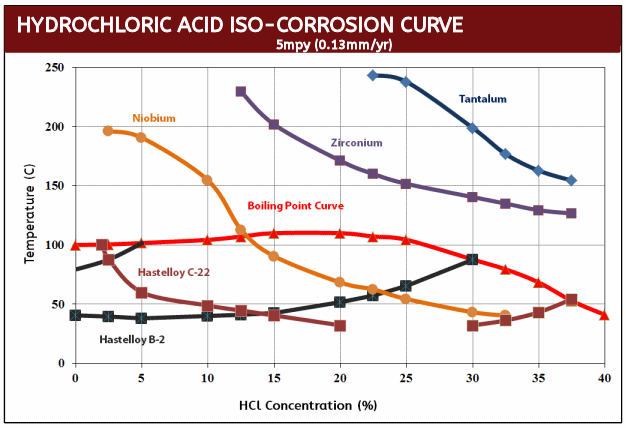
What makes Zirconium screws particularly useful to industry is their resistance to hydrochloric acid where they exhibit a corrosion rate of less than 5mpy at all concentrations and temperatures in excess of the boiling point. Even in 37% HCI, Zirconium screws do not begin to show substantial corrosion until 130°C (266°F). This performance is unmatched by any other engineering metal or alloy with the exception of tantalum. To give you a point of reference, Hastelloy C276 will experience 288 mpy (mils per year) of corrosion in just 10% HCl at the boiling point while Zirconium screws will have a nil corrosion rate even when aerated. As a result, Zirconium screws are most beneficial when used is in hydrochloric acid processes with temperatures above the boiling point and in the absence of oxidizing impurities.
General Acid Resistance
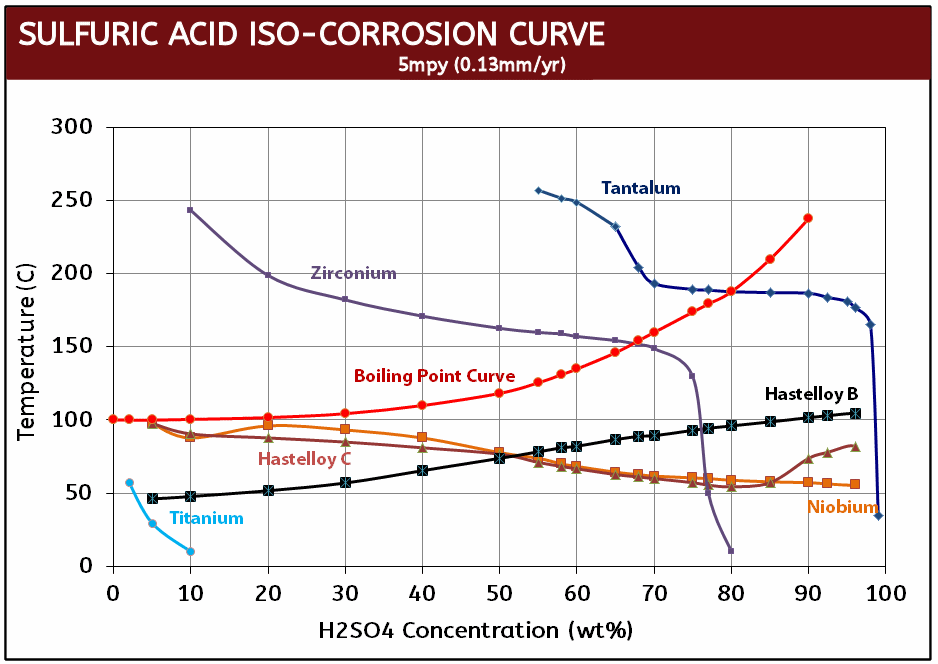
In addition to its impressive performance in hydrochloric acid, in sulfuric acid, Zirconium screws are resistant to temperatures well above boiling and at acid concentrations up to 70%. Only one other metal, tantalum, is equal to zirconium in nitric acid, where zirconium can be used in all concentrations up to 90% and temperatures up to 200°C. Zirconium is also resistant to most organic media and is considered one of the most corrosion resistant materiala in virtually all acetic acid solutions.
When Zirconium Does Not Perform
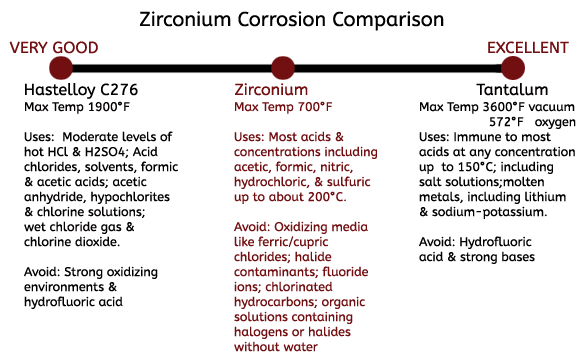
Zirconium is known for its tough resistance to acid corrosion, but there are instances that it is not recommended to use Zirconium. Though aeration does not affect the resistance of Zirconium screws, even small amounts of oxidizing media such as ferric or cupric chlorides will greatly decrease its corrosion resistance. This often occurs from upstream equipment that carry corrosion contaminants into the zirconium equipment, making process control of upstream equipment critical in maintaining the corrosion resistance of Zirconium. In addition, acid in the presence of oxidizing halide contaminants and can accelerate the rate of attack on Zirconium screws even at low concentrations. Use of Zirconium screws in the presence of fluoride ions is also not recommended, even at low concentrations.
Applications
- Nuclear industry utilize Zirconium screws for its inability to absorb neutrons
- Zirconium has been used for decades in over 20 years in dye manufacturing for its incredible corrosion resistance and inertness.
- Chemical processing plants often utilized Zirconium in the production of polymers that utilize strong acids .
- Commonly used with nitric acid for the production ammonium nitrate for fertilizers.
Zirconium Grades, Chemistry and Specifications
Zirconium 702
99.2% commercially pure zirconium with the highest corrosion resistance.
Zirconium 702 Specifcations: UNS R60702, ASTM B493 and B550, ASME SB493 and SB550 Rod (Bar), ASTM SB551, ASME SB551 Plate, Sheet and Strip
| Zirconium 702 | Zr | Fe/Cr |
|---|---|---|
| Typical % | >99.2 | 0.2 |
Zirconium 705
95.5% zirconium with the addition of 2-3% niobium. This addition increases the impact strength of the alloy.
Zirconium 705 Specifications: UNS R06705, ASTM B493 and B550, ASME SB493 and SB550 Rod (Bar)
| Zirconium 705 | Zr | Hf | Nb | Fe/Cr |
|---|---|---|---|---|
| Typical % | Bal | 4.5 | 2-3 | 0.20 |
| Temperature (°F) | Ultimate Tensile (ksi) | Yield Strength 0.2% Offset (ksi) | Elongation % |
|---|---|---|---|
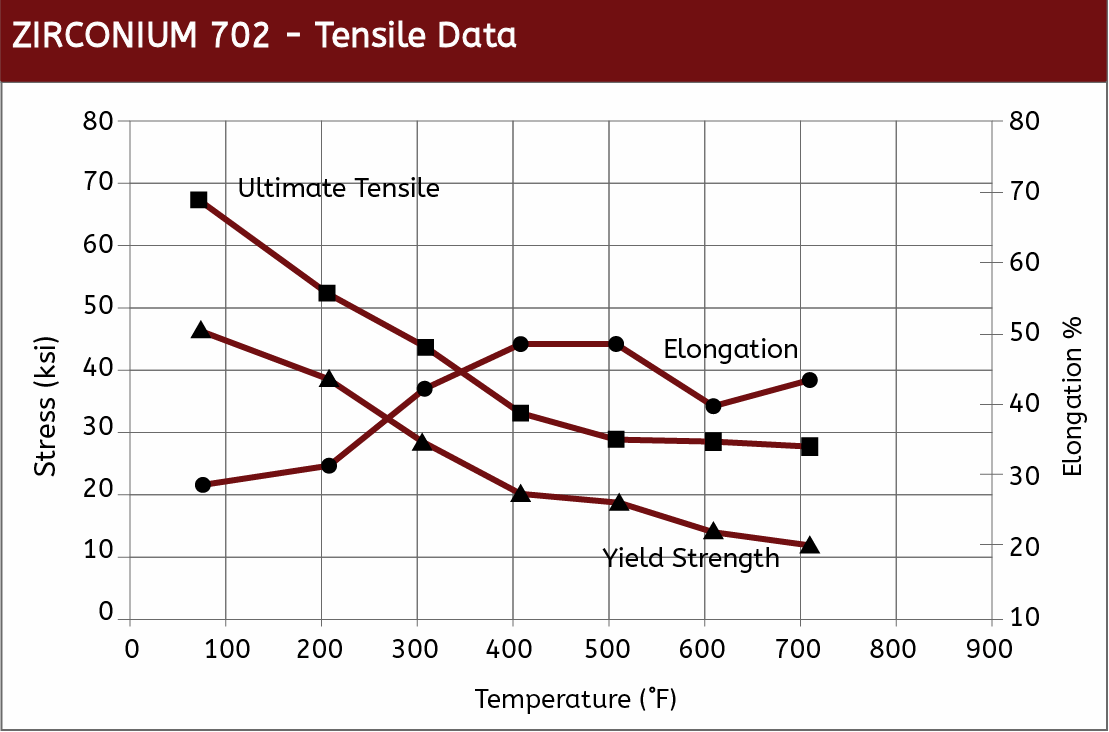
| Room Temp. | 68 | 47 | 29 |
| 200 | 53 | 39 | 32 |
| 300 | 44 | 28 | 42 |
| 400 | 33 | 20 | 49 |
| 500 | 29 | 19 | 49 |
| 600 | 29 | 14 | 40 |
| 700 | 22 | 12 | 44 |
| Temperature (°F) | Ultimate Tensile (ksi) | Yield Strength 0.2% Offset (ksi) | Elongation % |
|---|---|---|---|
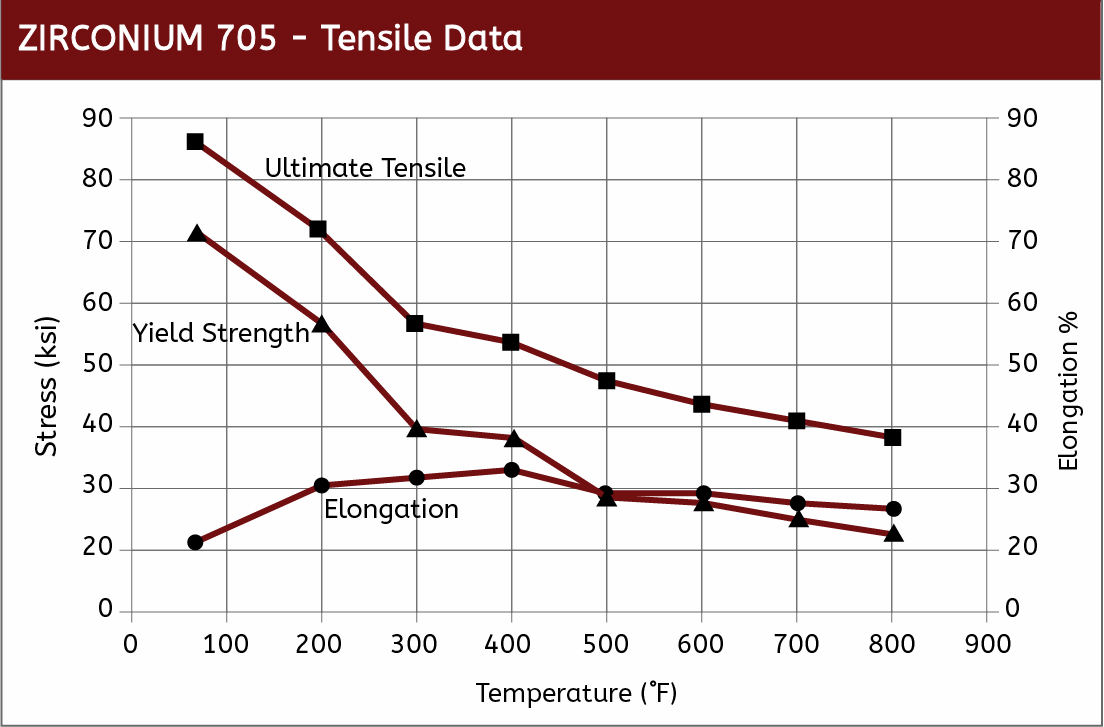
| Room Temp. | 89 | 73 | 19 |
| 200 | 72 | 56 | 30 |
| 300 | 56 | 39 | 32 |
| 400 | 54 | 38 | 33 |
| 500 | 47 | 28 | 29 |
| 600 | 44 | 27 | 29 |
| 700 | 41 | 25 | 28 |
Zirconium fastener styles
Zirconium Screws


Zirconium Bolts


Zirconium Studs & Threaded Rods
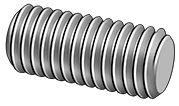

Zirconium Washers


Zirconium - Frequently Asked Questions
Answers from our engineers, drawn from the Zirconium technical questions we're asked most.
Sulfuric Acid: Which Fastener Material is Best?
Sulfuric Acid ( H2SO4 ) is one of the most widely used and important acids, being an essential component to many industries. Equally as important is selecting the right material to survive this environment. This newsletter will provide options.
WHICH IS BEST? That depends on BOTH concentration and temperature – TOGETHER
When looking at corrosion, the temperature of an application and chemical concentration are interconnected – always. You cannot consider one without the other. If the concentration of a chemical is high, typically the temperature at which a material can handle the acid will be lower, and vice versa – for applications that run at a higher temperature, the concentration will generally need to be lower to prevent corrosion. That said there are still many materials that can handle hot sulfuric acid:
Alloy 20 bolts deserve a first look for basic high temperature resistance. It works well in 20-40% boiling sulfuric acid.
Hastelloycannot work in boiling H2SO4, but it can service high concentrations sulfuric acid to high temperatures typically below 135°F.
Zirconium is excellent for high temperature sulfuric acid up to 300°F and 70% concentration. But beware. Zirconium bolts can readily corrode if exposed to any oxidizers – even trace amounts. (see chart below)
Tantalum is the ultimate protection from H2SO<sub 4 </sub but comes at very high price. Therefore it is reserved for the most severe services. For ALL concentrations up to 98% at any temperature up to 350°F tantalum bolts will have virtually no corrosion rate.
• Hastelloy screws will not only perform excellent in high temperatures and concentrations, but also offers up to 100ksi of tensile strength.
• For higher strength, you can look at Inconel 625. Inconel bolts offer slightly less corrosion resistance than Hastelloy but can provide 144ksi of strength.
POLYMERS FOR H<sub 2</sub SO<sub 4</sub
• PTFE and PFA offer the highest level of corrosion resistance for polymers. The only drawback is they lack in strength.
• For high strength corrosion resistance to sulfuric acid, PEEK screws can offer good corrosion resistance and are the highest strength polymer available.
AND CERAMICS?
Yes, of course we always forget to mention these. Ceramics are usable to 4000°F and are almost inert to most chemicals including sulfuric acid. So they can handle both high temperatures and high concentrations – but not strength. Though ceramic screws are the right material for many applications, they lack yield strength and can be brittle – so they are an option under certain circumstances.
I have a high pressure application that exposes my flanges to sulfuric acid? Can you suggest the best flange and material for this situation?
For high pressure applications weld neck flanges have a beveled end that, when connected to a pipe, creates a trough for a strong weld which is highly suitable for this situation. In terms of material, this always depends on concentration and temperature and various materials may work from Inconel, Hastelloy, Zirconiumand Tantalum(for the most severe).
Can I use zirconium bolts in boiling HCl. Concentration would be about 5%?
Yes, zirconium fasteners work well in hydrochloric acid but may be a bit overkill at that relatively low concentration but depends on the temperature and other media it may be exposed to. Zirconium screws do not begin to show substantial corrosion in HCl until 130°C (266°F) even up to 37% concentration (reagent grade HCl). You just need to make sure you’re not exposing these bolts to any oxidizing contaminants. Though zirconium is extremely corrosion resistant to acids, if it is exposed to even small amounts of oxidizing media such as ferric or cupric chlorides, it will cause a breakdown in protection, and rapidly corrode. If you are exposing your bolts to oxidizers in addition to the hydrochloric acid you may want to try tantalum bolts which is the combination of harsh chemicals better than zirconium. If not you may also consider Hastelloy C276 bolts.
I have a process that utilizes about 10% hydrochloric acid with trace amounts of other chemicals. I tried zirconium bolts because they are known for HCl but we’re burning through them like crazy and I can’t figure out why they are corroding. Any ideas and what other material may work?
I think the key to what you are describing is not the hydrochloric acid corrosion but the “other chemicals” in your process. Zirconium bolts offer excellent resistance to HCl corrosion even upwards of 37%. The problem with zirconium fasteners is that if they are exposed to any oxidizing media. Oxidizers, even in trace amounts can cause zirconium to corrode rather quickly. Depending on the temperature of your process, Hastelloy C276 bolts will be a good fit. For a high temperature application, I would suggest tantalum fasteners. They can handle HCl corrosion even up to the boiling point.
Choosing a Refractory Metal Fastener
What is a refractory metal fastener?
Molybdenum, tantalum, tungsten and zirconium are all refractory metals. (We are excluding titanium from this topic although it can be considered a refractory metal by certain definitions). All these refractory metal fasteners are characterized by their high-temperature melting points, but they also have other unique attributes such as corrosion resistance, high density or wear-resistance. Though all can handle high temperatures, refractory metals should be ONLY used in a vacuum or inert atmosphere when exceeding 500°C as they begin to react, sometimes quickly, with oxygen.
Molybdenum Screws: High Temperature Focus Molybdenum bolts offer high temperature stability combined with low coefficient of thermal expansion – so they stay strong without expanding or loosing shape even in extreme heat over repeated cycles. Molybdenum fasteners can handle temperatures up to 2900°F/1600°C, however the must be in a vacuum or inert atmosphere when exceeding 500°C
Tantalum: Extreme Corrosion
There is no better material for corrosion resistance. Tantalum bolts out-perform Hastelloy and zirconium fasteners in the harshest environments like high concentration boiling hydrochloric and sulfuric acid. Being an inert material it also very compatible with the human body.
Although tantalum is most known for its corrosion resistance, tantalum has a very density making 50% denser than lead and is radio-opaque. For medical devices this can be important as the tantalum fasteners easily show up on x-rays.
Tungsten: Density and Weight Tungsten’s extreme high density of 19.3 gm/cc (70% denser than lead), as well as radiopaque attributes provide unique capabilities for weight distribution and balancing, medical devices, as well as vacuum furnace applications.
Zirconium: Excellent Corrosion Resistance
Offering excellent corrosion protection exceed even Hastelloy in hydrochloric acid but not quite as good as tantalum. While zirconium fasteners are very corrosion resistant there are some conditions where zirconium will rapidly corrode when exposed to oxidizing media.
High Temperature Strength: Vacuum vs Air
One important characteristic to note is the differing temperature limits in an oxygen-rich environment compared to a vacuum or inert environment where there is no oxygen. For example, exposing Molybdenum bolts to 1500°F in air will cause it to rapidly oxidize, where in a vacuum it will remain stable and strong.
We have on application that utilizes an HCl tank and are currently using hastelloy C276 bolts but they are not sufficient. Should we try tantalum fasteners or anther material like PEEK? The bolts are for a flanged valves connections concentration is 36%, temperature 45ºC.
Though the HCl is not at a high temperature, I would suggest Tantalum bolts or possible Zirconium bolts. I would not recommend polymer fasteners for a flanged connection unless your sure the load is very low. Follow the link to the blog we wrote specifically on this problem. If your acid is clean, Zirconium could be a good choice.https://www.extreme-bolt.com/blog/fasteners-for-hydrochloric-acid-hcl/
More on Zirconium
What our customers say
More customer feedback“I purchased from you specifically because of Jon’s expertise and professionalism.”
“Very impressed; good prices and delivered earlier than lead time given, which was a real bonus.”
“Extreme Bolt is definitely on my go-to list.”