17-4 PH Fasteners - Bolts, Screws & Nuts
Last updated
An extremely strong precipitation hardened stainless steel

Need help choosing a material?

- Well suited for high strength applications
- Up to 4x stronger than 316 stainless steel
- Maintains its mechanical strength up to 600°F
- 17-4PH Chemistry & Specifications
- ASTM F593, Grade 630
- ASTM A564, Grade 630
- 17-4PH Datasheet
17-4 PH fasteners are made from a precipitation hardened stainless steel most known for its exceptional strength and its ability to maintain its mechanical properties to 600°F. Compared to 316 stainless steel, 17-4 PH fastener's yield strength is up over 4 times greater. When compared to Duplex 2205 fasteners, the yield strength of 17-4 PH can be up to 2-½ times greater.
17-4 fasteners are available in 8 different aged (precipitation hardened) conditions offering a variety of mechanical properties (see below). In addition, we also offer 17-4PH fasteners per ASTM F593 Grade 630 which ensures specific tensile and yield strengths.
17-4PH Chemistry & Specifications
17-4PH Specifications: UNS S17400, AISI 630, ASTM A564-630, Werkstoff 1.4542, AMS 5604 Sheet, Strip and Plate, ASTM A 693 Plate
| 17-4PH | Fe | Cr | Ni | Cu | Mn | Si | Mo | Nb+Ta | C | P | S |
|---|---|---|---|---|---|---|---|---|---|---|---|
| Min % | - | 15.0 | 3.0 | 3.0 | - | - | - | - | - | - | - |
| Max % | Bal | 17.5 | 5.0 | 5.0 | 1.0 | 1.0 | 0.50 | 0.45 | 0.07 | 0.04 | 0.03 |
ASTM F593, Grade 630
This specification covers seven groups of stainless steel alloys, with ASTM F593, Grade 630 applying 17-4PH. ASTM F593 Grade 630 covers the requirements for 17-4PH stainless steel bolts, hex cap screws, and studs sized 0.25 to 1.50 inches, inclusive, in nominal diameter. It is intended for common use and for service applications requiring general corrosion resistance.
| Full-Size Tests | Machined Specimen Tests | ||||||||
|---|---|---|---|---|---|---|---|---|---|
| Stainless Steel Alloy Group | Condition | Alloy Mechanical Property Marking | Nominal Diameter (inches) | Tensile Strength (ksi) | Yield Strength (ksi) | Rockwell Hardness | Tensile Strength (ksi) | Yield Strength (ksi) | Elongation % |
| 7 (630) | AH | F593U | 1/4 to 1.5, incl | 135 to 170 | 105 | C28 to 38 | 135 | 105 | 16 |
Common 17-4 Fastener Conditions: Aged Conditions vs Tensile Strength
ASTM A564 GR 630
This specification covers bars and shapes (such as fasteners) of age hardened stainless steels such as 17-4PH. It includes hot-finished or cold-finished fasteners that are produced by hot rolling, extruding, or forging. Grade 630 shall be furnished in the solution-annealed or or age-hardened condition.
| Aged Condition | Ultimate Tensile (min. ksi) | Yield Strength 0.2% Offset (min. ksi) | Elongation (min. %) | Hardness (Rockwell C, min.) |
|---|---|---|---|---|
| H900 | 190 | 170 | 10 | 40 |
| H925 | 175 | 155 | 10 | 38 |
| H1025 | 155 | 145 | 12 | 35 |
| H1075 | 145 | 125 | 13 | 32 |
| H1100 | 140 | 115 | 14 | 31 |
| H1150 | 135 | 105 | 16 | 28 |
| H1150-M | 115 | 75 | 18 | 24 |
| H1150-D | 125 | 105 | 16 | 24 / 33 max |
17-4 PH fastener styles
17-4 PH Screws
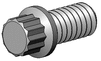


17-4 PH Bolts
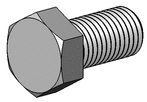
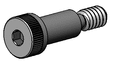


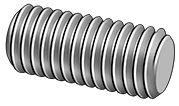
17-4 PH Studs & Threaded Rods

17-4 PH Washers


17-4 PH - Frequently Asked Questions
Answers from our engineers, drawn from the 17-4 PH technical questions we're asked most.
I am looking for high strength bolts, any that are > 160ksi yield? Is A286 an option?
A286 cold worked – which is one of the strongest version of an A286 bolt – has a 160ksi ultimate tensile strength, but not the yield strength. However if 160 ksi yield is needed, there are some other options to keep in mind if you need guaranteed min yield over 160ksi, like Inconel 718 (Cold Worked version 220KSI UTS, 200ksi min yield) and MP35N bolts having a min yield of 230ksi. Additionally, a more budget friendly option would be 17-4 stainless steel bolts in the H900 condition. This is a stainless steel material that has a 170ksi min yield but low elongation.
We have plastic molding machines that uses a grade 8 screw to connect to the hydraulic motor. This grade 8 shoulder bolt often breaks and we want something a little tougher. We’ve already increased the diameter but don’t have enough shaft to go larger. Any suggestions?
What you might want to consider is our 17-4 PH boltsin the H900 condition. These will get you a min tensile of 190KSI versus Grade 8 alloy steel at 150KSI. This would be a significant improvement. Click here for more information on 17-4 screws.
We have gear mounted alloy steel screws that rotate a loaded arm. As the gear rotates over its lifetime, these screws ultimately stretch and wear resulting in the bolts loosening, shearing, and breaking. Is there a screw material capable of being made that would help solve any of these issues: less likely to loosen, as well as more resistance to wear, stretching and shearing?
For your application if the material creeping is the issue you might want to try an age hardened stainless steel that is more resilient to these forces. A material to consider would be 17-4 PH particularly in the H900 condition. (https://www.extreme-bolt.com/17-4-ph-fasteners-flanges.html#ASTMA564GR630). 17-4 bolts will provide a low elongation and have a higher yield point, which may improve your situation.
So I was told that 17-4PH Group 630 bolts per ASTM F593 are heat treated to H1150. So how is a 17-4PH F593 bolt any different from the standard 17-4PH H1150 bolt, as they both have the same heat treatment?
Great question. Yes, you are correct, they are both are heat treated to H1150. Often when you see F593 listed it will state ASTM F593 Group AH. The AH denotes age harden which is per H1150. The difference between a standard H1150 bolt and one per F593 is that the ASTM F593 specification includes additional requirements for dimensions, sampling, workmanship, testing etc.To clarify further F593 is a specification that applies to the bolting and is limited to only the H1150 heat treatment. If addition strength and mechanical properties are required beyond those allowed by H1150, you can combine an ASME or DIN dimensional spec with ASTM A564, a raw material spec, which includes additional heat treat/age harden conditions including H1150D, H1150M, H1150, H1100, H1075, H1025, H925 and H900. This combination will give you additional strength options.
We are trying to move away from zinc plated 12.9 bolts due to hydrogen embrittlement problems and the geomet finish is giving us problems due to the diameter of the screw. As a better solution, we have thought about using Super Duplex screws or Nimonic 80A screws. I understand that we would achieve tensile strength with both materials and at the same time avoid having to use a coating.
Do you think the solution I propose is correct?
The concept of replacing coated material with a higher performance alloy is a good idea, however both Nimonic 80A and Super Duplex will not have the minimum strength requirements of 12.9 which is 1100MPa (159KSI) minimum yield strength and 1220MPa (177 KSI) minimum tensile strength. You could see a material strength comparison table at: https://www.extreme-bolt.com/high-strength-fasteners.html#Metals
From a strength perspective, a material you could consider as a replacement for 12.9 would be 17-4 PH Stainless Steel H900 bolts. This will have 190KSI min Tensile and 170KSI min Yield. Learn more at: https://www.extreme-bolt.com/17-4-ph-fasteners-flanges.html
We are essentially having issue identifying the highest available high strength stainless steel nylon insert nuts. Is Duplex 2205 the best option?
If you are just looking for strength for your lock nut with a nylon insert, one of the highest strength stainless steel’s you could consider would be 17-4 PH (ranging from 136-190KSI)
A286 locknuts are a good option as well with good high temperature stability (130 KSI)
Duplex lock nuts are also much stronger than 316 with about 120KSI tensile strength. Duplex also offers better corrosion resistance. This material is not as strong as A286 or 17-4
More on 17-4 PH
What our customers say
More customer feedback“I purchased from you specifically because of Jon’s expertise and professionalism.”
“Very impressed; good prices and delivered earlier than lead time given, which was a real bonus.”
“Extreme Bolt is definitely on my go-to list.”