

Nitronic Fasteners - Bolts, Screws & Nuts
Last updated
General-purpose steel alloy for strength, temperature & wear

Need help choosing a material?

-
Nearly double the yield strength of 300 series stainless
- Maintains mechanical properties across wide temperature range
- Good toughness and impact resistance
- Nitronic 50 and 60 chemistry & specifications
- Datasheets for Nitronic 50 and Nitronic 60
Nitronic is a high strength austenitic steel alloy that was designed for high temperature use. It offers good high temperature properties as well as good low-temperature impact resistance. In addition, Nitronic bolts also offer nearly double the yield strength of 300 series stainless steel. Nitronic fasteners are available in two alloy variations, Nitronic 50 and Nitronic 60, each offering different niche capabilities.
Nitronic 50: Corrosion Resistance & Strength
Nitronic 50 (1.3964; also known as N-50 and XM-19) fasteners offers reasonable corrosion resistance and a good combination of strength, ductility, and toughness, across a wide range of temperatures from extreme heat to cryogenic. Due to Nitronic 50 fasteners improved corrosion resistance compared to 316 and 317 stainless and good mechanical strength, they are often used in marine applications, pump shafts, petrochemical and pulp & paper applications. Perhaps their most unique characteristic is their low magnetic permeability. This attribute allows Nitronic 50 screws to be used for medical implants.
| Nitronic 50 Properties | |
|---|---|
| Tensile strength | 100ksi |
| Yield Strength | 55ksi |
| Elongation | 35% |
| Hardness | 293 |
| Usable Temperature | 1200°F |
Nitronic 60: Wear & Oxidation Resistance
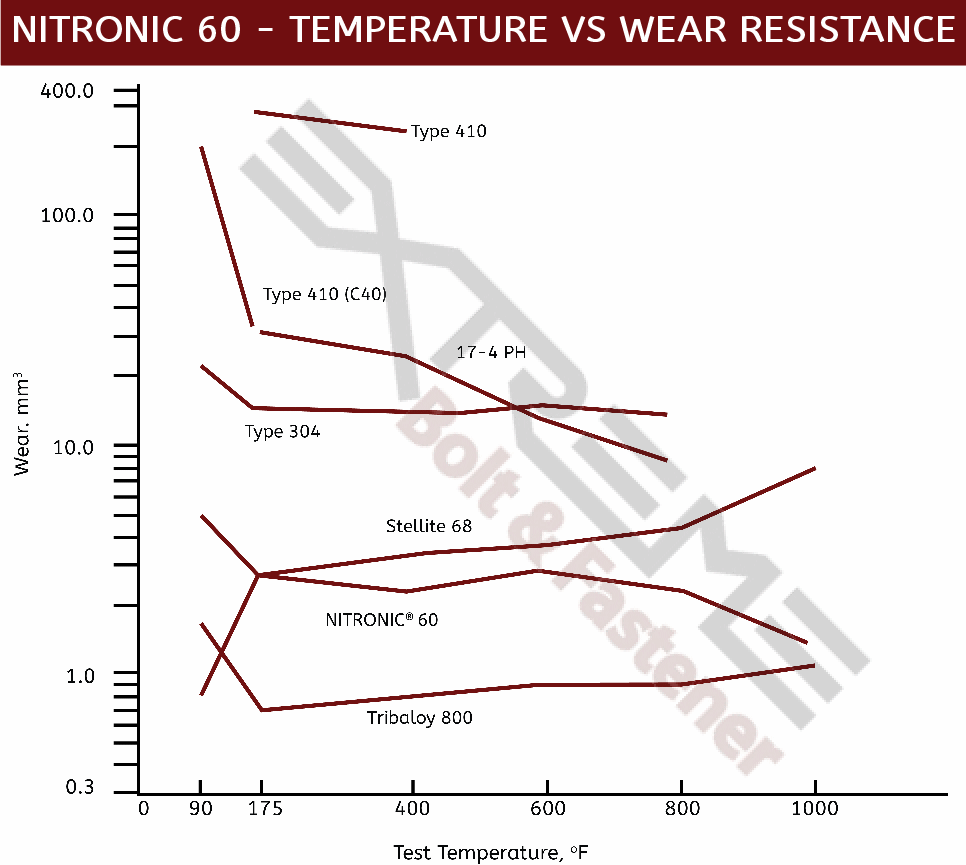
Nitronic 60 is known for its good resistance to wear, fretting, and galling even at elevated temperatures. Nitronic 60 bolts are typically chosen for these attributes as an economic alternative compared to high cost cobalt-bearing and nickel alloys. In terms of oxidation resistance, Nitronic 60 is comparable to that of 309 stainless steel. At high temperatures, Nitronic 60 bolts exhibit carburization resistance superior to both 316L and 309. General corrosion resistance of Nitronic 60 falls between that of 304 and 316SS. Nitronic 60 bolts are often used in chemical processing, bridges and infrastructure, and aerospace applications.
| Nitronic 60 Properties | |
|---|---|
| Tensile strength | 95ksi |
| Yield Strength | 50ksi |
| Elongation | 35% |
| Hardness | 241 (max) |
| Usable Temperature | 1800°F |
Nitronic (1.3964) Chemistry & Specifications
Nitronic 50 Specifications: ASTM A479, UNS S20910, AMS 5848 (bar), W. Nr./EN: 1.3964
| Nitronic 50 | Cr | Ni | Mn | Mo | Si | N | Nb | V | C | P | S | Fe |
|---|---|---|---|---|---|---|---|---|---|---|---|---|
| Min % | 20.5 | 11.5 | 4.0 | 1.5 | - | 0.2 | 0.1 | 0.1 | - | - | - | - |
| Max % | 23.5 | 13.5 | 6.0 | 3.0 | 1.0 | 0.4 | 0.3 | 0.3 | 0.06 | 0.04 | 0.01 | Bal |
Nitronic 60 Specifications: ASTM A479, UNS S21800
| Nitronic 60 | Cr | Ni | Mn | Si | Mo | N | C | P | S | Fe |
|---|---|---|---|---|---|---|---|---|---|---|
| Min % | 16.0 | 8.0 | 7.0 | 3.5 | - | 0.08 | - | - | - | - |
| Max % | 18.0 | 9.0 | 9.0 | 4.5 | 0.75 | 0.18 | 0.1 | 0.06 | 0.03 | Bal |
Nitronic fastener styles
Nitronic Screws


Nitronic Bolts
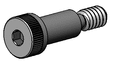


Nitronic Studs & Threaded Rods
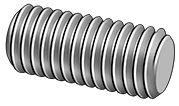

Nitronic Washers


Nitronic - Frequently Asked Questions
Answers from our engineers, drawn from the Nitronic technical questions we're asked most.
I’m trying to figure out what material will work for my application based on the shear strength. I see you published tensile but not shear. Do you have the shear strength for A286 and Inconel 718?
Unfortunately, there is no published standard value for shear strength like tensile and yield strength. Instead, for ductile materials, shear strength is typically estimated to be approximately 60% of the ultimate tensile strength. Here is a charge with all the tensile strengths of our metals and alloys: Metals
How does Nitronic 60 compare to an A286 bolt for high temperature strength?
That depends on the strength required and the temperature of your application. A Nitronic 60 bolt is known for its high temperature properties up to 1800F. At these extreme temperatures it can offer good resistance to wear, fretting, and galling; and oxidation resistance comparable to that of 309 stainless. On the other hand it doesn’t offer the high strength of A286. Nitronic 60 offers 95ksi UTS compared to the 120-160ksi UTS of A286. A286 bolts offer excellent high strength, creep resistance and oxidation resistance to a temperature of 1300F – not as high as Nitronic. So it will depend on the temperature range and strength you require.
Can you explain to me the difference between Inconel 625 and Nitronic 60 in terms of high temperatures? Both seem to be able to handle temps up to 1800F but which is better?
Well that depends on what you are using them for. Inconel 625 boltsare a nickel-chrome based alloy and not only offers high temperature capabilities but it also has excellent corrosion resistance. Inconel 625 bolts provide very good resistance to corrosive chemicals like hydrochloric and sulfuric acid, and are almost completely resistant to salts. Furthermore Inconel 625 fastenershave a typical tensile strength of 144ksi and will maintain its strength to about 1200F before starting to drop and maxes out around 1800F. On the other hand, Nitronic 60 fasteners are stainless steel based and cannot offer the robust level of corrosion resistance or high temperature strength as Inconel. Nitronic 60 boltsare known for good resistance to wear, fretting, galling and oxidation resistance even at elevated temperature and have a typical tensile strength of 95ksi. Nitronic 60 will max out at about 1800F as well.
I have a high temperature exhaust stream that needs an oxidation resistant fastener? Any suggestions, my temperature is about 1400F?
For this temperature you have a few options depending on the strength you need. One option may be Nimonic 80A bolts which are usable to about 1500F. Also Nitronic 60 fasteners offer good wear and oxidation resistance to about 1800F. Finally there are 310 stainless steel fasteners. 310 stainless bolts are usable to about 2000F and offer excellent oxidation and carburization resistance. In terms of strength they offer a wide range with 310 stainless at 70ksi of ultimate tensile strength, Nitronic 60 at 90ksi and Nimonic 80A being the strongest at 181ksi.
What is the difference between Nitronic 50 and 60? <br clear="all" />
Both grades of Nitronic offer similar strength which is nearly double the yield strength of 300 series stainless steel (Nitronic 50 100ksi UTS and Nitronic 60 95ksi UTS). The real difference is in the temperature capabilities and the usage focus. Nitronic 50 fasteners are usable to about 1200F. They are mainly used for strength, ductility, and toughness as well as mild corrosion resistance in marine applications. They can also be used for their low magnetic permeability in medical applications. In contrast, Nitronic 60 is typically used for fretting and galling resistance as well as oxidation and carburization at moderate temperatures. Fretting is surface damage that occurs from the wear of two contacting surfaces, whereas galling is friction between two surfaces that actually causes them to fuse together. Nitronic 60 bolts are used to prevent these types of wear.
What our customers say
More customer feedback“I purchased from you specifically because of Jon’s expertise and professionalism.”
“Very impressed; good prices and delivered earlier than lead time given, which was a real bonus.”
“Extreme Bolt is definitely on my go-to list.”
