

Duplex Steel Fasteners - Bolts, Screws & Nuts
Last updated
Engineered stainless: 2x stronger yield than 316 stainless steel

Need help choosing a material?

- Decent general corrosion & cracking resistance
- Chemistry & Specs: Duplex 2205, Super Duplex 2507, Zeron 100
- ASTM A1082 fasteners
- Insight on Duplex 2205, Super Duplex 2507 and Zeron 100
- Strength Properties: tensile, yield & elongation charts
- Duplex stainless steel fastener styles
- Datasheet for Super Duplex 2507
- Datasheet for Duplex 2205
Duplex Fastener Overview
Duplex 2205 and Super Duplex 2507 (UNS S32205 / UNS S32750) stainless steel fasteners are characterized by their high yield strength, which is twice that of annealed austenitic stainless steels, like 304 and 316. In addition, Duplex steels offer improved corrosion protection compared to 300 series stainless, especially in terms of localized corrosion such as crevice and pitting, as well as stress corrosion cracking. In general, Duplex steel bolts are a great step up from 300 series stainless.
The main difference between the Duplex alloys is that 2507 offers higher strength and better corrosion resistance compared to Duplex 2205.
- Duplex 2205 (1.4462): Higher strength and corrosion resistance than 300 series stainless.
- Super Duplex 2507 (1.4410): Improved corrosion resistance and strength compared to 2205.
Mechanical Properties
Duplex 2205 bolts provide a typical UTS of 110ksi and a yield strength of 80ksi, whereas Super Duplex bolts offer slightly higher strength at 125ksi UTS and 82ksi yield. In general, Duplex fasteners have significantly better toughness and ductility than ferritic grades of steel, but not the levels of austenitic grades. Usage of both a Duplex screw and Super Duplex stainless steel screw should be limited to temperatures below 570°F, as extended exposure to elevated temperatures can embrittle this material.
Key properties:
- High strength and fatigue resistance
- Good toughness & ductility
- Temperature usage limit: 570°F
- Low thermal expansion
Corrosion Resistance
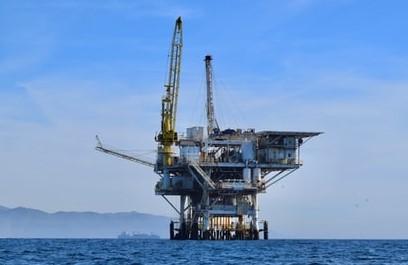
Though Duplex steel screws are not ideal for harsh chemical environments, they do offer better corrosion resistance than 300 series stainless steel and are ideal for saltwater and chloride applications. Duplex bolts offer resistance to:
- Saltwater: salt air, brackish water and marine environments.
- Localized chloride corrosion: pitting and crevice corrosion as well as stress corrosion cracking.
- Sulfide stress corrosion resistance
- Oxidation
Which Duplex Steel is Best for Your Application?
The most common grades of Duplex steel fasteners are Duplex 2205 and Super Duplex 2507. If you are still not sure, our engineering team is here to offer their expertise on which grade will meet the specific requirements of your application. We also offer other resources including Duplex Torque Specs.
Common Duplex Bolt Grades
Duplex Alloy 2205 (1.4462)
Duplex 2205, UNS S32205, is a stainless steel material, whose “Duplex” name is derived from the mixed microstructure which contains roughly equal portions of ferrite and austenite. This grade is the most popular variety and this two-phase material is a significant upgrade from 316 stainless steel in terms of both yield strength and corrosion resistance. Click here for more in-depth information on a Duplex 2205 Screw.
DUPLEX 2205 SPECIFICATIONS: ASME SA 182, ASME SA 240, ASME SA 479, ASME SA 789, ASME SA 789 Section IV Code Case 2603, ASTM A 240, ASTM A 276 Condition A, ASTM A 276 Condition S, ASTM A 479, ASTM A 790, NACE MR0175/ISO 15156, NORSOK MDS D45 Grade F51, UNS S31803, UNS S32205, W. NR./EN 1.4462, Werkstoff 1.4462 Duplex
| Duplex 2205 | Fe | Cr | Ni | Mo | Mn | Si | N | P | C | S |
|---|---|---|---|---|---|---|---|---|---|---|
| Min % | - | 22.0 | 4.5 | 3.0 | - | - | - | - | - | - |
| Max % | Bal | 23.0 | 6.5 | 3.5 | 2.0 | 1.0 | 0.20 | 0.030 | 0.03 | 0.020 |
Super Duplex Alloy 2507 (1.4410)
Super Duplex 2507, UNS S32750, is a two-phase stainless steel and is particularly well suited for use in environments such as warm chlorinated seawater and acidic, chloride containing media. It has similiar properties to Duplex 2205 but is more corrosion resistant and performs well in moderately corrosive environments. Click here for more in-depth information on a Super Duplex 2507 Screw.
SUPER DUPLEX 2507 SPECIFICATIONS: EN 10216-5, ASTM A789; A790, ASTM A182 ASTM A182, ASTM A815, ASTM A240, EN 10088-2, ASTM A479, EN 10088-3 EN 10088, ISO 15156-3, NACE MR0175, Werkstoff 1.4410 S.Duplex
| Super Duplex 2507 | Fe | Cr | Ni | Mo | Mn | Si | P | C | S |
|---|---|---|---|---|---|---|---|---|---|
| Typical | - | 25.0 | 7 | 4 | ≤1.2 | ≤0.8 | ≤0.015 | ≤0.030 | ≤0.015 |
Zeron 100 / F55
Zeron 100 fasteners are made of a high-grade Super Duplex steel alloy that is designed for more aggressive corrosion than grades 2205 and 2507. Zeron 100 (also known as F55) has added copper and tungsten (compared to grade 2507) for improved corrosion resistance. Zeron 100 bolts offer mechanical strength similar to Duplex 2205 with tensile strength of 109ksi and yield strength of 80ksi. Zeron 100 fasteners have a maximum usable temperature of about 572˚F. Click here for additional data on Zeron 100 bolt's performance in sulfuric acid.
Key Attributes
- High level of resistance to pitting and crevice corrosion in warm seawater
- Excellent chloride-induced stress corrosion cracking and sulfide-stress cracking in sour-gas conditions
- Better resistance to alkalis and acids than other Duplex grades
- Improved resistance to fatigue and erosion corrosion that any other stainless steel alloy
Applications
- Marine and desalination rely on Zeron 100 bolts for their high level of seawater corrosion resistance.
- Zeron 100 is used in oil & gas, as well as flue gas desulfurization to protect from sulphide-stress cracking.
- For resistance to chlorides, Zeron 100 fasteners are used in pulp & paper bleaching processes.
ZERON 100/F55 SPECIFICATIONS: ASTM A 182, ASTM A 182 (Grade F55), ASTM A 240, ASTM A 276, ASTM A 473, ASTM A 479, ASTM A 790, ASTM A 815, ASTM A314, NORSOK MDS 055, UNS S32760, W. Nr./EN 1.4501, Werkstoff 1.4501
| Zeron 100 | Fe | Cr | Ni | Mo | Cu | W | Mn | Si | N | P | C | S |
|---|---|---|---|---|---|---|---|---|---|---|---|---|
| Min % | - | 24.0 | 6 | 3.0 | 0.5 | 0.5 | - | - | - | - | - | - |
| Max % | Bal | 26.0 | 8.0 | 4.0 | 1.0 | 1.0 | 1.0 | 1.0 | 0.30 | 0.030 | 0.03 | 0.010 |
ASTM A1082 Bolting Specification
For special applications, Extreme Bolt & Fastener can also provide Duplex stainless steel fasteners per ASTM A1082 specification. This specification applies to bolting and has been approved for use by agencies of the Department of Defense. ASTM A1082 sets standards for chemical composition and mechanical properties.
Mechanical Data
| Temperature (°F) | Ultimate Tensile (ksi) | Yield Strength 0.2% Offset | Elongation % |
|---|---|---|---|
| Room Temp. | 113-131 | 70-97 | 25 |
| 400 | 93-106 | 51-75 | - |
| 600 | 94 | 56 | - |
| 700 | 93 | 54 | - |
| Temperature (°F) | Ultimate Tensile (ksi) | Yield Strength 0.2% Offset | Elongation % |
|---|---|---|---|
| Room Temp. | 116 | 80 | 15 |
| 212 | 101 | 65 | - |
| 302 | 98 | 61 | - |
| 392 | 95 | 58 | - |
| 482 | 94 | 55 | - |

Duplex Steel fastener styles
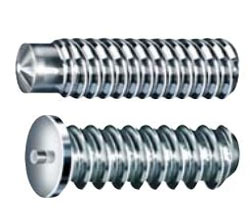
Duplex Steel Screws
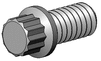


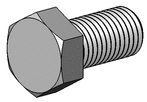
Duplex Steel Bolts
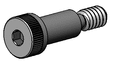


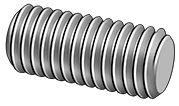
Duplex Steel Studs & Threaded Rods

Duplex Steel Washers


Duplex Steel - Frequently Asked Questions
Answers from our engineers, drawn from the Duplex Steel technical questions we're asked most.
Specialty Bolts for Crevice Corrosion
Q: Why is saltwater crevice corrosion so tough on metals? A: Saltwater contains chlorides that can be highly corrosive to many various metals including common grades of stainless steel. The most common corrosion concern in saltwater is crevice corrosion. This happens when saltwater gets trapped and remains stagnant in tight spaces like the threads of a bolt. In these crevices, and localized high concentrations of chlorides could exist which accelerate corrosion. Fortunately, there are some specialized metals that are ideal in preventing salt water crevice corrosion and minimizing its impact. These include: Titanium Bolts Titanium grade 2 and the stronger grade 5 are almost inert to salt water environments in both rapid and stagnant sea water. AL6XN Bolts Developed for use in salt water, AL6XN is a 6 Moly stainless alloy. This means it is composed of a minimum of 6% molybdenum, making it more corrosion resistant than standard grades of stainless. AL6XN bolts offer excellent resistance to pitting and crevice corrosion. Duplex Bolts Duplex steels (both Duplex 2205 and Super Duplex 2507) offer improved corrosion protection compared to 300 series stainless, especially in terms of localized corrosion such as crevice and pitting. Though Duplex bolts are not as robust as titanium or AL6XN in salt water, they are an excellent economic solution. MonelRenowned for its resistance to saltwater, Monel bolts are the go-to material for many naval vessels. Monel fasteners are available in two grades Monel 400 and Monel K500. Both grades are extremely resistant to saltwater, with K500 Monel offering twice the strength.
I’m trying to figure out if Duplex stainless steel bolts will gall with 304 stainless?
The more dissimilar the materials are the less likely they are to gall and bind together. In the case of 304 SS and Duplex stainless steel, the hardness of 304 is typically around a Brinell of 175. While the Brinell hardness of Duplex 2205 bolts are around 290. The different hardnesses between the materials will help to minimize the chances of galling.
We are essentially having issue identifying the highest available high strength stainless steel nylon insert nuts. Is Duplex 2205 the best option?
If you are just looking for strength for your lock nut with a nylon insert, one of the highest strength stainless steel’s you could consider would be 17-4 PH (ranging from 136-190KSI)
A286 locknuts are a good option as well with good high temperature stability (130 KSI)
Duplex lock nuts are also much stronger than 316 with about 120KSI tensile strength. Duplex also offers better corrosion resistance. This material is not as strong as A286 or 17-4
At what temperature is it safe to use 1.4462 Duplex Stainless Steel Screws in seawater?
1.4462 Duplex stainless steel comes under several material and trade names including, 2205, UNS S32205, UNS S31803, F51, AISI 318 LN.
It is normally safe to use duplex stainless bolting in brine / saltwater up to a temperature of 35°C. The 35°C relates to critical pitting temperature in chloride media. Above this temperature local corrosion (pitting) may be a risk.
I want to use Duplex bolts to bolt down a Monel plate. Will these materials be compatible?
When you mean compatible, I’m assuming you are referring to galvanic corrosion. Galvanic corrosion is when two dissimilar metals create an electrochemical reaction and corrosion occurs. Duplex and Monelcan experience this but for galvanic corrosion to occur the parts involved must be wet with a solution. Galvanic corrosion cannot occur when the metals in question are completely dry however humidity might be enough to create that galvanic coupling.
I’m trying to figure out what material will work for my application based on the shear strength. I see you published tensile but not shear. Do you have the shear strength for A286 and Inconel 718?
Unfortunately, there is no published standard value for shear strength like tensile and yield strength. Instead, for ductile materials, shear strength is typically estimated to be approximately 60% of the ultimate tensile strength. Here is a charge with all the tensile strengths of our metals and alloys: Metals
More on Duplex Steel
What our customers say
More customer feedback“I purchased from you specifically because of Jon’s expertise and professionalism.”
“Very impressed; good prices and delivered earlier than lead time given, which was a real bonus.”
“Extreme Bolt is definitely on my go-to list.”
