Torlon Flat Head Screws
Last updated
Metal-like performance from a light weight plastic

Need help choosing a material?
- Exceptional strength and stiffness up to 275°C (525°F)
- Outstanding wear resistance
- Superior toughness from cryogenic up to 275°C
- Resistant to strong acids and most organics
- Inherent flame resistance
- Metal-like coefficient of linear thermal expansion
- Torlon flat head screw features and benefits
Polyamide-imide or Torlon® flat head screws are one of the strongest and toughest polymer screws available. Having the highest strength and stiffness of any pure thermoplastic up to 275°C (525°F), Torlon screws are geared for the most demanding mechanical and high temperature applications. Torlon flat head screws also have outstanding resistance to wear, creep and most chemicals.
Torlon flat head screws are available in a glass fiber reinforced grade which improves the strength, modulus and creep resistance. Because of the outstanding mechanical properties of Torlon screws, they can be used as a replacement for metal screws some applications.
Torlon flat head screws are available in both metric and standard sizes. Please contact us if you have any questions about Torlon screws, their characteristics and their availability.
Screws made from customer specified polyamide-imide grades are available upon request.
Screw Types: Flat Head Screws, Hex Cap Screws, Pan Head Screws, Set Screws, Socket Head Cap Screws
Torlon Flat Head Screw Features and Benefits
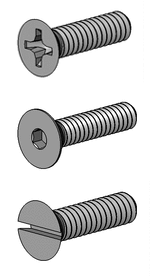
Torlon flat head screws are characterized by having a head with a top flat surface (which can feature either a slotted, phillips or allen driver) and bottom that is cone shaped or countersunk. With this design, the head of the screw can align flush or below the surrounding surface having obvious benefits.
Torlon Slotted vs. Phillips Driver
| Slotted Head Advantages | Phillips Head Advantages |
|
|
Countersink Angle
For most flat head screw designs the angle of countersink is usually 82° for UNC and UNF applications however other angles ranging from 60° -120° could be specified.
| Thread Type | Normal Flat Head Countersink Angle |
|
UNC / UNF |
82° |
| Aerospace | 100° |
| ISO Metric / Imperial | 90° |
Torlon Properties
Torlon Mechanical Properties
| Material | Ultimate Tensile (psi) | Yield Strength (psi) |
|---|---|---|
| Torlon Unfilled | 22,000 | - |
| Property | ASTM / UL Test | Torlon® PAI 4203 |
|---|---|---|
| PHYSICAL | ||
| Density (lb/in³) (g/cm³) | D792 | 0.051 (1.41) |
| Water Absorption, 24 hrs (%) | D570 | 0.33 |
| MECHANICAL | ||
| Strength/Weight Ratio | Tensile Strength / | 15600 |
| Tensile Strength (psi) | D638 | 22,000 |
| Tensile Modulus (psi) | D638 | 650,000 |
| Tensile Elongation at Break (%) | D638 | 7.6 |
| Flexural Strength (psi) | D790 | 41,000 |
| Flexural Modulus (psi) | D790 | 1,140,000 |
| Hardness, Rockwell, R/M Scale | D785 | M120 |
| IZOD Impact Notched (ft-lb/in) | D256 | 2.7 |
| THERMAL | ||
| Coefficient of Linear Thermal Expansion (x 10-5 in./in./°F) | D696 | 3.1 |
| Heat Deflection Temp (°F / °C) at 264 psi | D648 | 532 / 278 |
| Melting Temp (°F / °C) | D3418 | none (degrades ~500 °C |
| Max Operating Temp (°F / °C) | - | 525/ 275 |
| Thermal Conductivity (BTU-in/ft²-hr-°F) | C177 | 1.8 |
| ELECTRICAL | ||
| Dielectric Strength (V/mil) short time, 1/8" thick | D149 | 580 |
| Dielectric Constant at 1 MHz | D150 | 3.9 |
| Dissipation Factor at 1 MHz | D150 | 0.026 |
| Volume Resistivity (ohm-cm) at 50% RH | D257 | > 1016 |
| APPROVALS | ||
| Approval | FDA | NO |
| Approval | USDA | NO |
| Approval | NSF | NO |
| Approval | 3A DAIRY | NO |
| Approval | USP CLASS VI | NO |
TORLON CHEMICAL RESISTANCE
| Chemical | Tensile Strength % Retained |
|---|---|
| Acids | |
| Acetic (10%) | 100 |
| Glacial Acetic | 100 |
| Acetic Anhydride` | 100 |
| Lactic | 100 |
| Benzene Sulfonic | 28 |
| Chromic (10%) | 100 |
| Formic (88%) | 66 |
| Hydrochloric (10%) | 100 |
| Hydrochloric (37%) | 95 |
| Phosphoric (35%) | 100 |
| Sulfuric (30%) | 100 |
| Bases | |
| Ammonium Hydroxide (28%) | 81 |
| Sodium Hydroxide (15%) | 43 |
| Sodium Hydroxide (30%) | 7 |
| Aqueous Solutions (10%) | |
| Aluminum Sulfate | 100 |
| Ammonium Chloride | 100 |
| Ammonium Nitrate | 98 |
| Barium Chloride | 100 |
| Bromin (saturated solution, 120 °F) | 100 |
| Calcium Chloride | 100 |
| Calcium Nitrate | 96 |
| Ferric Chloride | 99 |
| Magnesium Chloride | 100 |
| Potassium Permanganate | 100 |
| Silver Chloride | 100 |
| Sodium Bicarbonate | 100 |
| Sodium Carbonate | 100 |
| Sodium Chloride | 100 |
| Sodium Chromate | 100 |
| Sodium Hypochlorite | 100 |
| Sodium Sulfate | 100 |
| Sodium Sulfide | 100 |
| Sodium Sultite | 100 |
| Alcohols | |
| 2-Aminoethanol | 9 |
| n-Amyl Alcohol | 100 |
| n-Butyl Alcohol | 100 |
| Cyclohexanol | 100 |
| Ethylene Glycol | 100 |
| Amines | |
| Aniline | 97 |
| n-Butyl Amine | 100 |
| Dimethylaniline | 100 |
| Thylene Diamine | 7 |
| Morpholine | 100 |
| Pyridine | 43 |
| Chemical | Tensile Strength % Retained |
|---|---|
| Aldehydes & Ketones | |
| Acetophenone | 100 |
| Benzaldehyde | 100 |
| Cyclohexanone | 100 |
| Formaldehyde (37%) | 100 |
| Furfural | 84 |
| Methyl Ethyl Ketone | 100 |
| Chlorinated Organics | 100 |
| Acetyl Chloride (120 °F) | 100 |
| Benzyl Chloride (120 °F) | 100 |
| Carbon Tetrachloride | 100 |
| Chlorobenzene | 100 |
| 2-Chloroethanol | 100 |
| Chloroform (120 °F) | 100 |
| Epichloroydrin | 100 |
| Ethylene Chloride | 100 |
| Esters | |
| Amyl Acetate | 100 |
| Butyl Acetate | 100 |
| Butyl Phihalate | 100 |
| Ethyl Acetate | 100 |
| Ethers | |
| Butyl Ether | 100 |
| Cellosolve | 100 |
| P-Dioxane (120 °F) | 100 |
| Tetrahydroturan | 100 |
| Hydrocarbons | |
| Cyclohexane | 100 |
| Diesel fuel | 99 |
| Gasoline (120 °F) | 100 |
| Heptane | 100 |
| Mineral Oil | 100 |
| Motor Oil | 100 |
| Stoddard Solvent | 100 |
| Toluene | 100 |
| Nitriles | |
| Acetonitrile | 100 |
| Benzonitrile | 100 |
| Nitro Compounds | |
| Nitrobenzene | 100 |
| Nitromethane | 100 |
| Miscellaneous | |
| Cresyldiphenyl Phosphate | 100 |
| Sulfolane | 100 |
| Triphenylphosphite | 100 |