Nickel 200 Fasteners - Bolts, Screws & Nuts
Last updated
Ideal for caustic alkali corrosive solutions

Need help choosing a material?

- Excellent corrosion resistance to caustic soda
- Moderate general corrosion resistance
- Chemistry and specifications
- Temperature and Strength Mechanical Data
- Nickel 200 datasheet
Nickel 200 (2.4060) fasteners are made from commercially pure nickel and are best known for their excellent performance in caustic alkali solutions such as caustic soda (NaOH). Nickel 200 also exhibits good performance in acids, especially HF (Hydrofluoric Acid - anhydrous) and hydroxides – but can be attacked by common solutions of hydrochloric or sulfuric acids.
From a mechanical perspective, Nickel 200 bolts have good ductility and low hardness, so they are tough, but not particularly strong (60-85 KSI UTS). See Tensile, Yield & Elongation Chart.
Corrosion
Nickel 200 screws are resistant to corrosive environments, most notably reducing chemicals. They offer outstanding protection to caustic alkaline solutions. However, Nickel 200 fasteners will be severely attacked in oxidizing salt solutions.
Chemical Resistance
- Sodium Hydroxide (NaOH): Excellent resistance to all concentrations of caustic soda.
- Alkalis: Excellent resistance except for ammonium hydroxide.
- Sulfuric acid: Moderate resistance to nonaerated sulfuric acid solutions near room temperature.
- Hydrochloric: Limited resistance in specific environments only.
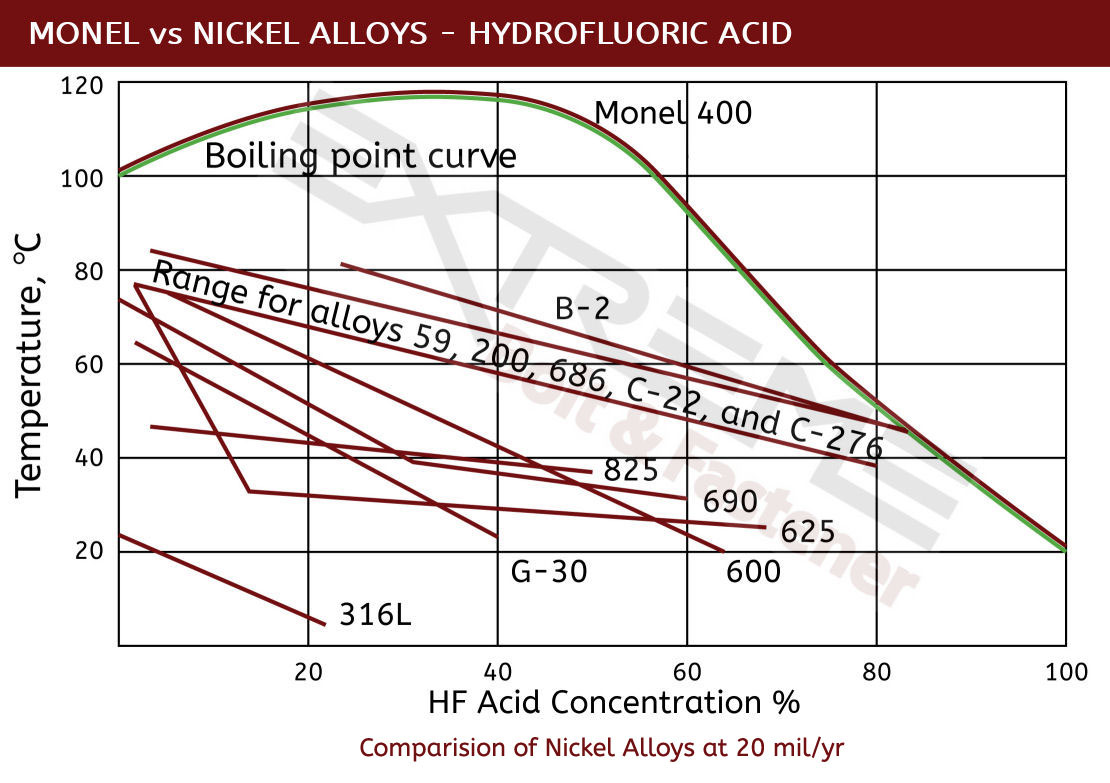
- Hydrofluoric: Good resistance to anhydrous hydrofluoric acid even at high temperatures. Nickel 200 it has limited resistance to aqueous HF solutions.
- Important: Oxidizing acid chlorides such as ferric, cupric and mercuric are very corrosive to Nickel 200 fasteners.
General
- 60-85 KSI UTS
- 15-45 KSI Yield
- Typically used in application temperatures less than 600⁰F / 315⁰C
Applications
- Most often used in chemical and electronic processing, especially applications that deal with caustic soda.
- High electrical and thermal conductivity, as well as magnetostrictive properties make Nickel 200 screws useful in electrics and sonic devices.
- Nickel 200 bolts are used in salt production and applications that use sodium hydroxide and fluorine.
Nickel 200 Chemistry and Specifications
NICKEL 200 SPECIFICATIONS: UNS N02200, EN 2.4060, EN 2.40666
| Nickel 200 | Ni | Fe | Mn | Si | Cu | C | S |
|---|---|---|---|---|---|---|---|
| 99.0 min | 0.40 max | 0.35 max | 0.35 max | 0.25 max | 0.15 max | 0.01 max |
| Media | Common Name | Temperature °F (°C) | Corrosion Rate (mpy) |
|---|---|---|---|
| 5% CH3CO2H with Air | Accetic Acid | 70 (21) | 40 |
| 10% CH3CO2H | Accetic Acid | 86 (30) | 3.4 |
| 56% CH3CO2H | Accetic Acid | 176 (80) | 66 |
| 85% CH3CO2H with Air | Accetic Acid | 70 (21) | 400 |
| 98% CH3CO2H | Accetic Acid | 241 (116) | 12 |
| 50% NaOH | Caustic Soda | 195 (90) | 0.55 |
| 50% NaOH | Caustic Soda | 310 (155) | 0.5 |
| 75% NaOH | Caustic Soda | 250 (120) | 1 |
| 90% CH2O2 | Formic Acid (liquid) | 70 (21) | 4 |
| 90% CH2O2 | Formic Acid (vapor) | 70 (21) | 7 |
| 1% HCl | Hydrochloric Acid | 214 (101) | 680 |
| 10% HCl | Hydrochloric Acid | 86 (30) | 80 |
| 10% HCl | Hydrochloric Acid | 221 (105) | 8,000 |
| 10% HNO3 | Nitric Acid | 216 (102) | 12,000 |
| 10% H3PO4 | Phosphoric Acid | 75 (24) | 0.6 |
| 10% H3PO4 | Phosphoric Acid | 214 (101) | 154 |
| 40% H3PO4 | Phosphoric Acid | 75 (24) | 1 |
| 500ppm NaClO | Sodium Hypochlorite | 77 (25) | 0.8 |
| 2% H2SO4 | Sulfuric Acid | 70 (21) | 2 |
| 5% H2SO4 | Sulfuric Acid | 140 (60) | 10 |
| 5% H2SO4 with Air | Sulfuric Acid | 86 (30) | 61 |
| 19% H2SO4 | Sulfuric Acid | 223 (106) | 110 |
| 20% H2SO4 | Sulfuric Acid | 70 (21) | 4 |
| 50% H2SO4 with Air | Sulfuric Acid | 86 (30) | 16 |
| 50% H2SO4 | Sulfuric Acid | 255 (124) | 1,000 |
| 93% H2SO4 with Air | Sulfuric Acid | 86 (30) | 10 |

Nickel 200 fastener styles
Nickel 200 Screws


Nickel 200 Bolts
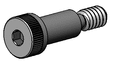


Nickel 200 Studs & Threaded Rods
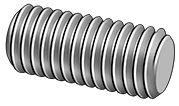

Nickel 200 Washers


Nickel 200 - Frequently Asked Questions
Answers from our engineers, drawn from the Nickel 200 technical questions we're asked most.
I have a process utilizing a high concentration caustic solution of sodium hydroxide. Would C276 bolts be a good option for corrosion resistance.
They could be a possibility but you might want to also consider Nickel 200. Nickel 200 bolts find their niche in corrosion resistance to caustic alkaline chemicals. They should be a good fit for this situation.
Because Nickel 200 bolts have much higher nickel content than Hastelloy C276 does that mean they are more corrosion resistant than a Hastelloy bolt?
No. Though nickel content plays a huge role in corrosion resistance, however there are other elements that contribute to the high level of corrosion protection of a Hastelloy C276 bolt. Hastelloy bolts contain materials like chromium and molybdenum which give it a higher level of general corrosion protection over a Nickel 200 bolt. Though Hastelloy C276 performs better in most hot acid situations, Nickel 200 bolts are known for its excellent performance in caustic alkaline solutions especially caustic soda.
Will Nickel 200 bolts be a good choice for hydrofluoric acid?
For aqueous HF, Nickel 200 fastenersoffer limited protection. If application requires a metal then you may want to consider Monel 400. Monel 400 bolts are the most resistant option for hydrofluoric acid in all concentrations up to the boiling point. If metals aren’t required, then engineered polymers like PVDF/ PTFE fastenersalso offer excellent protection to HF.
We’re using sodium hydroxide as a water treatment chemical to raise the pH of water but are experiencing corrosion. Is there a material that can handle this?
Typically for caustic soda (sodium hydroxide) corrosion, you might want to consider Nickel 200 bolts. Nickel 200 is best known for its resistance to caustic soda in all concentrations. The only drawback is that Nickel 200 isn’t particularly strong (60-85 KSI UTS) and can severely attacked by oxidizing salt solutions.
I’m using aqueous Hydrofluoric acid in a silicon etching process but amy Nickel 200 bolts aren’t holding up. Is there a better material I can use?
Nickel 200 fasteners are excellent for use in anhydrous hydrofluoric acid, but in the aqueous form of HF acid they offer limited resistance. The good news is that there is a solution. Monel 400is one of the few materials that can offer protection from hydrofluoric acid corrosion. Monel bolts have excellent resistance to HFin all concentrations up to the boiling point.
I work in a plant that manufactures paper. We’re treating pulp with a solution containing sodium sulfide and sodium hydroxide to dissolve the wood materials and produce cellulose to make paper. Can you suggest a material that can give our bolting some corrosion protection and better longevity. Some of the steels we are using are not lasting very long.
One of the best materials to consider for your alkali corrosion issues would be Nickel 200 bolts. Nickel 200 screws are highly resistant to alkaline solutions– especially sodium hydroxide. The only precaution would be to make sure there are no oxidizing chemicals (for example ferric chlorides) in your process as they can corrode Nickel 200 fasteners. You could learn more about nickel 200 fasteners at https://www.extreme-bolt.com/nickel-200-fasteners-bolts-screws-nuts.html.
More on Nickel 200
What our customers say
More customer feedback“I purchased from you specifically because of Jon’s expertise and professionalism.”
“Very impressed; good prices and delivered earlier than lead time given, which was a real bonus.”
“Extreme Bolt is definitely on my go-to list.”