

AL6XN Fasteners - Bolts, Screws & Nuts
Last updated
A mid-ranged corrosion resistant 6Mo alloy with good strength

Need help choosing a material?

- Good corrosion resistance to moderate acids & sea-water
- 50% stronger than stainless steel
- Usable temperature limit of 1000°F
- AL6XN Chemistry & Specifications
- AL6XN Datasheet
Originally developed to combat sea water corrosion, AL6XN has expanded its role as being good mid-range corrosion resistant alloy. AL6XN fasteners are a low carbon, high purity, nitrogen-bearing "super-austenitic" stainless alloy. Also considered a 6-Moly alloy (6% Molybdenum), AL6XN bolts are similar in composition and capabilities to Alloy 926 and SMO 254. With a higher nickel and molybdenum content than Duplex 2205 and Super Duplex 2507, it delivers better corrosion resistance while giving a more cost effective alternative to nickel super alloys like Inconel or Hastelloy in moderately corrosive conditions.
Corrosion Resistance
- Moderate general corrosion resistance
- Excellent chloride / salt water protection
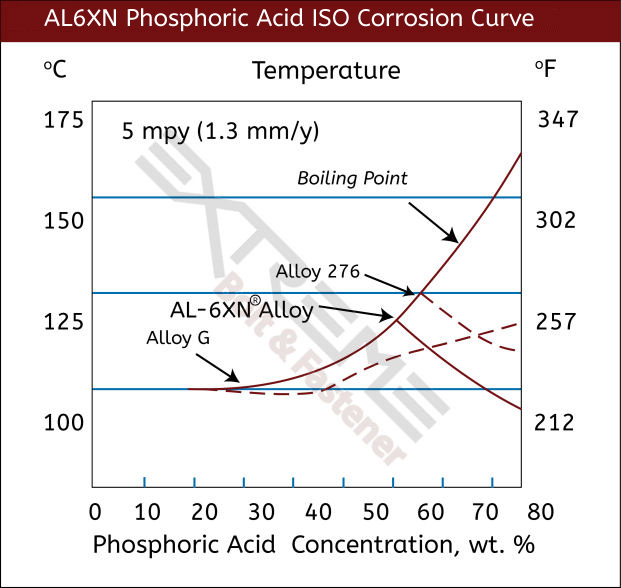
- Good performance in phosphoric acid
- Moderate resistance to nitric acid
Chemical Resistance
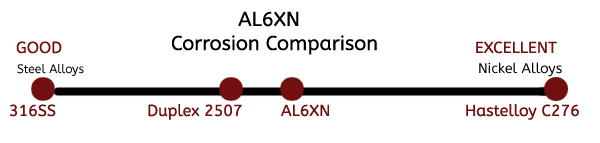
In chemical processes which utilize chlorides, such as paper mills and waste water, stress corrosion cracking (SCC) is a common culprit for 316L stainless failures. Duplex alloys will outlast environments that will cause SCC in 316 stainless, but for more severe low PH environments, fasteners made from higher nickel content alloys like AL6XN will generally work better. For the most extreme situations, alloys with >45% nickel content like Hastelloy are often considered.
Outstanding Resistance to Salt Water
Seawater is where AL6XN outperforms so many alloys providing protection to stress corrosion cracking, pitting and crevice corrosion in a broad range of marine applications. AL6XN fasteners contain a minimum of 6% molybdenum content and it is this addition of molybdenum that provides the greatest protection against pitting and crevice corrosion.
Mechanical Properties
Electrical Resistivity: 535 Ohm-circ mil/ft
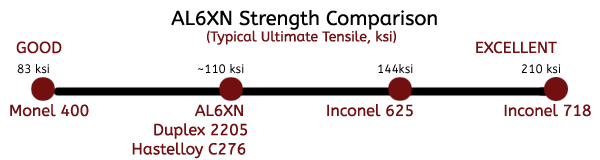
Ultimate Tensile Strength: 108 ksi
0.2% Yield Strength: 53 ksi
Density: 0.291 lb/in 3
Chemistry
- High molybdenum content provides enhanced corrosion protection in chloride environments.
- Carbon helps to prevent sensitization during welding
- Chromium enhances pitting and crevice corrosion resistance
- The interstitial strengthening effect of nitrogen gives AL6XN good high strength properties
AL6XN Applications
- Desalination plants depend on AL6XN for the salt water corrosion protection
- Pulp bleaching equipment and piping
- The power industry uses AL6XN screws where salt water and chlorides are present such as steam surface condensers, supercritical, high pressure, feed water heaters, steam surface condensers, flue-gas desulfurization equipment and in nuclear power water piping
- Offshore
- Chemical Processing - processing tanks, vessels and pipes as well as plate and frame heat exchangers.
AL6XN Chemical Composition & Specifications
AL6XN Specifications: ASTM A479, UNS NO8367, ASTM A 240, ASTM B 688, ASME SA-240, ASME SB-688, ASTM B690, ASTM B691, ASTM A240, ASTM B688, ASME SA-240, ASME SB-688
| AL6XN | Fe | Ni | Cr | Mo | Mn | Si | Cu | N | P | C | S |
|---|---|---|---|---|---|---|---|---|---|---|---|
| Min % | - | 23.5 | 20.0 | 6.0 | - | - | - | 0.18 | - | - | - |
| Max % | Bal | 25.5 | 22.0 | 7.0 | 2.0 | 1.0 | 0.75 | 0.25 | 0.040 | 0.03 | 0.030 |
| Temperature (°F) | Ultimate Tensile (ksi) | Yield Strength 0.2% Offset (ksi) | Elongation % |
|---|---|---|---|
| -450 | 218 | 142 | 36 |
| -320 | 196 | 107 | 49 |
| Room Temp. | 108 | 53 | 47 |
| 200 | 100 | 49 | 47 |
| 400 | 90 | 40 | 46 |
| 600 | 86 | 36 | 47 |
| 800 | 87 | 36 | 48 |
| 1000 | 84 | 34 | 50 |
| Media | TYPE 316L | TYPE 317L | ALLOY 904L | AL-6XN | ALLOY 276 |
|---|---|---|---|---|---|
| 20% Acetic Acid | 0.12 | 0.48 | 0.59 | 0.12 | 0.48 |
| -0.003 | -0.01 | -0.02 | -0.003 | -0.01 | |
| 45% Formic Acid | 23.41 | 18.37 | 7.68 | 2.40 | 2.76 |
| -0.6 | -0.47 | -0.2 | -0.06 | -0.07 | |
| 10% Oxalic Acid | 44.9 | 48.03 | 27.13 | 7.32 | 11.24 |
| -1.23 | -1.14 | -0.69 | -0.19 | -0.28 | |
| 20% Phosphoric Acid | 0.60 | 0.72 | 0.47 | 0.24 | 0.36 |
| -0.02 | -0.02 | -0.01 | -0.006 | -0.009 | |
| 10% Sodium Bisulfate | 71.57 | 55.76 | 8.88 | 4.56 | 2.64 |
| -1.82 | -1.42 | -0.23 | -0.12 | -0.067 | |
| 50% Sodium Hydroxide | 77.69 | 32.78 | 9.61 | 11.4 | 17.77 |
| -1.92 | -0.83 | -0.24 | -0.29 | -0.45 | |
| 10% Sulfamic Acid | 124.3 | 93.26 | 9.13 | 9.36 | 2.64 |
| -3.16 | -2.39 | -0.23 | -0.24 | -0.067 | |
| 10% Sulfuric Acid | 635.7 | 298.3 | 100.8 | 71.9 | 13.93 |
| -16.15 | -7.58 | -2.53 | -1.83 | -0.35 | |
| Testing per ASTM G-31 | |||||
AL6XN fastener styles
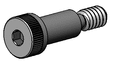
AL6XN Screws




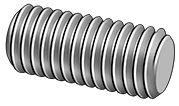
AL6XN Studs & Threaded Rods

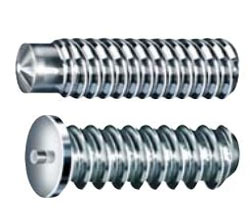
AL6XN Washers


AL6XN - Frequently Asked Questions
Answers from our engineers, drawn from the AL6XN technical questions we're asked most.
Specialty Bolts for Crevice Corrosion
Q: Why is saltwater crevice corrosion so tough on metals? A: Saltwater contains chlorides that can be highly corrosive to many various metals including common grades of stainless steel. The most common corrosion concern in saltwater is crevice corrosion. This happens when saltwater gets trapped and remains stagnant in tight spaces like the threads of a bolt. In these crevices, and localized high concentrations of chlorides could exist which accelerate corrosion. Fortunately, there are some specialized metals that are ideal in preventing salt water crevice corrosion and minimizing its impact. These include: Titanium Bolts Titanium grade 2 and the stronger grade 5 are almost inert to salt water environments in both rapid and stagnant sea water. AL6XN Bolts Developed for use in salt water, AL6XN is a 6 Moly stainless alloy. This means it is composed of a minimum of 6% molybdenum, making it more corrosion resistant than standard grades of stainless. AL6XN bolts offer excellent resistance to pitting and crevice corrosion. Duplex Bolts Duplex steels (both Duplex 2205 and Super Duplex 2507) offer improved corrosion protection compared to 300 series stainless, especially in terms of localized corrosion such as crevice and pitting. Though Duplex bolts are not as robust as titanium or AL6XN in salt water, they are an excellent economic solution. MonelRenowned for its resistance to saltwater, Monel bolts are the go-to material for many naval vessels. Monel fasteners are available in two grades Monel 400 and Monel K500. Both grades are extremely resistant to saltwater, with K500 Monel offering twice the strength.
How does 316 Stainless Compares to Specialty Steel Alloys
316 stainless is a familiar alloy to many of us and perhaps one of the most widely used fastening materials. Though it serves a critical function for industry, 316 can often fall short in servicing challenging high strength, temperature and corrosion resistant applications. Here is how it measures up in these areas against some of the more specialty stainless steel alloys.
Strength
Compared to many specialty alloyed steels, 316 stainless falls short in terms of strength. Beyond moderate strength options such as duplex steel, extreme steel alloys such as A286 and 17-4PH bolts can provide up to 210ksi of ultimate tensile strength – almost 3x that of a 316 bolt.
316 stainless steel bolts can be used from subzero to temperatures up to about 800F. Past this limit the mechanical properti
es of the alloy fails and the material can oxidize more rapidly. This falls around the middle of the temperature range of stainless steels, as there are some specialty stainless steels that are temperature sensitive, like duplex steels and 17-4PH, where going beyond 570F or 600F changes the materials characteristics. However, there are a handful heat / oxidation resistant stainless alloys like A286, alloy 310 and alloy 330 provide excellent protection high temperatures up to 2100F. These stainless steels are designed to be temperature stable and oxidation resistant.
Corrosion
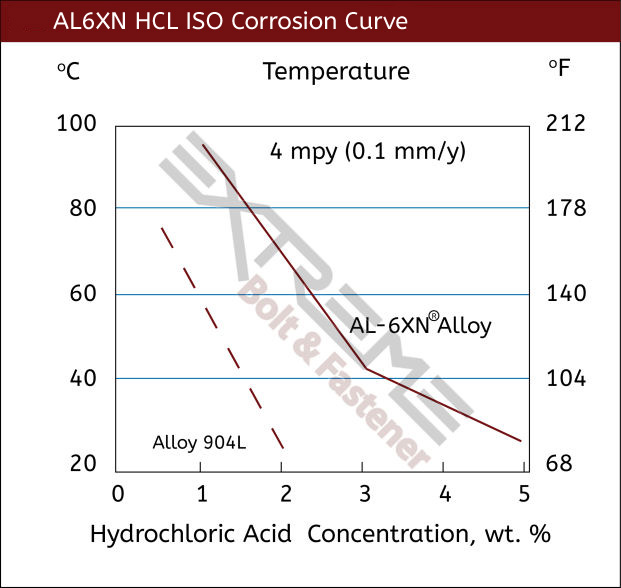
Though 316 doesn’t have the corrosion resistance of a nickel alloy it can perform reasonably well in mild corrosive situations. It is often used for mild resistance to sulfur compounds, acetic acid and phosphoric acid. In contrast, Alloy 20 is a stainless-steel alloy that is designed for corrosion protection and can offer significantly improved corrosive resistance to acids like, acidic acid, sulfuric acid and hydrochloric acid.
316 Hydrochloric Acid Corrosion 316 Phosphoric Acid Corrosion
316 Sulfuric Acid Corrosion 316 Nitric Acid Corrosion
316 Acetic Acid Corrosion
Chart Source: North American Stainless
AL6XN (6 Moly Alloy) is another stainless steel alloy developed for salt water environments and is ideal for marine corrosion – a vast improvement in these conditions over 316 bolts. For chlorides and mild saltwater corrosion, duplex and super duplex stainless steel bolts provide significant corrosion performance over 316 bolts. As always, it depends on the exact corrosion environment to determine which stainless steel is best, but for sure, Alloy 20, AL6XN (6 Moly Alloy) and the Duplex steels are optimized for improved corrosion performance over 316 stainless steel.
Chloride Stress Corrosion Cracking: 316 Stainless Steel vs. Duplex 2205
Chart Source: North American Stainless
How does a Duplex bolt compare to AL6XN in a hot saltwater situation?
Duplex bolts are ideal for chlorides and mild saltwater application such as brackish water, salt air and moderate temperature unpolluted seawater. An AL6XN boltwill provide more corrosion protection than a Duplex bolt in marine and salt water environments. They can also be used at higher temperatures 1000F compared to 570F of Duplex. Though for strength in seawater Super Duplex bolts offer 125ksi tensile strength compared to 108ksi of AL6XN.
I’ve been using 254 SMO bolts and am happy with their corrosion resistance but need a little more high temperature stability as sometimes our process can go up to 800F. Any suggestions?
254 SMO bolts are in a class of material called 6 Moly alloys. Another 6 Mo alloy that has similar chemistry to 254 SMO is AL6XN. AL6XN bolts offer slighter higher corrosion resistance as well as high temperature capabilities with a usable temperature limit of 1000F compared to 700F of 254 SMO.
How does 254 SMO compare with Alloy 20 and AL6XN? Can it handle sulfuric acid?
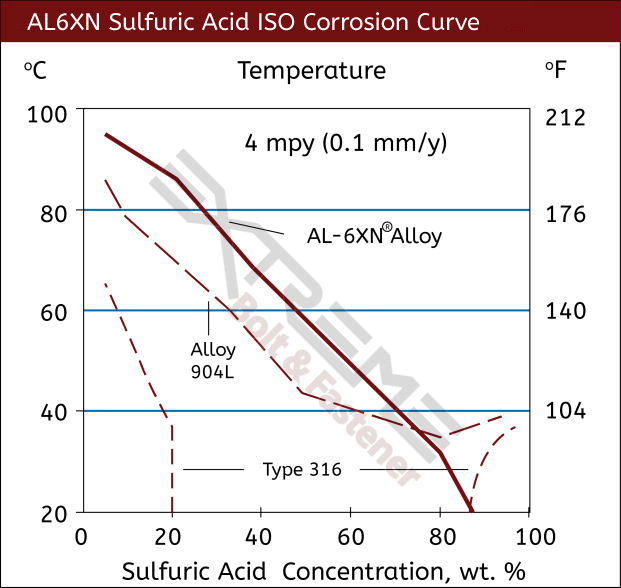
To answer your first question, I’ve ranked each of these specialty alloys in terms of their general corrosion resistance to sulfuric acid:1. Alloy 20 Most2. AL6XN Moderate3. 254 SMO LeastOverall these alloys all perform well in saltwater and chloride environments, but for an acid application like sulfuric acid, you would likely want to choose a more robust alloy like Alloy 20 fasteners (though it always depends on the concentration and temperature of the acid environment). For strong sulfuric acid environments 254 SMO bolts are not a good fit. Alloy 20 bolts are designed to provide a moderate range corrosion resistance to sulfuric acid, specifically in the range of 20% to 40% in concentration. In hot sulfuric acid Alloy 20 bolts are known for their resistance to stress-corrosion cracking. If you are dealing with a harsher sulfuric acid environment, I’d recommend Hastelloy boltsas they can be used in much higher sulfuric acid concentrations and at elevated temperatures.
Fasteners That Keep Us Safe
Modern day engineering is key to helping the world through this difficult time, and
specialty material bolts make it possible. Materials like titanium, PEEK and 17-4PH provide the corrosion resistance and high strength needed for manufacturing and high-tech distribution. This newsletter shows some of the ways Extreme Bolt & Fastener is helping their customers to help you.
Distribution
Large scale robotic systems play an important role in the fulfillment processes that bring you home deliveries. Extreme Bolt has supplied mass retailers high strength 17-4PH bolts to ensure these systems stay operational. Age hardened 17-4PH bolts provide extreme strength at 160-210ksi ultimate tensile strength.
Paper Goods
From toilet paper to disinfecting wipes, fasteners make it possible. Titanium screws are highly resistance to chloride corrosion, making them ideal for pulp and paper bleaching. Grade 5 titanium combines chloride resistance with high strength that is 4x that of 316 stainless. AL6XN fasteners are also key to chloride resistance and bleaching processes.
Pharmaceuticals & Medical Equipment
Inert fasteners (like PTFE and Hastelloy C276) that will not interact with sensitive pharmaceuticals and contaminate testing environments are essential. Extreme Bolt & Fastener works with leading pharma and medical device companies to ensure their products are safe and reliable.
Protective Gear P 