
Weld Studs
Last updated
Made of specialty metals, polymers and ceramics
 Weld studs are an ideal way to securely attached fasteners in extreme applications where reaching both sides of a structure is impossible or undesired. These weld studs can be attached by a variety of welding techniques, such as MIG or TIG welding or they can be attached by automated welding guns using Arc or Capacitor Discharge (CD) technologies.
Weld Stud Sizes
- #4 - 4"
- M3 - M100
Availability
Both fine and coarse threads available
Arc & Capacitive Discharge Weld Stud Benefits
 Capacitor Discharge Weld StudArc Weld StudSecurity: Unlike the peripheral weld used on a common bolt, the weld used to secure a weld stud fastener is a full cross sectional weld, so the full face of the fastener is welded in place for a strong, secure hold. And since there are no drilled holes – which weakens the structural integrity of the application – the attachment is even stronger.
Speed: Installing a weld stud is a fast and simple process with a most fasteners taking less than 1 second to weld in place. Plus there is no secondary work such as drilling, polishing or grinding.
Simplicity: Weld studs require almost no special skills and minimal training and equipment is needed for installation. In addition, the equipment is also portable.
Variety: Weld studs are available in a wide variety of fastener styles including (but not limited to) fully threaded, partially threaded, full base, reduced base, long, tapped base, and shoulder thread to name a few.
Weld Stud Methods
| Method | Arc Weld | Capacitor Discharge |
|---|---|---|
| Overview | Allows for use of any size or type of weld stud, but is generally used to weld large diameter fasteners to rougher and thicker base metals | Semi-automatic arc welding process best used to weld small diameter studs to very thin material |
| Fastener size | Larger diameter Fasteners (up to 1-1/4") | Small diameter studs up to 3/8" diameter |
| Weld | Results in full fusion weld with penetration of weld zone for structural-type strength that becomes stronger than the stud itself | Millisecond process that that produces a weld without pronounced distortion, burn-through or reverse side marking |
| Power | DC (direct current), 220 or 440 volt power sourcing | Only 110 volt power required |
| Length | Reduced ~1/8-inch in length after welding for diameters up to 1/2-inch weld base diameter and ~3/16-inch for 5/8-inch weld base or larger. | Do not undergo any loss of length after welding. |
Transcribed from the original Weld Stud Methods chart — pending verification.
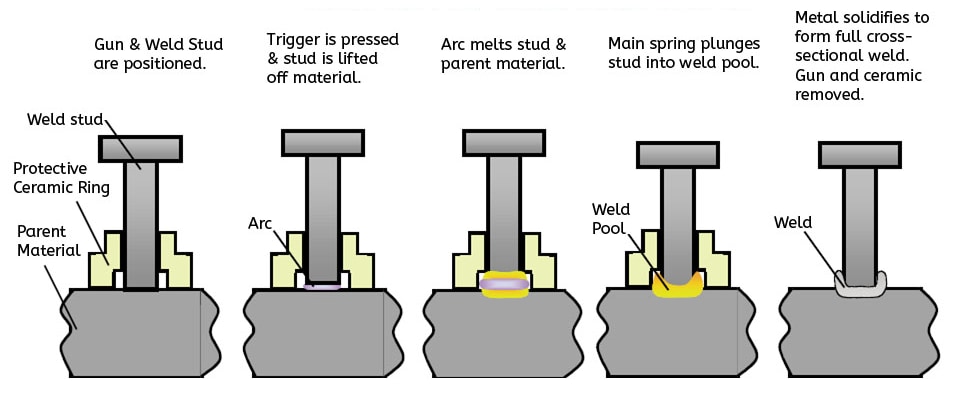
How an Arc Weld Stud Works
Thread Options
Visit our thread options page for more information on Extreme Bolt's threading capabilities:
- Thread types and attributes
- Classes and tolerances
- How threading can affect bolt performance
- Specialty threads