Inconel Fasteners - Bolts, Screws & Nuts
Last updated
A Ni-Cr alloy known for its high temperature stability & corrosion resistance

Need help choosing a material?

- High temperature stability up to 2200°F (1204°C)
- Good corrosion resistance at elevated temperatures
- High strength material with excellent toughness at elevated temperatures
- Inconel grades: 600, 601, 625, 686, 718, 725, X750
- Inconel 718 AMS Specifications
- Inconel ASTM F2281 fasteners
- In-depth insight on Alloy 625 (2.4856) and Alloy 718 (2.4668)
- Inconel mechanical charts
- Inconel datasheets available on 625 and 718
Inconel fasteners, like Inconel 600, 601, 625, 686, 718, 725 & X750 fasteners, are a family of nickel-chromium-molybdenum alloys used for their high strength at elevated temperatures and good corrosion resistance. Because of its high thermal stability, Inconel can be used in service temperatures ranging from cryogenic to 2200°F (982°C). The high alloy content of Inconel fasteners enable it to withstand a wide variety of severe corrosive environments. In mild environments, such as the atmosphere, sea water, neutral salts, and alkaline media, there is almost no attack to Inconel fasteners. In more severe corrosive environments the combination of nickel and chromium provides resistance to oxidizing chemicals, whereas the high nickel and molybdenum contents supply resistance to nonoxidizing environments.
Because Inconel fasteners offer a good balance of corrosion resistance, temperature stability, toughness and strength they are often a material of choice for chemical processing, aerospace, marine, electronics and oil & gas.
The most common grades of Inconel nickel alloy fasteners are Inconel 625 (2.4856) and Inconel 718 (2.4668). Gain more insight on these two grades by accessing our Inconel 625 and Inconel 718 overviews or by contacting our engineering experts.
Common Inconel Fastener Grades
Inconel 600 (2.4816)
Alloy 600, UNS N06600, is a nickel-chromium alloy with good carburization and oxidation resistance through 2000°F. The alloy has long been used in the heat treating industry and Inconel 600 has useful resistance to dry Cl2 and HCl gases at moderately elevated temperatures.
Inconel 600 Specifications: AMS 5540, AMS 5665, ASME SB 166, ASME SB 167, ASME SB 168, ASTM B 166, ASTM B 167, ASTM B 168, EN 2.4816, UNS N06600, Werkstoff 2.4816, ASTM F2281
| Inconel 600 | Ni | Cr | Fe | Mn | Cu | Si | C | S |
|---|---|---|---|---|---|---|---|---|
| Min % | 72 | 14.0 | 6.0 | - | - | - | - | - |
| Max % | - | 17.0 | 10.00 | 1.00 | 0.50 | 0.50 | 0.15 | 0.015 |
Inconel 601 (2.4851)
Inconel 601, UNS N06601, is highly resistant to oxidation through 2200°F even under severe thermal cycling. The alloy has good high temperature strength, and retains its ductility after long service exposure. Inconel 601 alloy has good hot corrosion resistance under oxidizing conditions.
Inconel 601 Specifications: AMS 5715, AMS 5870, ASME SB 167, ASME SB 168, ASTM B 167, ASTM B 168, EN 2.4851, UNS N06601, Werkstoff 2.4851, ASTM F2281
| Inconel 601 | Ni | Cr | Fe | Al | Mn | Cu | Si | C | S |
|---|---|---|---|---|---|---|---|---|---|
| Min % | 58 | 21.0 | - | 1.0 | - | - | - | - | - |
| Max % | 63 | 25.0 | Bal | 1.7 | 1.00 | 1.00 | 0.50 | 0.10 | 0.015 |
Inconel 625 (2.4856)
Inconel 625, UNS N06625, EN 2.4856 is the workhorse of the Inconel family and is one of the most common grades. It exhibits high creep-rupture strength and is oxidation resistant to 1800°F (982°C). Inconel 625 has excellent resistance to hot seawater, scrubber environments and reducing acids and this alloy resists a wide range of severely corrosive environments and is especially resistant to pitting and crevice corrosion. For more indepth information, download our Inconel 625 datasheet.
Inconel 625 Specifications: AMS 5666, AMS 5837, ASME SB 443 Gr 1, ASME SB 446 Gr 1, ASTM B 443 Gr 1, ASTM B 446 Gr 1, EN 2.4856, ISO 15156-3, NACE MR0175-3, UNS N06625, Werkstoff 2.4856, ASTM F467 (Nuts), ASTM F468 (Bolts, Screws, Studs)
| Inconel 625 | Ni | Cr | Mo | Fe | Nb+Ta | Co | Mn | Si | Al | Ti | C | P | S |
|---|---|---|---|---|---|---|---|---|---|---|---|---|---|
| Min % | - | 20.0 | 8.0 | - | 3.15 | - | - | - | - | - | - | - | - |
| Max % | Bal | 23.0 | 10.0 | 5.0 | 4.15 | 1.0 | 0.5 | 0.5 | 0.4 | 0.40 | 0.10 | 0.015 | 0.015 |
Inconel 686 (2.4606)
Alloy 686, UNS N06686, is designed for outstanding corrosion resistance in a wide range of severe environments. The alloy is used in the most severe environments encountered in chemical processing, pollution control, pulp and paper production, and treatment of industrial and municipal waste.
Inconel 686 Specifications: ASTM B 462, ASTM B 564 / ASME SB 564, ASTM B 574 / ASME B 574, DIN 17752, DIN 17753, DIN 17754
| Inconel 686 | Ni | Cr | Mo | Ti | W | Mn | Si | C | P | S | Fe |
|---|---|---|---|---|---|---|---|---|---|---|---|
| Min % | - | 19.0 | 15.00 | 0.02 | 3.0 | - | - | - | - | - | - |
| Max % | Bal | 23.0 | 17.00 | 0.25 | 4.4 | 0.75 | 0.08 | 0.01 | 0.04 | 0.02 | 2.0 |
Inconel 718 (2.4668)
Inconel 718, UNS N07718, EN 2.4668, is the most common grade of the hardenable Inconels. This precipitation-hardened nickel-chromium alloy combines outstanding corrosion resistance and high strength at elevated temperatures. The alloy is a about 2x as strong as Inconel 625 having excellent creep-rupture strength at temperatures to 1300°F (700°C). Inconel 718 is often used in gas turbines, rocket motors, spacecraft, nuclear reactors, pumps, and tooling. For more indepth technical information, download our Inconel 718 datasheet.
Inconel 718 Specifications: AMS 5596, AMS 5662, AMS 5663, AMS 5962, ASME Case 2222-1, ASME SFA 5.14, ASTM B 637, ASTM B 670, EN 2.4668, GE B50TF14, GE B50TF15, UNS N07718, Werkstoff 2.4668, ASTM F2281.
AMS 5662
Inconel 718 bolts per AMS 5662 are made of a solution annealed bar material. It is the rawest state of Inconel 718 and the "softest" of the AMS specifications for this material. In comparison solution annealed Inconel 718 bolts, AMS 5662 will be slightly lower than its aged harded counterpart, AMS 5663.
AMS 5663
AMS 5663 is an aged hardened specification that applies to Inconel 718 bolts. As these bolts are age hardened, they offer higher tensile strength and hardness compared to 718 bolts in the annealed condition of AMS 5662.
AMS 5962
AMS 5962 is a highly specialized version of Inconel 718 bolts which offers the high level of strength. Inconel bolts per AMS 5962 are cold worked after solution annealing. AMS 5962 bolts are typically used when high strength is critical as they offer a minimum tensile strength of 220 ksi (at room temperature). This version of Inconel 718 bolts are typically used up to 900°F.
AMS 5596
Like the specification AMS 5662, which pertains to solution annealed bar, AMS 5596 bolts are made a similar specification for solution treated condition sheet and plate. It is used when applications require strength and creep resistance to 1300°F.
ASTM B637
ASTM B637 bolts are a raw material specification for both hot- and cold-worked precipitation-hardened nickel alloys, including Inconel 718. It is a spec that applies to high-temperature service. Inconel bolts per ASTM B637 must meet specific mechanical properties including strength, hardness, and stress-rupture requirements. ASTM B637 is the standard, most common specification for Inconel 718.
| Inconel 718 | Ni+Co | Fe | Cr | Nb+Ta | Mo | Ti | Co | Al | Mn | Si | Cu | C | P | S | B |
|---|---|---|---|---|---|---|---|---|---|---|---|---|---|---|---|
| Min % | 50 | - | 17.0 | 4.75 | 2.80 | 0.65 | - | 0.20 | - | - | - | - | - | - | - |
| Max % | 55 | Bal | 21.0 | 5.50 | 3.30 | 1.15 | 1.0 | 0.80 | 0.35 | 0.35 | 0.30 | 0.08 | 0.015 | 0.015 | 0.006 |
Inconel 725
Alloy 725, UNS N07725, nickel-chromium-molybdenum-niobium age-hardenable alloy that has essentially the same corrosion resistance as Inconel 625, but with a strength of that is twice that of annealed Inconel 625. The strength of this alloy is developed by heat treatment to achieve high ductility and toughness. The alloy is resistant to hydrogen embrittlement and stress-corrosion cracking as well.
| Inconel 725 | Ni+Co | Cr | Fe | Mo | Nb | Ti | Al | Mn | Si | C | P | S |
|---|---|---|---|---|---|---|---|---|---|---|---|---|
| Min % | 55 | 19.0 | - | 7.00 | 2.75 | 1.00 | - | - | - | - | - | - |
| Max % | 59 | 22.5 | Bal | 9.50 | 4.00 | 1.70 | 0.35 | 0.35 | 0.20 | 0.03 | 0.015 | 0.010 |
Inconel X750 (EN 2.4665)
Alloy X-750, UNS N07750, EN 2.4665, is a precipitation hardened alloy known for its corrosion resistance and high temperature oxidation resistance up to temperatures of 1300°F. This alloy is similar to Alloy 600 but made precipitation hadenable with the addition of titanium and aluminium.
Inconel X750 Specifications: ASTM B 637/ASME SB 637; ISO 9723-9725; SAE AMS 5667-5671 and 5747; EN 10269
| Inconel X750 | Ni | Cr | Fe | Nb+Ta | Mn | Co | Al | Si | Cu | C | S |
|---|---|---|---|---|---|---|---|---|---|---|---|
| Min % | 70.0 | 14.0 | 5.0 | 0.70 | - | - | 0.40 | - | - | - | - |
| Max % | - | 17.0 | 9.0 | 1.20 | 1.00 | 1.00 | 1.00 | 0.50 | 0.50 | 0.08 | 0.01 |
Inconel Frequently Asked Question of the Week
| Is Inconel 600 for Creep Resistance at Elevated Temperatures? |
|
Q: I am currently using 18-8 stainless steel socket head cap screws coated with MoS2 in a vacuum. I am having problems with the screws clamping force is sometimes loosening and they sometimes gall and jam, due to elevated temperature (700° to 1000° C) and heat cycling. What would be the most cost-effective screw option that will be less susceptible to these problems?
A. Yes, coating a 18-8 stainless screw with MoS2 will not really help. The stainless steel screw will stretch or creep at those temperatures and that is what you are seeing. The best option will be an Inconel 600 bolt as it will not be susceptible to creep at those temperatures and will also be a cost effective solution. Another solution to consider may be Molybdenum screws if you are in a vacuum with no oxygen.
|
Mechanical Data
| Temperature (°F) | Ultimate Tensile (ksi) | Yield Strength 0.2% Offset (ksi) | Elongation % |
|---|---|---|---|
| Room Temp. | 93.0 | 37.0 | - |
| 1000 | 84.0 | 28.5 | - |
| 1200 | 65.0 | 26.5 | - |
| 1400 | 27.5 | 17.0 | - |
| 1600 | 15.0 | 9.0 | - |
| 1800 | 7.5 | 4.0 | - |
| Temperature (°F) | Ultimate Tensile (ksi) | Yield Strength 0.2% Offset (ksi) | Elongation % |
|---|---|---|---|
| Room Temp. | 100.0 | 54.0 | 45.0 |
| 1000 | 90.0 | 48.0 | 44.0 |
| 1200 | 60.0 | 41.0 | 45.0 |
| 1400 | 34.0 | 26.0 | 70.0 |
| 1600 | 18.0 | 15.0 | 120.0 |
| Temperature (°F) | Ultimate Tensile (ksi) | Yield Strength 0.2% Offset (ksi) | Elongation % |
|---|---|---|---|
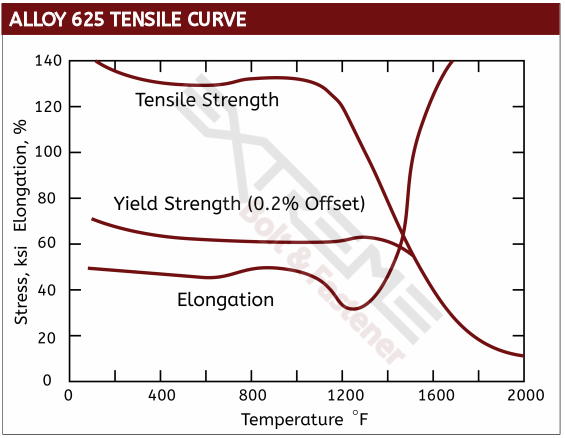
| Room Temp. | 144.0 | 84.0 | 44.0 |
| 400 | 134.0 | 66.0 | 45.0 |
| 600 | 132.0 | 63.0 | 42.5 |
| 800 | 132.0 | 61.0 | 45.0 |
| 1000 | 130.0 | 61.0 | 48.0 |
| 1200 | 119.0 | 60.0 | 34.0 |
| 1400 | 78.0 | 59.0 | 59.0 |
| 1600 | 40.0 | 39.0 | 117.0 |
| Temperature (°F) | Ultimate Tensile (ksi) | Yield Strength 0.2% Offset (ksi) | Elongation % |
|---|---|---|---|
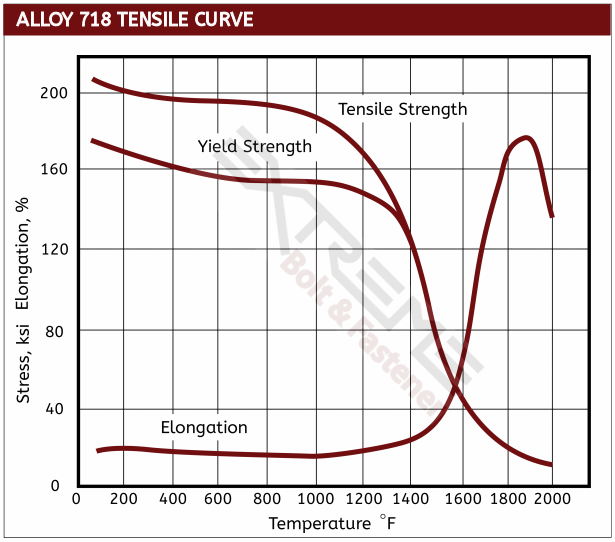
| Room Temp. | 210.0 | 175.0 | 22.0 |
| 400 | 198.0 | 163.0 | 20.0 |
| 800 | 191.0 | 156.0 | 19.0 |
| 1000 | 185.0 | 155.0 | 18.0 |
| 1200 | 168.0 | 149.0 | 19.0 |
| 1400 | 111.0 | 110.0 | 27.0 |
| Ultimate Tensile Strength (Min KSI) | Specification |
|---|---|
| 185 | AMS 5662 / 5663 ASTM B637 |
| 220 | AMS 5962 |
 |
 |
| Nominal Designation | Forgings | Castings | Plates | ||||
|---|---|---|---|---|---|---|---|
| 54Ni 16Mo 15Cr | B462 Gr. N10276 | ... | B575 Gr. N10276 (1), (2) | ||||
| 60Ni 22Cr 9Mo 3.5Cb | B564 Gr. N06625 | ... | B443 Gr. N06625 (3), (5) | ||||
| 42Ni 21.5Cr 3Mo 2.3Cu | B564 Gr. N08825 | B424 Gr. N08825 (3),(7) | |||||
| Working Pressures by Classes, psig | |||||||
| Temp., F | 150 | 300 | 400 | 600 | 900 | 1500 | 2500 |
| 20 to 100 | 290 | 750 | 1000 | 1500 | 2250 | 3750 | 6250 |
| 200 | 260 | 750 | 1000 | 1500 | 2250 | 3750 | 6250 |
| 300 | 230 | 730 | 970 | 1455 | 2185 | 3640 | 6070 |
| 400 | 200 | 700 | 930 | 1395 | 2095 | 3490 | 5820 |
| 500 | 170 | 665 | 885 | 1330 | 1995 | 3325 | 5540 |
| 600 | 140 | 605 | 805 | 1210 | 1815 | 3025 | 5040 |
| 650 | 125 | 590 | 785 | 1175 | 1765 | 2940 | 4905 |
| 700 | 110 | 570 | 755 | 1135 | 1705 | 2840 | 4730 |
| 750 | 95 | 530 | 710 | 1065 | 1595 | 2660 | 4430 |
| 800 | 80 | 510 | 675 | 1015 | 1525 | 2540 | 4230 |
| 850 | 65 | 485 | 650 | 975 | 1460 | 2435 | 4060 |
| 900 | 50 | 450 | 600 | 900 | 1350 | 2245 | 3745 |
| 950 | 35 | 385 | 515 | 775 | 1160 | 1930 | 3220 |
| 1000 | 20 | 365 | 485 | 725 | 1090 | 1820 | 3030 |
| 1050 | ... | 360 | 480 | 720 | 1080 | 1800 | 3000 |
| 1100 | ... | 325 | 430 | 645 | 965 | 1610 | 2685 |
| 1150 | ... | 275 | 365 | 550 | 825 | 1370 | 2285 |
| 1200 | ... | 205 | 275 | 410 | 615 | 1030 | 1715 |
| 1250 | ... | 165 | 220 | 330 | 495 | 825 | 1370 |
| 1300 | ... | 120 | 160 | 240 | 360 | 600 | 1000 |
| Media | Concentration, Percent By Weight | Test Temperature °F (°C) | Average Corrosion Rate Per Year, mils* | |||
|---|---|---|---|---|---|---|
| 625 alloy | C-22® alloy | C-276 alloy | G-30® alloy | |||
| Acetic Acid | 99 | Boiling | <1 | Nil | <1 | 1 |
| Ferric Chloride | 10 | Boiling | 7325 | 1 | 2 | -- |
| Formic Acid | 88 | Boiling | 9 | <1 | 1 | 2 |
| Hydrochloric Acid | 1 | Boiling | 1 | 3 | 13 | 1 |
| 1.5 | Boiling | 353 | 14 | 32 | -- | |
| 2 | 194 (90) | Nil | Nil | 1 | -- | |
| 2 | Boiling | 557 | 61 | 51 | -- | |
| 2.5 | 194 (90) | 72 | <1 | 12 | -- | |
| 2.5 | Boiling | 605 | 141 | 85 | -- | |
| 10 | Boiling | 642 | 400 | 288 | 2364 | |
| Hydrochloric Acid + 42 g/l Fe2(SO4)3 | 1 | 200 (93) | 238 | 2 | 41 | 803 |
| 5 | 150 (66) | 2 | 2 | 5 | 557 | |
| Hydrochloric Acid + 2% HF | 5 | 158 (70) | 123 | 59 | 26 | 97 |
| Hydrofluoric Acid | 2 | 158 (70) | 20 | 9 | 9 | 10 |
| 5 | 158 (70) | 16 | 14 | 10 | 11 | |
| P2O5 (Commercial Grade) | 39 | 185 (85) | 1 | 2 | 9 | -- |
| 44 | 240 (116) | 23 | 21 | 100 | -- | |
| 52 | 240 (116) | 12 | 11 | 33 | -- | |
| P2O5 + 2000 ppm Cl | 38 | 185 (85) | 2 | 1 | 12 | -- |
| P2O5 + 0.5% HF | 38 | 185 (85) | 9 | 7 | 45 | -- |
| Nitric Acid | 10 | Boiling | <1 | <1 | 7 | <1 |
| 65 | Boiling | 21 | 134 | 888 | 5 | |
| Nitric Acid + 6% HF | 5 | 140 (60) | 73 | 67 | 207 | -- |
| Nitric Acid + 25% H2SO4 + 4% NaCl | 5 | Boiling | 713 | 12 | 64 | -- |
| Nitric Acid + 1% HCl | 5 | Boiling | 1 | <1 | 8 | -- |
| Nitric Acid + 2.5% HCl | 5 | Boiling | <1 | 2 | 21 | -- |
| Nitric Acid + 15.8% HCl | 8.8 | 126 (52) | >10,000 | 4 | 33 | 14 |
| Sulfuric Acid | 10 | Boiling | 37 | 12 | 19 | 31 |
| 20 | 150 (66) | <1 | <1 | <1 | -- | |
| 20 | 174 (79) | <1 | 1 | 3 | <1 | |
| 20 | Boiling | 91 | 33 | 39 | 54 | |
| 30 | 150 (66) | <1 | <1 | 1 | <1 | |
| 30 | 174 (79) | <1 | 3 | 4 | <1 | |
| 30 | Boiling | 227 | 64 | 55 | 60 | |
| 40 | 100 (38) | <1 | <1 | <1 | <1 | |
| Sulfuric Acid | 40 | 150 (66) | 1 | <1 | 1 | <1 |
| 40 | 174 (79) | 35 | 9 | 10 | 2 | |
| 50 | 100 (38) | 1 | <1 | Nil | <1 | |
| 50 | 150 (66) | 25 | 1 | 4 | <1 | |
| 50 | 174 (79) | 58 | 16 | 12 | 10 | |
| 60 | 100 (38) | <1 | <1 | <1 | <1 | |
| 70 | 100 (38) | <1 | Nil | Nil | <1 | |
| 80 | 100 (38) | <1 | Nil | <1 | -- | |
| Sulfuric Acid + 0.1% HCl | 5 | Boiling | 151 | 26 | 33 | -- |
| Sulfuric Acid + 0.5% HCl | 5 | Boiling | 434 | 61 | 49 | -- |
| Sulfuric Acid + 1% HCl | 10 | 158 (70) | 121 | <1 | 11 | -- |
| 10 | 194 (90) | 326 | 94 | 45 | -- | |
| 10 | Boiling | 869 | 225 | 116 | -- | |
| Sulfuric Acid + 2% HF | 10 | Boiling | 55 | 29 | 22 | 53 |
| Sulfuric Acid + 200 ppm Cl- | 25 | 158 (70) | 110 | 11 | 12 | -- |
| 25 | Boiling | 325 | 215 | 186 | 101 | |
| Sulfuric Acid +1.2% HCl + 1% FeCl3 + 1% CuCl2 | 11 | Boiling | 1815 | 3 | 42 | 1227 |
| Sulfuric Acid +1.2% HCl + 1% FeCl3 + 1% CuCl2 (ASTM G28B) | 23 | Boiling | 2721 | 8 | 55 | -- |
| Sulfuric Acid +42 g/l Fe2(SO4)3 (ASTM G28B) | 50 | Boiling | 23 | 40 | 250 | 7 |
*To convert mils per year (mpy) to mm per year, divide by 40 | ||||||
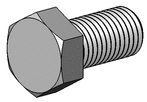
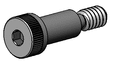
Inconel fastener styles
Inconel Screws


Inconel Bolts


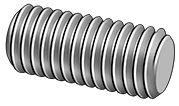
Inconel Studs & Threaded Rods

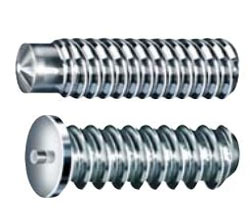
Inconel Washers


Inconel - Frequently Asked Questions
Answers from our engineers, drawn from the Inconel technical questions we're asked most.
Uses for Hastelloy & Inconel Bolts
<p <strong What are Hastelloy C276 and Inconel 625, and what are they typically used for?</strong </p <p Both Hastelloy bolts and <a href="/materials/inconel" Inconel 625 bolts</a are made of nickel alloys designed for extreme industrial environments. In brief comparison, <a href="/materials/hastelloy" C276 bolts</a offer improved corrosion resistance over Inconel 625 bolts in <a href="/applications/corrosion" harsh acids</a and <a href="/applications/corrosion/salt-water-sea-water-corrosion" saltwater</a . Inconel 625 bolts provide <a href="/applications/high-strength" higher strength</a and increased temperature resistance compared to <a href="/materials/hastelloy" Hastelloy</a .</p
Is Hastelloy Better than Inconel in Acids
<p <strong Are Hastelloy C276 bolts a better choice than Inconel 625 bolts in severe acid situations?</strong </p <p Yes, <a href="/materials/hastelloy" Hastelloy C276 bolts</a perform far better than <a href="/materials/inconel" Inconel 625</a in harsh acids. Hastelloy was specifically designed for this type of service. Due to its higher molybdenum, C276 fasteners offer excellent resistance to <a href="/applications/corrosion" acid environments</a . For example, in some <a href="/applications/corrosion/hydrochloric-acid-corrosion" hydrochloric acid</a temperatures and concentrations, <a href="/materials/inconel" Inconel 625 bolts</a corrode rapidly, while C276 barely reacts. Another example is <a href="/corrosion/sulfuric-acid-corrosion" sulfuric acid</a where <a href="/materials/hastelloy" C276 bolts</a consistently outlast Inconel 625 fasteners; in some situations, Inconel can corrode over 10 times faster.</p
Hastelloy C276 Bolts Offer Better Corrosion Resistance Than Inconel
<p <strong Why are C276 bolts more resistant to harsh acids and chemicals than Inconel 625 bolts? Aren’t they both nickel alloys?</strong </p <p Yes, both <a href="/materials/hastelloy" C276</a and <a href="/materials/Inconel" Inconel 625</a are nickel alloys. Though nickel composition is critical to corrosion resistance, other metals also play a role. <a href="/materials/hastelloy" Hastelloy fasteners</a have a higher level of molybdenum which is important in preventing localized corrosion and corrosion in strong acids.</p
Comparing Inconel 601 and 625
<p Inconel 601 and 625 are both seemingly similar nickel alloys for extreme temperature applications – so how do you choose which is best for your application. Let’s look at the distinct capabilities of these two Inconel grades. </p <p <strong <img src=" alt="high temp symbol small" width="137" height="141" data-align="left" / High Temperature Focus: Inconel 601<br / </strong For applications that focus solely on high temperatures – especially severe thermal cycling, <a href="/materials/inconel inconel601" Inconel 601 fasteners</a are ideal. Not only do they have a higher usable temperature limit than <a href="/materials/inconel inconel625" grade 625</a , but <a href="/materials/inconel inconel601" Inconel 601</a can withstand extreme cyclic thermal conditions as well as long-term service exposure.</p <p </p <p <strong <img src=" alt="oxidation symbol small" width="137" height="143" data-align="left" / Oxidation, Scaling & Spalling: Inconel 601</strong <br / Inconel 601 fasteners were specifically engineered for high temperature concerns. They offer exceptional oxidation and scaling resistance, even in applications with extreme thermal cycling environments. <a href="/materials/inconel inconel601" Grade 601</a also provides excellent resistance to spalling (the flaking, peeling or cracking of a material’s surface layer) that can occur in excessive heat.</p <p </p <p <strong <img src=" alt="corrosion symbol small" width="140" height="141" data-align="left" / Corrosion Resistance and Strength: Inconel 625</strong <br / The most unique attribute of <a href="/materials/inconel inconel625" Inconel 625 bolts</a is their ability to provide both strength <em <strong and </strong </em corrosion resistance in high temperature. Though they don’t offer the resistance of Hastelloy C276, <a href="/materials/inconel inconel625" alloy 625</a is significantly stronger at elevated temps and still can be used in many hot corrosive applications. Also, 625 bolts are able to retain excellent mechanical and creep properties over time at elevated temperatures.</p <p </p
C276 vs Inconel 625: Which is best?
When comparing Hastelloy C276and Inconel 625 fasteners, there is no single “winner.” The right choice depends entirely on the unique demands of your application. In this newsletter, we break down the key differences between these high-performance nickel-alloy fasteners and identify when each should be your material of choice. Corrosion Resistance: Advantage Hastelloy C276
If aggressive chemicals are your primary concern, Hastelloy C276 bolts have a clear edge over Inconel 625. Hastelloy fasteners offer improved resistance to Inconel in both hydrochloric and sulfuric acid. C276 is also renowned for its sour gas service, as well protection from many other harsh acids. High-Temperature: Advantage Inconel 625 Inconel 625 bolts offer superior heat resistance, withstanding temperatures up to 1800°F, whereas Hastelloy bolts max out around 1500°F. Inconel bolts also exhibit high temperature oxidation resistance. Mechanical Strength: Advantage Inconel 625
In terms of strength, Inconel 625 bolts far exceed the capabilities of Hastelloy. Inconel 625 offers 144 kis ultimate tensile strength (UTS), verses Hastelloy’s 107 ksi UTS. In addition, alloy 625 fasteners provide high creep-rupture strength.
C276 Bolts Compared to Inconel 625 Bolts in Acids
Q: Why are C276 bolts more resistant to harsh acids and chemicals than Inconel 625 bolts? Aren’t they both nickel alloys?
A: Yes, both C276 and Inconel 625 are nickel alloys. Though nickel composition is critical to corrosion resistance, other metals also play a role. Hastelloy fasteners have a higher level of molybdenum which is important in preventing localized corrosion and corrosion in strong acids.
More on Inconel
What our customers say
More customer feedback“I purchased from you specifically because of Jon’s expertise and professionalism.”
“Very impressed; good prices and delivered earlier than lead time given, which was a real bonus.”
“Extreme Bolt is definitely on my go-to list.”