
Tungsten Fasteners - Bolts, Screws & Nuts
Last updated
Ultra-high density & high temperature / strength stability

Need help choosing a material?

- High strength at extreme high temperatures (vacuum)
- Radiopaque to x-rays and other radiation
- Very high density of 19.3 gm/cc
- Mechanical properties of tungsten screws
- Tungsten material datasheet
Tungsten screws are an ideal material for high temperature stability. Their extremely high melting point of 3420°C, makes tungsten fasteners useful for some of the hottest vacuum furnace environments. Another attribute of tungsten is its extreme high density. The high mass of tungsten screws make them radiopaque, allowing them to block radiation and show up well on x-rays – even better than lead. In addition, their high density also makes them ideal for balancing rotating parts. Beyond their high mass and temperature stability, tungsten fasteners are also very corrosion resistant.
Tungsten screws are usually made from tungsten alloys per ASTM B777, and range from 90% to 97% pure tungsten, alloyed with nickel and copper or nickel and iron. Fasteners can also be made from Commercially Pure (CP) Tungsten.
Applications
- The heat treating / furnace industry uses tungsten screws in high temperature vacuum furnaces due to tungstens great high temperature strength & stability.
- The oil & gas industry uses tungsten screws for radiation shielding properties to protect equipment used in oil and gas detection, as well as down hole logging for density and ability to withstand intense hydrostatic pressure
- Tungsten screws also play a role in the medical community for their low magnetic properties as well as their radiopaque properties.
- The aerospace industry depends on the tungsten screws for their combination of high density and mechanical strength which allows them to reduce the physical size of components, offering greater control of weight distribution for propellers, inertial systems and fluid control systems to name a few.
Tungsten Chemistry & Specifications
Tungsten Specifications: ASTM B777, Mil Spec T-21014D
| Tungsten Alloy ASTM-B777 | Class 1 | Class 2 | Class 3 | Class 4 | CP Tungsten |
|---|---|---|---|---|---|
| Material Composition | 90% W 6% Ni 4% Cu | 92.5% W 5.25% Ni 2.25% Fe | 95% W 3.5% Ni 1.5% Cu | 97% W 2.1% Ni 0.9% Fe | 99.95% W |
| Density | 17 gm/cc | 17.5 gm/cc | 18 gm/cc | 18.5 gm/cc | 19.3 gm/cc |
| Mil. Spec. T-21014 D | Class 1 | Class 2 | Class 3 | Class 4 | - |
| Type | Type II & III | Type II & III | Type II & III | Type II & III | - |
| Hardness; Rockwell C | 24.0 | 26.0 | 27.0 | 28.0 | 31.0 |
| Ultimate Tensile Strength; PSI | 94,000 | 110,000 | 94,000 | 100,000 | 142,000 |
| Yield Strength, .2% Offset; PSI | 75,000 | 75,000 | 75,000 | 75,000 | 109,000 |
| Elongation, % in 1” | 2+ | 2+ | 2+ | 2+ | |
| Modulus of Elasticity; PSI | 40 x 10E6 | 47 x 10E6 | 45 x 10E6 | 53 x 10E6 | 58 x 10E6 |
| Coefficient of Thermal Expansion x 10E-6/°C (20°-400°C) | 5.4 | 4.6 | 4.4 | 4.5 | 4.2 |
| Electrical Conductivity; %IACS | 14 | 13 | 16 | 17 | 18 |
Tungsten fastener styles
Tungsten Screws


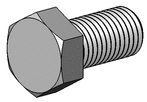
Tungsten Bolts
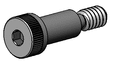
Tungsten Nuts

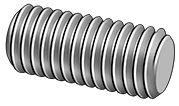
Tungsten Studs & Threaded Rods

Tungsten Washers


Tungsten - Frequently Asked Questions
Answers from our engineers, drawn from the Tungsten technical questions we're asked most.
I’m looking to get some 1/2″ hex head screws that can survive up to 2000C. It is not a vacuum, but it will be in an inert environment.
In regards to ceramics, Zirconia screws would be the only option for these temperatures, but unfortunately a 1/2″ diameter is too large to produce from Zirconia. Probably your best bet in this environment would be a tungsten or tantalum screw. A vacuum or inert environment is fine for for tantalum or tungsten metals at 2000C, as long as there is no oxygen present.
How do I know if a material is magnetic?
Iron is the element that causes magnetism. Therefore, any material/alloy containing iron MAY be magnetic to some extent. However while all stainless steels contain iron, some stainless steels are magnetic, and others are not. The defining factor of magnetism comes down to the steel’s microstructure. Martensitic stainless steels (which have a ferritic microstructure) are magnetic. Austenitic stainless steels contain nickel and are non-magnetic. Metals containing little to no iron are also non-magnetic. These metals/alloys would include titanium, aluminum, Monel, Inconel, and tungsten to name a few. And of course, ceramics and polymers are non-magnetic as well.
I’m working with a high temperature, bi-metallic bolted flange design. The steady state temperature of the flange is 1400 degrees F. The bolt is TZM, which has a lesser CTE than the thru-hole material. I’m looking for a material with a CTE less than TZM to use as a washer under the bolt head that will balance out the overall flange & bolt CTEs, to prevent overstressing the bolt at temperature. Any suggestions?
Probably the best bet is commercially pure tungsten. A Tungsten bolthas a melting point of 3420°C . The high temperature stability of tungsten fasteners make them ideal for some of the hottest vacuum furnace environments and will have a CTE of 4.2 10-6 (m/m-K) as long as they are in an inert or vacuum environment.
I’m looking for a radiopaque material for an xray application. I’ve tried lead but need something that is more intense that could be made into a screw. Is there a material you can suggest?
Tungsten screws are excellent for radiopaque x-ray applications. Tungsten offers a higher density than lead at 19.3 gm/cc and therefore shows up better on x-rays than lead. Depending on what your application requires, you may also consider tantalum fasteners, as tantalum has a density of 16.7gm/cc.
What is the difference between the different grades of tungsten and why would I choice one vs the other?
Tungsten fasteners are available in commercially pure tungsten (Tungsten CP) which is 99.95% pure. This grade offers the highest density, strength and hardness of all the grades. It is also the most costly grade and the most limiting in the styles of fasteners that can be produced. If you don’t need pure tungsten screws for your application, then I would suggest using one of the other grades alloyed tungsten grades which are much easier to fabricate: Classes 1-4, each offers a slightly different density depending on the amount of tungsten it contains. For example, Tungsten class 1 fasteners only have 90% tungsten and are less dense than tungsten class 4 which contains 97% tungsten. The alloyed tungsten grades/classes also offer differing levels of strength. This chart will give you more information on the strength and density offered by each class of tungsten fastener.
I’m looking for a material that is radiopaque. Do you have any suggestions?
Two materials come to mind. First is tantalum. It is often used in medical applications for its radiopacity. Tantalum fasteners are also bio-compatible and extremely corrosion resistant. The second material is tungsten. Tungsten fasteners come in several grades depending on the strength and density needed. Tungsten is extremely dense and radiopaque. It also offers good high strength ranging from 94ksi up to 142 ksi for pure tungsten.
More on Tungsten
What our customers say
More customer feedback“I purchased from you specifically because of Jon’s expertise and professionalism.”
“Very impressed; good prices and delivered earlier than lead time given, which was a real bonus.”
“Extreme Bolt is definitely on my go-to list.”