PTFE Socket Head Cap Screws
Last updated
Outstanding chemical resistance at elevated temperatures

Need help choosing a material?
- Virtually inert to most organics, acids and bases
- Usable up to 260°C / 500°F but weakens significantly
- Excellent electrical insulator
- High purity for sensitive pharmaceutical and food type applications
- Material datasheet for PTFE
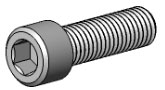
- PTFE socket head cap screw features and benefits
PTFE socket head cap screws are made from the fluoropolymer polytetrafluoroethylene and are known for being exceptionally corrosion resistant and inert at elevated temperatures. PTFE socket head cap screws are inert to most chemical environments including organics, acids, bases, mixed chemicals and hyrdofluoric acid. Additionally PTFE socket head cap screws are bio-inert and will not leach into or contaminate sensitive pharmaceuticals or food based products.
Compared to other high performance polymer socket head cap screws like PEEK or PVDF, PTFE socket head cap screws offer the best all-around corrosion resistance especially at elevated temperatures. However the trade-off for its extraordinary corrosion resistance is the lower tensile strength compared to PVDF or PEEK socket head cap screws.
Screw Types: Flat Head Screws, Hex Cap Screws, Pan Head Screws, Set Screws, Socket Head Cap Screws
PTFE Socket Head Cap Screw Features and Benefits
When it comes to PTFE socket head cap screws, it’s all about clearance. These screws are the best choice for applications with limited installation access or clearance. Yet if you have an application with a lot of debris, you may want to select a PTFE hex head bolt or hex head cap screw, as they don’t have a socket drive which could get clogged.
Advantages:
- Ideal for applications with limited access as they require very little clearance around the fastener.
- Socket head cap screws can be used in locations where externally wrenched fasteners aren't desirable.
- Weight reduction on application as PTFE socket head cap screws are smaller – being that the cylindrical heads of socket screws need less space than hex heads and require no additional wrench space.
- Also known for safety, reliability and economy.
Mechanical Data
 |

PTFE Properties
| Property | ASTM or UL Test | Teflon® PTFE |
|---|---|---|
| PHYSICAL | ||
| Density (lb/in³) (g/cm³) | D792 | 0.078 (2.2) |
| Water Absorption, 24 hrs (%) | D570 | < 0.01 |
| MECHANICAL | ||
| Strength/Weight Ratio | Tensile Strength / Density (g/cc) | 1800 |
| Tensile Strength (psi) | D638 | 3,900 |
| Tensile Modulus (psi) | D638 | 80,000 |
| Tensile Elongation at Break (%) | D638 | 300 |
| Flexural Strength (psi) | D790 | No Break |
| Flexural Modulus (psi) | D790 | 72,000 |
| Hardness, Rockwell, R/M Scale | D785 | R58 |
| IZOD Impact Notched (ft-lb/in) | D256 | 3.5 |
| THERMAL | ||
| Coefficient of Linear Thermal Expansion (x 10-5 in./in./°F) | D696 | 7.5 |
| Heat Deflection Temp (°F / °C) at 264 psi | D648 | 132 / 55 |
| Melting Temp (°F / °C) | D3418 | 635 / 335 |
| Max Operating Temp (°F / °C) | - | 500 / 260 |
| Thermal Conductivity (BTU-in/ft²-hr-°F) | C177 | 1.7 |
| Flammability Rating | UL94 | V-O |
| ELECTRICAL | ||
| Dielectric Strength (V/mil) short time, 1/8" thick | D149 | 600 |
| Dielectric Constant at 1 MHz | D150 | 2.1 |
| Dissipation Factor at 1 MHz | D150 | < 0.0002 |
| Volume Resistivity (ohm-cm) at 50% RH | D257 | > 10¹⁸ |
| APPROVALS | ||
| Approval | FDA | YES |
| Approval | USDA | NO |
| Approval | NSF | NO |
| Approval | 3A DAIRY | NO |
| Approval | USP CLASS VI | Medical Grades Available |