
PFA Flat Head Screws
Last updated
Outstanding chemical resistance at elevated temperatures

Need help choosing a material?
- Virtually inert to most organics, acids and bases
- Usable up to 260°C / 500°F and tougher than PTFE
- Excellent electrical insulator
- High purity for sensitive pharmaceutical and food type applications
- Material datasheet for PFA
- PFA flat head screw features and benefits
PFA flat head screws made from perfluoroalkoxy alkanes (PFAs) are fluoropolymers with properties similar to polytetrafluoroethylene (PTFE). PFA's are known for being exceptionally corrosion resistant and inert at elevated temperatures. PFA screws are inert to most chemical environments including organics, acids, bases, mixed chemicals and hyrdofluoric acid. Additionally PFA flat head screws are bio-inert and will not leach into or contaminate sensitive pharmaceuticals or food based products.
Compared to other high performance polymer screws like PEEK or PVDF, PFA screws offer the best all-around corrosion resistance especially at elevated temperatures. However the trade-off for its extraordinary corrosion resistance is its lower tensile strength compared to PVDF or PEEK flat head screws.
Screw Types: Flat Head Screws, Hex Cap Screws, Pan Head Screws, Set Screws, Socket Head Cap Screws
PFA Flat Head Screw Features and Benefits
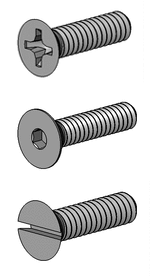
PFA flat head screws are characterized by having a head with a top flat surface (which can feature either a slotted, phillips or allen driver) and bottom that is cone shaped or countersunk. With this design, the head of the screw can align flush or below the surrounding surface having obvious benefits.
PFA Slotted vs. Phillips Driver
| Slotted Head Advantages | Phillips Head Advantages |
|
|
Countersink Angle
For most flat head screw designs the angle of countersink is usually 82° for UNC and UNF applications however other angles ranging from 60° -120° could be specified.
| Thread Type | Normal Flat Head Countersink Angle |
|
UNC / UNF |
82° |
| Aerospace | 100° |
| ISO Metric / Imperial | 90° |
| Temperature (°F) | Ultimate Tensile (ksi) | Yield Strength 0.2% Offset (ksi) | Elongation % |
|---|---|---|---|
| Room Temp. | 3.6 | 2.0 | 300 |
| 480 | 2.0 | - | 480 |
| Property | ASTM or UL Test | Teflon® PFA |
|---|---|---|
| PHYSICAL | ||
| Density (lb/in³) (g/cm³) | D792 | 0.077 (2.14) |
| Water Absorption, 24 hrs (%) | D570 | <0.03 |
| MECHANICAL | ||
| Strength/Weight Ratio | Tensile Strength / Density (g/cc) | 1700 |
| Tensile Strength (psi) | D638 | 3,600 |
| Tensile Modulus (psi) | D638 | 80,000 |
| Tensile Elongation at Break (%) | D638 | 330 |
| Flexural Strength (psi) | D790 | No Break |
| Flexural Modulus (psi) | D790 | 85,000 |
| Hardness, Rockwell, R/M Scale | D785 | R55 |
| IZOD Impact Notched (ft-lb/in) | D256 | No Break |
| THERMAL | ||
| Coefficient of Linear Thermal Expansion (x 10-5 in./in./°F) | D696 | 7.8 |
| Heat Deflection Temp (°F / °C) at 264 psi | D648 | 163 / 73 |
| Melting Temp (°F / °C) | D3418 | 575 / 302 |
| Max Operating Temp (°F / °C) | - | 500 / 260 |
| Thermal Conductivity (BTU-in/ft²-hr-°F) | C177 | 1.4 |
| Flammability Rating | UL94 | V-O |
| ELECTRICAL | ||
| Dielectric Strength (V/mil) short time, 1/8" thick | D149 | 6500 |
| Dielectric Constant at 1 MHz | D150 | 2.03 |
| Dissipation Factor at 1 MHz | D150 | 0.0001 |
| Volume Resistivity (ohm-cm) at 50% RH | D257 | > 10¹⁸ |
| APPROVALS | ||
| Approval | FDA | YES |
| Approval | USDA | NO |
| Approval | NSF | NO |
| Approval | 3A DAIRY | NO |
| Approval | USP CLASS VI | Medical Grades Available |