Salt Water & Sea Water Corrosion
Last updated
Fasteners for salt water and marine environments

Need help choosing a material?
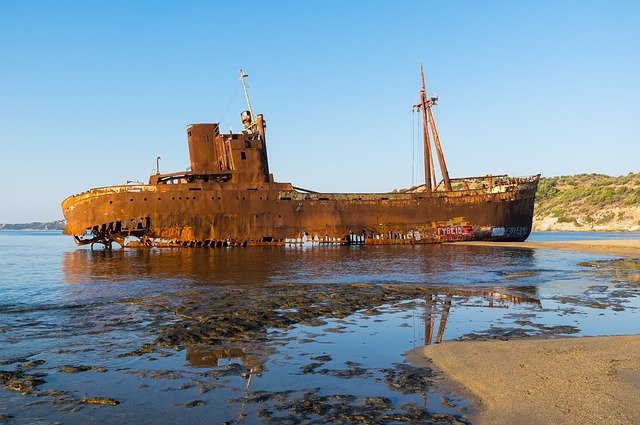
Salt water, whether in a desalination plant or in an offshore oil marine environment, can be very corrosive to many materials. Although most of the specialty metal fasteners we offer will do well to combat sea and salt corrosion there are a few that are very well suited for these environments and stand out. The most common metal fasteners used to combat salt water corrosion are titanium (Grades 2 and Grade 5) and Monel (alloy 400 and K500). While some of the nickel alloys like Hastelloy are resistant to sea water, they are generally overkill.
Common Saltwater Corrosion Resistant Materials:
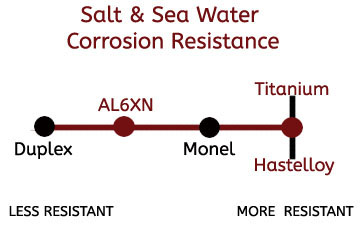
Selecting the best material for a salt water environment also requires you consider several additional variables. Below are how the five most commonly used metals and alloys compare in these instances:
Strength
| Material Strength | Yield Strength (ksi) |
|---|---|
| Titanium Grade 5 | 138 |
| Monel K500 | 110 |
| Super Duplex 2507 | 82 |
| Duplex 2205 | 80 |
| AL-6XN | 53 |
| Titanium Grade 2 | 50 |
| Hastelloy C276 | 49 |
| Monel 400 | 45 |
Chloride
The level of chloride ions in salt water, also referred to as salinity, is one of the most aggressive causes of seawater corrosion. Many things affect the salinity including evaporation (increasing saline levels), precipitation (decreasing), and dilution (decreasing). The chlorides can also increase pitting corrosion in stagnant water. Titanium fasteners offer superior resistance to chloride and chlorine solutions as they fully resistant to chlorides, hypochlorites, chlorates, perchlorates and chlorine dioxide. Duplex steels also offer good corrosion protection to chlorides, including high resistance to chloride stress corrosion cracking, as well as pitting and crevice corrosion.
Temperature
Seawater temperature varies greatly from 28.4°F at the poles, up to 95°F in the tropics. As for any type of water, the warmer it is, the higher the fastener corrosion due to the fact that heat enables the oxide reaction. As a result, applications where there are hot engines, processes or locations in tropical areas will see a higher rates of corrosion.
Water Velocity
The speed and movement of sea water can also affect the corrosion resistant ability of a material. In terms of high velocity marine environments, titanium is nearly resistant to any erosion even up to a velocity of 120 ft./sec, as well as stagnant water. Like Titanium, Monel is extraordinarily resistant to rapidly flowing seawater, yet in contrast it can experience pitting and cracking if the saltwater is stagnant. For additional information on salt water corrosion, visit our blog post or contact one of our engineering staff for their expert insight.