Titanium Grade 5 Fasteners & Flanges
Last updated
Grade 5 (3.7165): Lightweight strength that is 2x stronger than Grade 2

Need help choosing a material?

Unlike Grade 2 which is a commercially pure titanium, Grade 5 (3.7165) is a titanium alpha-beta alloy, which includes 6% aluminum (alpha stabilizer) and 4% vanadium (beta stabilizer). Also known as Ti 6Al-4V, Titanium Grade 5 is the most commonly used form of titanium, accounting for 50% of titanium worldwide. Though it offers slightly less corrosion resistance than unalloyed Grade 2, Titanium Grade 5 fasteners are critical because of their superior strength-to-weight ratio being 4 times stronger than 316 stainless steel at nearly half the weight. Compared to Grade 2,Titanium Grade 5 is about 2x stronger. In addition to its strength benefits over commercially pure grades, it also provides about 60% lower thermal conductivity. Learn more about titanium grade 5 chemistry and specifications.
Key Benefits of Titanium Grade 5 Fasteners:
- Exceptional strength-to-weight ratio: making it both light weight and strong
- Extremely corrosion resistance to salt water as well as almost all chlorides
- Non-toxic, biocompatibility and osteointegration
Charts and Data:
Salt Water Corrosion Resistance
Titanium Grade 5 fasteners offer exceptional corrosion resistance to sea water due to their oxide layer (TiO2), also called a passive layer which protects it from corrosion and forms spontaneously upon exposure to oxygen.
Because of these properties Titanium has for many years been a gold standard for salt water corrosion resistance, as it is unaffected by most marine environments including tide, splash, atmosphere and currents. Titanium is resistant to seawater up to 500F (260C) and has been shown to last almost two decades in tests of polluted seawater. In addition, Titanium Grade 5 fasteners have shown no signs of pitting and crevice corrosion even when one mile below the surface or when marine deposits form on the surface. In terms of high velocity marine environments, titanium is practically completely resistant to any erosion even up to a velocity of 120 ft./sec.
General Corrosion Resistance
In addition to salt water protection, Titanium Grade 5 also resists attack by pure hydrocarbons, and most chlorinated and fluorinated hydrocarbons provided that there is no acid contamination. Titanium fasteners are also unique among metals in the chemical processing industry for handling wet chlorine gas and chlorine compounds in aqueous solutions. Titanium fasteners are also fully resistant to solutions of chlorides, hypochlorites, chlorates, perchlorates and chlorine dioxide. As a result titanium fasteners are often using within the chlorine related industries such as pulp and paper and chlor-alkali / bleach.
Though Titanium Grade 5 fasteners offer excellent resistance to sea water corrosion, they are not a good fit for corrosive applications such as hydrofluoric, hydrochloric, sulfuric and phosphoric acids, which cause the breakdown of the protective oxide layer.
Titanium Grade 5 in Medical
Titanium Grade 5 (6AL4V) fasteners play a huge role in the medical field including orthopedic and dental implants, prosthetics, spinal components, and surgical instrumentation to name a few. This is due to the unique properties of this alloy.
First, Titanium Grade 5 is non-toxic and biocompatible – it is not rejected but harmonizing with the human body. Not only is able to fight off the corrosion of all body fluids, but it actually possesses a rare trait called osseointegration where the body’s natural bone and tissue actually bond to it. This feature allows Titanium Grade 5 medical implants to be firmly anchored and integrated into the body. It is also light weight and super strong – resisting fracture – which is also important to bone use. Titanium Grade 5 fasteners also give the medical community a material that has flexibility and elasticity simliar to human bone. Finally, Titanium Grade 5 fasteners are non-ferromagnetic, which allows patients with titanium medical components to be safely examined using MRIs and NMRIs.
Mechanical Properties
Tensile Strength: 145 ksi
Yield Strength: 138 ksi
Thermal Conductivity: 46.5 BTU-in/h-ft-°F
Elongation: 14%
Density: 4.43 g/cm³ (0.163 lbs/in³)
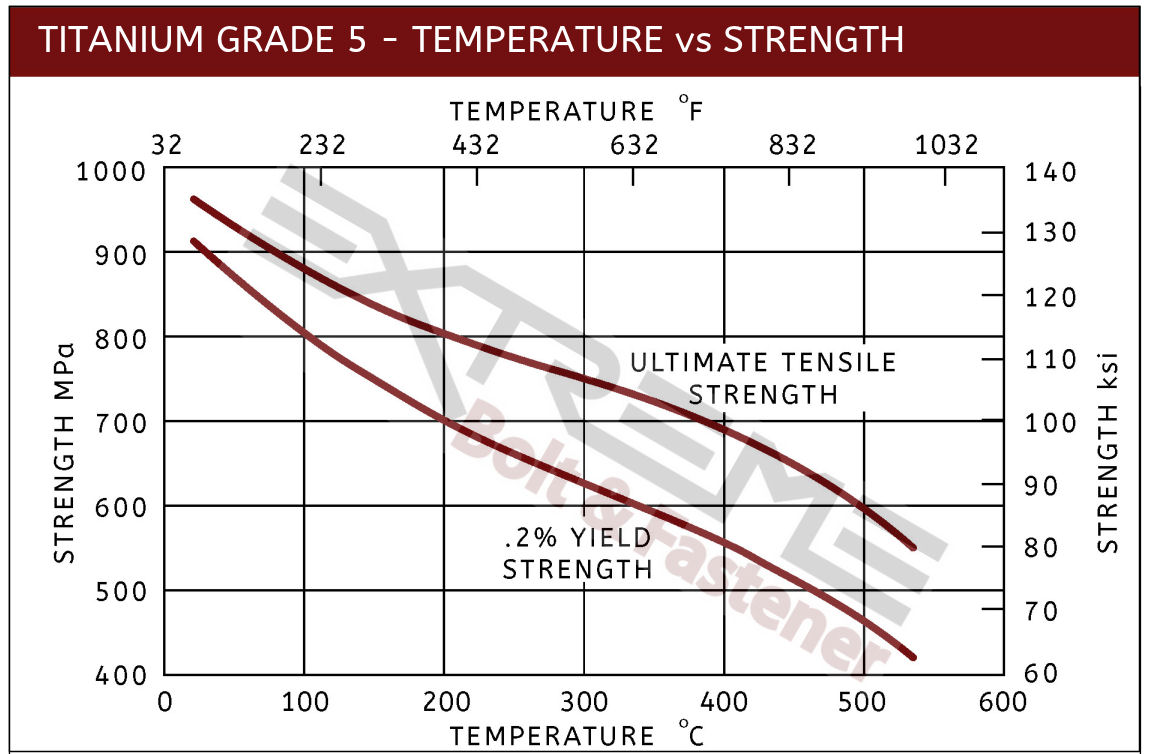
Usable temperature limits of approximately 660°F / 350°C
Applications
- Aerospace relies on Titanium grade 5 for aircraft turbines, engine parts and aircraft structural components.
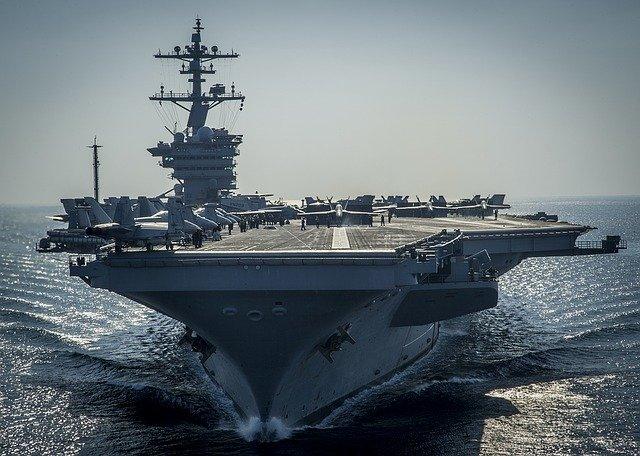
- Marine applications are a common place for Titanium Grade 5 due to its salt water corrosion resistance and light weight strength.
- Sports equipment and high performance automobiles use Titanium Grade 5 fasteners for their lightweight strength.
- Medical applications such as dental implants and bone replacements look to Titanium Grade 5 fasteners for their osseointegration and non-ferromagnetic properties, strength and biocompatibility.
Datasheets: Titanium Grade 2 and Titanium Grade 5
Flange Types Available: Blind Flanges, Lap Joint Flanges, Slip On Flanges, Socket Weld Flanges, Threaded Flanges, Weld Neck Flanges
Titanium Grade 5 Chemistry & Specifications
Known as the “workhorse” of the titanium alloys, Ti 6Al-4V, or Grade 5 titanium, is 2x stronger than titanium grade 2. This alloy offers high strength and light weight, useful formability and high corrosion resistance. Ti 6AI-4V finds many uses in the aerospace, medical, marine and chemical processing industries.
Titanium Grade 5 Specifications: ASTM - B265, B348, B381, B861, F467 and F468, AMS - 4911, 4928, 4935, 4965 and 4967, MIL-T - 9046 and - 9047, Werkstoff 3.7165
| Titanium Grade 5 | Ti | Al | V | Fe | O | C | N | H |
|---|---|---|---|---|---|---|---|---|
| Min % | - | 5.5 | 3.5 | - | - | - | - | - |
| Max % | Bal | 6.75 | 4.50 | 0.30 | 0.20 | 0.08 | 0.05 | 0.0150 |
| Temperature (°F) | Ultimate Tensile (ksi) | Yield Strength 0.2% Offset (ksi) | Elongation % |
|---|---|---|---|
| Room Temp. | 70 | 50 | 28 |
| 212 | 56 | 37 | 31 |
| 392 | 41 | 28 | 37 |
| 572 | 33 | 18 | 43 |
| 752 | 27 | 13 | 38 |
| 842 | 26 | 11 | 34 |
| Temperature (°F) | Ultimate Tensile (ksi) | Yield Strength 0.2% Offset (ksi) | Elongation % |
|---|---|---|---|
| Room Temp. | 138 | 128 | 14 |
| 300 | 121 | 105 | 16 |
| 500 | 110 | 93 | 17 |
| 700 | 100 | 82 | 18 |
| Temperature (°F) | Ultimate Tensile (ksi) | Yield Strength 0.2% Offset (ksi) | Elongation % |
|---|---|---|---|
| Room Temp. | 50 | 40 | 20 |
| 200 | 57 | 40 | 28 |
| 400 | 41 | 24 | 41 |
| 600 | 32 | 15 | 38 |
| Media | Temperature °F | Corrosion Rate mpy (mm/y) |
|---|---|---|
| Wet Chlorine | 50-190 | Nil - 0.02 (0.001) |
| Water Saturated, Chlorine Cell Gas | 190 | 0.065 (0.002) |
| Dry Chlorine | 86 | Rapid Attack, Ignition |
| Chloride | Concentration % | Temperature °F (°C) | Corrosion Rate mpy (mm/y) |
|---|---|---|---|
| Aluminum chloride | 5-10 | 140 (60) | 0.12 (0.003) |
| 10 | 212 (100) | 0.09 (0.002) | |
| 10 | 302 (150) | 1.3 (0.033) | |
| 20 | 300 (149) | 630 (16.0) | |
| 25 | 68 (20) | 0.04 (0.001) | |
| 25 | 212 (100) | 258 (6.55) | |
| 40 | 250 (121) | 4300 (109.2) | |
| Ammonium chloride | All | 68-212 (20-100) | <0.5 (<0.013) |
| Barium chloride | 5-25 | 212 (100) | <0.01 (<0.000) |
| Calcium chloride | 5 | 212 (100) | 0.02 (0.001) |
| 10 | 212 (100) | 0.3 (0.008) | |
| 20 | 212 (100) | 0.6 (0.015) | |
| 55 | 220 (104) | 0.02 (0.001) | |
| 60 | 300 (149) | <0.01 (<0.000) | |
| 62 | 310 (154) | 2-16 (0.051-0.406) | |
| 73 | 350 (177) | 84 (2.13) | |
| Cupric chloride | 1-20 | 212 (100) | <0.5 (<0.013) |
| 40 | Boiling | 0.2 (0.005) | |
| Cuprous chloride | 50 | 194 (90) | <0.1 (<0.003) |
| Ferric chloride | 1-20 | 70 (21) | Nil |
| 1-40 | Boiling | <0.5 (<0.013) | |
| 50 | Boiling | 0.16 (0.004) | |
| 50 | 302 (150) | <0.7 (<0.018) | |
| Lithium chloride | 50 | 300 (149) | Nil |
| Magnesium chloride | 5 | 212 (100) | 0.03 (0.001) |
| 20 | 212 (100) | 0.4 (0.010) | |
| 50 | 390 (199) | 0.2 (0.005) | |
| Manganous chloride | 5-20 | 212 (100) | Nil |
| Mercuric chloride | 1 | 212 (100) | 0.01 (0.000) |
| 5 | 212 (100) | 0.42 (0.011) | |
| 10 | 212 (100) | 0.04 (0.001) | |
| 55 | 215 (102) | Nil | |
| Nickel chloride | 5-20 | 212 (100) | 0.14 (0.004) |
| Potassium chloride | Saturated | 70 (21) | Nil |
| Saturated | 140 (60) | <0.01 (<0.000) | |
| Stannic chloride | 5 | 212 (100) | 0.12 (0.003) |
| Stannous chloride | Saturated | 70 (21) | Nil |
| Sodium chloride | 3 | Boiling | 0.01 (0.000) |
| 20 | 165 (74) | 0.01 (0.000) | |
| 29 | 230 (110) | 0.01 (0.0003) | |
| Saturated | 70 (21) | Nil | |
| Saturated | Boiling | Nil | |
| Zinc chloride | 20 | 220 (104) | Nil |
| 50 | 302 (150) | Nil | |
| 75 | 392 (200) | 24 (0.610) | |
| 80 | 392 (200) | 8000 (203.2) |