
Alumina Ceramic Fasteners - Bolts, Screws & Nuts
Last updated
A superb combination of corrosion resistance, temperature stability and non-conductivity

Need help choosing a material?

- Exceptional temperature resistance up to 3000°F (1650°C)
- Outstanding corrosion resistance to acids, solvents, salts, and organics
- Excellent electrical & thermal insulator
- High purity
- Alumina ceramic datasheet
Alumina ceramic fasteners are one of the most thermally resistant fasteners available. Due to their outstanding thermal resiustance, alumina ceramic fasteners are geared for the most demanding high temperature applications. Alumina ceramic fasteners also have outstanding corrosion resistance and are highly chemically resistant to acids, solvents, and salts. Additionally, alumina ceramic fasteners find many uses in high voltage applications due to their non-conductive electrical properties.
Alumina ceramic fasteners are available in both metric and standard sizes. Please contact us if you have any questions about the properties or availability of our ceramic fasteners.
Fasteners made from customer specified ceramic grades or custom dimensions are available upon request.
Common Ceramic Grades
Alumina 99.8%
Alumina ceramic or Aluminum oxide (Al203) is the most common grade of alumina ceramics and is designated as being 99.8% pure. Alumina is most known for high temperature stability and has a usable temperature limit of 3000°F (1650°C). Alumin has the greatest balance of economy, mechanical and thermal properties.
Various other compositions of alumina ceramic are available upon request.
Alumina and Zirconia Properties
| Property | ASTM or UL Test | Alumina | Zirconia |
|---|---|---|---|
| PHYSICAL | |||
| Density (lb/in³) (g/cm³) | D792 | 0.141 (3.89) | 0.220 (6.1) |
| Water Absorption, 24 hrs (%) | D570 | 0 | 0 |
| MECHANICAL | |||
| Strength/Weight Ratio | Tensile Strength / Density (g/cc) | 7700 | 12300 |
| Tensile Strength (psi) | D638 | 30,000 | 75,000 |
| Tensile Modulus (psi) | D638 | 43,500,000 | 30,000,000 |
| Tensile Elongation at Break (%) | D638 | 0 | - |
| Flexural Strength (psi) | D790 | 55,000 | 100,000 |
| Flexural Modulus (psi) | D790 | 54,000,000 | - |
| Hardness, Rockwell, R/M Scale | D785 | A88 | A80 |
| IZOD Impact Notched (ft-lb/in) | D256 | - | - |
| THERMAL | |||
| Coefficient of Linear Thermal Expansion (x 10-5 in./in./°F) | D696 | 0.5 | 0.6 |
| Heat Deflection Temp (°F / °C) at 264 psi | D648 | none | none |
| Melting Temp (°F / °C) | D3418 | - | - |
| Max Operating Temp (°F / °C) | - | 3000/1650 | 4350/2400 |
| Thermal Conductivity (BTU-in/ft²-hr-°F) | C177 | 242.0 | 15.0 |
| Flammability Rating | UL94 | non-flammable | non-flammable |
| ELECTRICAL | |||
| Dielectric Strength (V/mil) short time, 1/8" thick | D149 | 230 | 50 |
| Dielectric Constant at 1 MHz | D150 | 10 | 28 |
| Dissipation Factor at 1 MHz | D150 | 0 | - |
| Volume Resistivity (ohm-cm) at 50% RH | D257 | 1x10¹⁴ | > 1012 |
| APPROVALS | |||
| Approval | FDA | YES | - |
| Approval | USDA | NO | - |
| Approval | NSF | NO | - |
| Approval | 3A DAIRY | NO | - |
| Approval | USP CLASS VI | Medical Grades Available | - |

Alumina fastener styles
Alumina Ceramic Screws


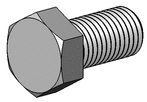
Alumina Ceramic Bolts
Alumina Ceramic Nuts

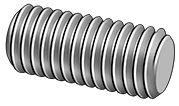
Alumina Ceramic Studs & Threaded Rods

Alumina Ceramic Washers


Alumina Ceramic - Frequently Asked Questions
Answers from our engineers, drawn from the Alumina technical questions we're asked most.
Hi, I’m search to get a 1/4″-20 x 3ft long alumina ceramic rod. Is this something you can make?
For Extreme Bolt & Fastener, 3″ long is the max length we can produce a ceramic bolt, rod or other fastener. As you may know ceramics are brittle, but breakage isn’t the real barrier in creating a ceramic fastener in a longer length.
The real issue is that these parts are molded/fired. Each part must have tooling to make the part to a specific length – tooling is quite costly – often thousands of dollars. We do not have tooling for any rods longer than 3″. Additionally, long lengths of “green” ceramics do not want to stay straight when fired. They will have the propensity to bend and warp. The process is not good for long parts.
Do ceramic fasteners provide strength?
The answer to your question is both yes and no. They provide decent tensile strength similar to some stainless steels(Aluminia bolts has a tensile strength of 30 ksi and Zirconia screws 75 ksi), however they don’t have any yield strength. Due to the fact that they are brittle and lack yield strength, they are susceptible to cracking and fracturing under varying conditions.
We are looking for a non-conductive screw with lower dielectric constant / dissipation factor to replace a steel screw (Tensile Strength 70kpsi) in one of our products.
So were trying to get to similar strength / properties to the steel screw to meet our torque requirements. Will a ceramic screw be a work?
Any polymer or ceramic will have a lower dielectric constant than steel. The question is what other properties do you need. Ceramics will certainly work for an electrically insulating point of view but will be very expensive and brittle. Depending on your application this option has to be evaluated carefully.
Generally speaking a good material to consider would be a PEEK Glass filled material. The carbon filed is electrically conductive so that probably will not work for your application. Glass filled PEEK screws are tough, strong and non-conductive. It will not be as strong as your steel fasteners, having a tensile around 28-30ksi, but if your application could accept that it would be a good choice.
How do ceramic alumina screws compare to steel screws as far as strength goes? The load would most likely be tension, but some compression too.
If you compare 316 Stainless Steel to Zirconia ceramic screws, their tensile strengths are similar (around 75 ksi tensile) with Alumina ceramics being about 1/2 as strong. So you certainly can match the strength of 316 stainless steel with zirconia ceramics in constant compression or tension. However the ceramic screwswill be much more brittle and susceptible to shock so care must be taken in the application.
I need a bolt that can handle high temperatures and be an electric insulator? What can I use?
That depends on what you mean by high temperature and what other issues you have like the strength requirements. If you are talking about temperatures under 500F, then you may consider some engineered polymers. They are non-conductive both electrically and thermally. PEEK is the most economic choice up to about 500F. If you are talking about higher temperatures, then you would have to go with a ceramic like alumina which is an excellent insulatorand resistant to heat well over 2000F
I’m hoping you can help me with a high temperature issue. I’m running an ammonia plant where gases, along with hot air are heated to temps of 1800-2000F. The secondary reformer unit is made of carbon steel with refractory lining. I need bolting that can survive these temps so I tried Moly but its burning up which I don’t understand because I thought molybdenum was for temps to almost 3000F. Help…
Molybdenum can be used to over 2900F but only in a vacuum where oxygen isn’t present, otherwise it will oxidize quickly. For the temperatures you are dealing with in an air-rich environment, I would suggest Inconel 600 which is usable to 2000F in air or a ceramic like alumina which is usable to 3000F.
More on Alumina
What our customers say
More customer feedback“I purchased from you specifically because of Jon’s expertise and professionalism.”
“Very impressed; good prices and delivered earlier than lead time given, which was a real bonus.”
“Extreme Bolt is definitely on my go-to list.”