Titanium Set Screws
Last updated
Unique for its strength, lightness of weight and corrosion resistance

Need help choosing a material?
- Lightweight and high strength
- Corrosion resistant to chlorides, sea water & chlorine
- Excellent mechanical properties
- Titanium grades, chemistry & specifications
- Titanium set screw features and benefits
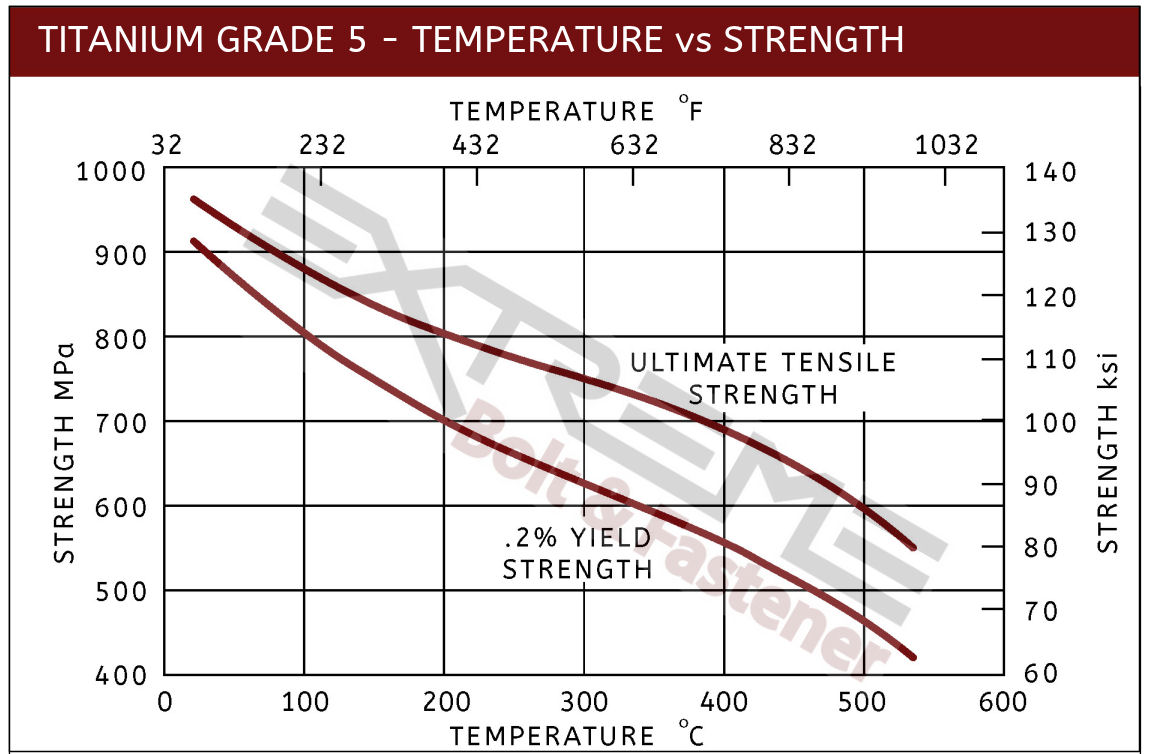
- Temperature vs. strength data
- In-depth information on Grade 2 and Grade 5
Titanium set screws are best known for being strong, lightweight and corrosion resistant. One property that stands out when compared to other metal screws is that titanium screws have the highest strength-to-weight ratio with a density of 4.51 g /cm3. As an example, titanium grade 5 is 4 times stronger than 316 stainless steel at nearly half the weight. This makes titanium set screws ideal for applications that require both lightness of weight and excellent strength such as oil & gas (down-hole), military and sporting goods.
Titanium screws are also unique among metals in the chemical processing industry for handling chlorine (wet) and chlorine compounds in aqueous solutions. Titanium set screws are fully resistant to solutions of chlorides, hypochlorites, chlorates, perchlorates and chlorine dioxide. As a result titanium screws are often using within the chlorine related industries such as pulp and paper and chlor-alkali / bleach.
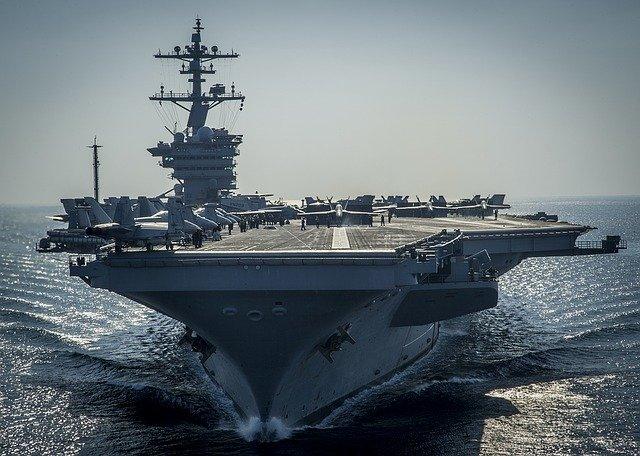
Titanium set screws are also an excellent material to prevent seawater corrosion. Because titanium screws can resists corrosion by seawater up to temperatures as high as 500°F (260°C) as well as survive at ocean depths over a mile below the surface, titanium set screws are used throughout the oil & gas, desalination and marine industries.
The most common grades of Titanium set screws are Grade 2 and Grade 5. Gain more insight on these by accessing our Grade 2 and Grade 5 overviews or by contacting our engineering experts.
Screw Types: 12 Point Screws, Button Head Cap Screws, Flat Head Screws, Hex Head Cap Screws, Pan Head Screws, Set Screws, Socket Head Cap Screws, Tamper Resistant Security Screws, Vented Screws
Titanium Set Screw Features & Benefits
Titanium set screws are unique in that they have no screw head, meaning that they have no protruding part past the threaded shaft. They are thread only and are available with a socket or slotted driver insert at one end. Set screws are used to secure an object within or against another object. Typically they secure a rotating part such as a gear or shaft. Titanium set screws are driven through a threaded hole in the rotating part until it is tight against the inner object, preventing from moving relative to the outer object. Set screws are available with various points depending on the application.
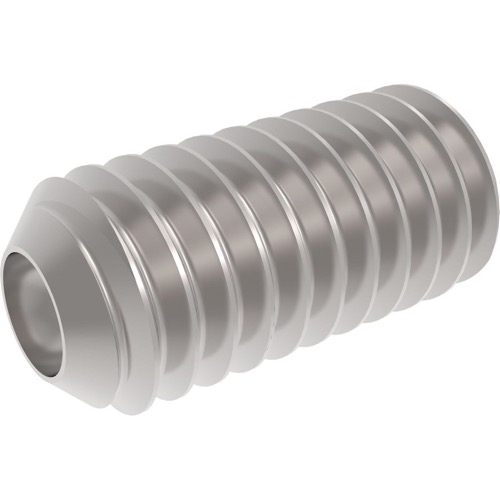
Cup Point
This is the most commonly used set screw and is identified by a cup-shaped indentation on one end. Titanium cup points are typically used for a quick, semi-permanent or permanent applications where it is acceptable to cut the cup point edge of the screw.
Cone Point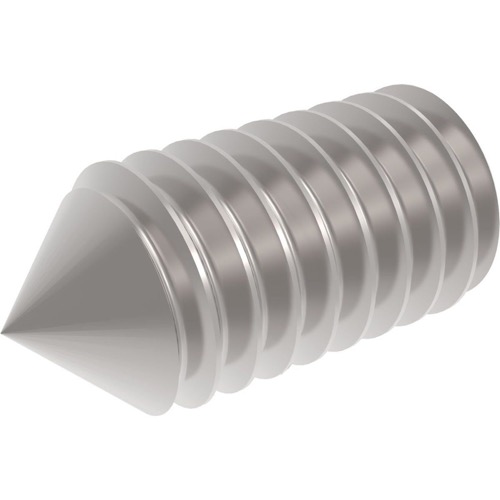
A cone point is easily identifiable by its sharp cone-shaped point – just like an ice cream cone. Titanium cone point set screws deliver the strongest clamping force due to the deep penetration of the point. As a result they are used for permanent assembly.
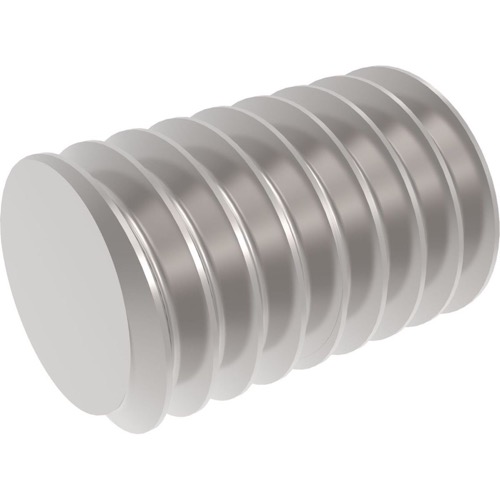 Flat Point
The cheapest and simplest of the set screw point styles, this screw has a flat surface on the bottom of the screw. This type is used when you need the ability to frequently change parts and require minimal shaft deformation.
Titanium Grades, Chemistry & Specifications
Titanium Grade 2 (Commercially Pure)
Unalloyed titanium; Commercially pure titanium is the most common grade of titanium utilized throughout industry due to its ease of availability and good properties.
Titanium Grade 2 Specifications: UNS R50400, ASTM B 348, AMS 4921, ASTM F 67, ISO 5832-2, Werkstoff 3.7035
| Titanium Grade 2 | Ti | Fe | O | C | N | H |
|---|---|---|---|---|---|---|
| Min % | - | - | - | - | - | - |
| Max % | Bal | 0.30 | 0.25 | 0.08 | 0.03 | 0.015 |
Titanium Grade 5 (Ti 6Al-4V)
Known as the “workhorse” of the titanium alloys, Ti 6Al-4V, or Grade 5 titanium, is 2x stronger than titanium grade 2. This alloy offers high strength and light weight, useful formability and high corrosion resistance. Ti 6AI-4V finds many uses in the aerospace, medical, marine and chemical processing industries.
Titanium Grade 5 Specifications: ASTM - B265, B348, B381, B861, F467 and F468, AMS - 4911, 4928, 4935, 4965 and 4967, MIL-T - 9046 and - 9047, Werkstoff 3.7165
| Titanium Grade 5 | Ti | Al | V | Fe | O | C | N | H |
|---|---|---|---|---|---|---|---|---|
| Min % | - | 5.5 | 3.5 | - | - | - | - | - |
| Max % | Bal | 6.75 | 4.50 | 0.30 | 0.20 | 0.08 | 0.05 | 0.0150 |
Titanium Grade 7
Grade 7 is the most corrosion resistant of all titanium alloys and is typically used in chemical processes and production equipment components. Similar to Grade 2, but with the addition of 0.12 to 0.25% palladium, Grade 23 has enhanced corrosion resistance to reducing acids and localized attack in hot halides.
Titanium Grade 7 Specifications: ASTM - B265, B337, B338, B348, B363, B381, B861 and B862, Werkstoff 3.7235
| Titanium Grade 7 | Ti | Fe | Pd | O | C | N | H |
|---|---|---|---|---|---|---|---|
| Min % | - | - | 0.12 | - | - | - | - |
| Max % | Bal | 0.30 | 0.25 | 0.25 | 0.08 | 0.03 | 0.0150 |
Titanium Grade 23 (TI 6AL-4V ELI)
Titanium grade 23 or TI 6AL-4V ELI is an Extra Low Intersticial grade. This grade is similar to Grade 5, but because of the low intersticials, its mechanical properties are enhanced. This ELI grade is often found in more demanding medical device applications as well as industrial applications.
Titanium Grade 23 Specifications:
ASTM - B265, B348, B363, B381, B861, B862 andF136, AMS - 4907, 4930 and 4956
| Titanium Grade 23 | Ti | Al | V | Fe | O | C | N | H |
|---|---|---|---|---|---|---|---|---|
| Min % | - | 5.5 | 3.5 | - | - | - | - | - |
| Max % | Bal | 6.50 | 4.50 | 0.25 | 0.13 | 0.08 | 0.03 | 0.0125 |
| Temperature (°F) | Ultimate Tensile (ksi) | Yield Strength 0.2% Offset (ksi) | Elongation % |
|---|---|---|---|
| Room Temp. | 70 | 50 | 28 |
| 212 | 56 | 37 | 31 |
| 392 | 41 | 28 | 37 |
| 572 | 33 | 18 | 43 |
| 752 | 27 | 13 | 38 |
| 842 | 26 | 11 | 34 |
| Temperature (°F) | Ultimate Tensile (ksi) | Yield Strength 0.2% Offset (ksi) | Elongation % |
|---|---|---|---|
| Room Temp. | 138 | 128 | 14 |
| 300 | 121 | 105 | 16 |
| 500 | 110 | 93 | 17 |
| 700 | 100 | 82 | 18 |
| Temperature (°F) | Ultimate Tensile (ksi) | Yield Strength 0.2% Offset (ksi) | Elongation % |
|---|---|---|---|
| Room Temp. | 50 | 40 | 20 |
| 200 | 57 | 40 | 28 |
| 400 | 41 | 24 | 41 |
| 600 | 32 | 15 | 38 |
| Media | Temperature °F | Corrosion Rate mpy (mm/y) |
|---|---|---|
| Wet Chlorine | 50-190 | Nil - 0.02 (0.001) |
| Water Saturated, Chlorine Cell Gas | 190 | 0.065 (0.002) |
| Dry Chlorine | 86 | Rapid Attack, Ignition |
| Chloride | Concentration % | Temperature °F (°C) | Corrosion Rate mpy (mm/y) |
|---|---|---|---|
| Aluminum chloride | 5-10 | 140 (60) | 0.12 (0.003) |
| 10 | 212 (100) | 0.09 (0.002) | |
| 10 | 302 (150) | 1.3 (0.033) | |
| 20 | 300 (149) | 630 (16.0) | |
| 25 | 68 (20) | 0.04 (0.001) | |
| 25 | 212 (100) | 258 (6.55) | |
| 40 | 250 (121) | 4300 (109.2) | |
| Ammonium chloride | All | 68-212 (20-100) | <0.5 (<0.013) |
| Barium chloride | 5-25 | 212 (100) | <0.01 (<0.000) |
| Calcium chloride | 5 | 212 (100) | 0.02 (0.001) |
| 10 | 212 (100) | 0.3 (0.008) | |
| 20 | 212 (100) | 0.6 (0.015) | |
| 55 | 220 (104) | 0.02 (0.001) | |
| 60 | 300 (149) | <0.01 (<0.000) | |
| 62 | 310 (154) | 2-16 (0.051-0.406) | |
| 73 | 350 (177) | 84 (2.13) | |
| Cupric chloride | 1-20 | 212 (100) | <0.5 (<0.013) |
| 40 | Boiling | 0.2 (0.005) | |
| Cuprous chloride | 50 | 194 (90) | <0.1 (<0.003) |
| Ferric chloride | 1-20 | 70 (21) | Nil |
| 1-40 | Boiling | <0.5 (<0.013) | |
| 50 | Boiling | 0.16 (0.004) | |
| 50 | 302 (150) | <0.7 (<0.018) | |
| Lithium chloride | 50 | 300 (149) | Nil |
| Magnesium chloride | 5 | 212 (100) | 0.03 (0.001) |
| 20 | 212 (100) | 0.4 (0.010) | |
| 50 | 390 (199) | 0.2 (0.005) | |
| Manganous chloride | 5-20 | 212 (100) | Nil |
| Mercuric chloride | 1 | 212 (100) | 0.01 (0.000) |
| 5 | 212 (100) | 0.42 (0.011) | |
| 10 | 212 (100) | 0.04 (0.001) | |
| 55 | 215 (102) | Nil | |
| Nickel chloride | 5-20 | 212 (100) | 0.14 (0.004) |
| Potassium chloride | Saturated | 70 (21) | Nil |
| Saturated | 140 (60) | <0.01 (<0.000) | |
| Stannic chloride | 5 | 212 (100) | 0.12 (0.003) |
| Stannous chloride | Saturated | 70 (21) | Nil |
| Sodium chloride | 3 | Boiling | 0.01 (0.000) |
| 20 | 165 (74) | 0.01 (0.000) | |
| 29 | 230 (110) | 0.01 (0.0003) | |
| Saturated | 70 (21) | Nil | |
| Saturated | Boiling | Nil | |
| Zinc chloride | 20 | 220 (104) | Nil |
| 50 | 302 (150) | Nil | |
| 75 | 392 (200) | 24 (0.610) | |
| 80 | 392 (200) | 8000 (203.2) |