Refractory Metals
Last updated
Unique attributes of corrosion, high temperature and ultra density

Need help choosing a material?
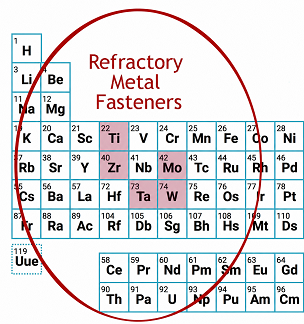
Molybdenum, tantalum, tungsten and zirconium are all classified as refractory metals due to their high temperature melting points and wear resistance. Though all can handle high temperatures, refractory metals should be ONLY used in a vacuum or inert atmosphere when exceeding 500°C as they begin to react, sometimes quickly, with oxygen. By wider definition, Titanium is also considered a refractory.
| Refractory Metal | Temperture limit: Vacuum | Temperture Limit: Air |
|---|---|---|
| Molybdenum | 2912°F (1600°C) | 1112°F (600°C) |
| Zirconium 705 | Same as air | 800°F (426°C) |
| Zirconium 702 | Same as air | 700°F (371°C) |
| Tantalum | 3600°F (2000°C) | 572°F (300°C) |
| Tungsten | 3600°F (2000°C) | 572°F (300°C) |
Molybdenum
Molybdenum bolts offer high temperature stability combined with low coefficient of thermal expansion – so they stay strong without expanding or loosing shape even in extreme heat over repeated cycles. Molybdenum fasteners can handle temperatures up to 2900°F/1600°C in a vacuum environment.
Tantalum
Tantalum fasteners are best known for their corrosion resistance. Tantalum bolts out-perform Hastelloy and zirconium fasteners in the harshest environments like with elevated concentrations and high temperatures of hydrochloric and sulfuric acid. Tantalum is also used for medical devices as it is inert and very compatible with the human body. In addition, it is 50% denser than lead and is radio-opaque. For medical devices this can be important as the tantalum fasteners easily show up on x-rays. Along with these unique characteristics, tantalum fasteners are excellent in high temperature environments as well. In semi-conductor processing tantalum is used in high temperature furnaces as it will not contaminate sensitive electronics.
Titanium
Titanium screws are best known for their unparalleled strength to weight ratio as well as their saltwater and chloride corrosion resistance. Titanium grade 2 is primarily used for marine projects and applications that require resistance to chlorides such as pulp and paper bleaching and water treatment. Titanium grade 5 is 4 times stronger than 316 stainless steel at nearly half the weight. It is used often for high strength, salt water/chloride resistance, and medical applications.
Tungsten
Tungsten’s extreme high density of 19.3 gm/cc (70% denser than lead), as well as its radiopaque attributes provide unique capabilities for weight distribution and balancing, medical devices, as well as vacuum furnace applications.
Zirconium
Though not as resistant as tantalum, Zirconium offers excellent corrosion protection exceeding even Hastelloy in hydrochloric acid. Zirconium fasteners provide excellent corrosion resistance in many acids but will rapidly corrode when exposed to oxidizing media.
Refractory Metals - Frequently Asked Questions
Answers from our engineers, drawn from the Refractory Metals technical questions we're asked most.
Choosing a Refractory Metal Fastener
What is a refractory metal fastener?
Molybdenum, tantalum, tungsten and zirconium are all refractory metals. (We are excluding titanium from this topic although it can be considered a refractory metal by certain definitions). All these refractory metal fasteners are characterized by their high-temperature melting points, but they also have other unique attributes such as corrosion resistance, high density or wear-resistance. Though all can handle high temperatures, refractory metals should be ONLY used in a vacuum or inert atmosphere when exceeding 500°C as they begin to react, sometimes quickly, with oxygen.
Molybdenum Screws: High Temperature Focus Molybdenum bolts offer high temperature stability combined with low coefficient of thermal expansion – so they stay strong without expanding or loosing shape even in extreme heat over repeated cycles. Molybdenum fasteners can handle temperatures up to 2900°F/1600°C, however the must be in a vacuum or inert atmosphere when exceeding 500°C
Tantalum: Extreme Corrosion
There is no better material for corrosion resistance. Tantalum bolts out-perform Hastelloy and zirconium fasteners in the harshest environments like high concentration boiling hydrochloric and sulfuric acid. Being an inert material it also very compatible with the human body.
Although tantalum is most known for its corrosion resistance, tantalum has a very density making 50% denser than lead and is radio-opaque. For medical devices this can be important as the tantalum fasteners easily show up on x-rays.
Tungsten: Density and Weight Tungsten’s extreme high density of 19.3 gm/cc (70% denser than lead), as well as radiopaque attributes provide unique capabilities for weight distribution and balancing, medical devices, as well as vacuum furnace applications.
Zirconium: Excellent Corrosion Resistance
Offering excellent corrosion protection exceed even Hastelloy in hydrochloric acid but not quite as good as tantalum. While zirconium fasteners are very corrosion resistant there are some conditions where zirconium will rapidly corrode when exposed to oxidizing media.
High Temperature Strength: Vacuum vs Air
One important characteristic to note is the differing temperature limits in an oxygen-rich environment compared to a vacuum or inert environment where there is no oxygen. For example, exposing Molybdenum bolts to 1500°F in air will cause it to rapidly oxidize, where in a vacuum it will remain stable and strong.
What our customers say
More customer feedback“I purchased from you specifically because of Jon’s expertise and professionalism.”
“Very impressed; good prices and delivered earlier than lead time given, which was a real bonus.”
“Extreme Bolt is definitely on my go-to list.”