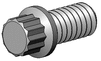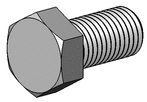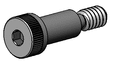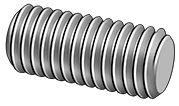
Nickel 200 Screws
Last updated
Ideal for caustic alkali corrosive solutions

Need help choosing a material?

- Excellent corrosion resistance to caustic soda
- Moderate general corrosion resistance
- Chemistry and specifications
- Temperature and Strength Mechanical Data
- Nickel 200 datasheet
Nickel 200 (2.4060) fasteners are made from commercially pure nickel and are best known for their excellent performance in caustic alkali solutions such as caustic soda (NaOH). Nickel 200 also exhibits good performance in acids, especially HF (Hydrofluoric Acid - anhydrous) and hydroxides – but can be attacked by common solutions of hydrochloric or sulfuric acids.
From a mechanical perspective, Nickel 200 bolts have good ductility and low hardness, so they are tough, but not particularly strong (60-85 KSI UTS). See Tensile, Yield & Elongation Chart.
Corrosion
Nickel 200 screws are resistant to corrosive environments, most notably reducing chemicals. They offer outstanding protection to caustic alkaline solutions. However, Nickel 200 fasteners will be severely attacked in oxidizing salt solutions.
Chemical Resistance
- Sodium Hydroxide (NaOH): Excellent resistance to all concentrations of caustic soda.
- Alkalis: Excellent resistance except for ammonium hydroxide.
- Sulfuric acid: Moderate resistance to nonaerated sulfuric acid solutions near room temperature.
- Hydrochloric: Limited resistance in specific environments only.
- Hydrofluoric: Good resistance to anhydrous hydrofluoric acid even at high temperatures. Nickel 200 it has limited resistance to aqueous HF solutions.
- Important: Oxidizing acid chlorides such as ferric, cupric and mercuric are very corrosive to Nickel 200 fasteners.
General
- 60-85 KSI UTS
- 15-45 KSI Yield
- Typically used in application temperatures less than 600⁰F / 315⁰C
Applications
- Most often used in chemical and electronic processing, especially applications that deal with caustic soda.
- High electrical and thermal conductivity, as well as magnetostrictive properties make Nickel 200 screws useful in electrics and sonic devices.
- Nickel 200 bolts are used in salt production and applications that use sodium hydroxide and fluorine.
Nickel 200 Chemistry and Specifications
NICKEL 200 SPECIFICATIONS: UNS N02200, EN 2.4060, EN 2.40666
| Nickel 200 | Ni | Fe | Mn | Si | Cu | C | S |
|---|---|---|---|---|---|---|---|
| 99.0 min | 0.40 max | 0.35 max | 0.35 max | 0.25 max | 0.15 max | 0.01 max |
| Media | Common Name | Temperature °F (°C) | Corrosion Rate (mpy) |
|---|---|---|---|
| 5% CH3CO2H with Air | Accetic Acid | 70 (21) | 40 |
| 10% CH3CO2H | Accetic Acid | 86 (30) | 3.4 |
| 56% CH3CO2H | Accetic Acid | 176 (80) | 66 |
| 85% CH3CO2H with Air | Accetic Acid | 70 (21) | 400 |
| 98% CH3CO2H | Accetic Acid | 241 (116) | 12 |
| 50% NaOH | Caustic Soda | 195 (90) | 0.55 |
| 50% NaOH | Caustic Soda | 310 (155) | 0.5 |
| 75% NaOH | Caustic Soda | 250 (120) | 1 |
| 90% CH2O2 | Formic Acid (liquid) | 70 (21) | 4 |
| 90% CH2O2 | Formic Acid (vapor) | 70 (21) | 7 |
| 1% HCl | Hydrochloric Acid | 214 (101) | 680 |
| 10% HCl | Hydrochloric Acid | 86 (30) | 80 |
| 10% HCl | Hydrochloric Acid | 221 (105) | 8,000 |
| 10% HNO3 | Nitric Acid | 216 (102) | 12,000 |
| 10% H3PO4 | Phosphoric Acid | 75 (24) | 0.6 |
| 10% H3PO4 | Phosphoric Acid | 214 (101) | 154 |
| 40% H3PO4 | Phosphoric Acid | 75 (24) | 1 |
| 500ppm NaClO | Sodium Hypochlorite | 77 (25) | 0.8 |
| 2% H2SO4 | Sulfuric Acid | 70 (21) | 2 |
| 5% H2SO4 | Sulfuric Acid | 140 (60) | 10 |
| 5% H2SO4 with Air | Sulfuric Acid | 86 (30) | 61 |
| 19% H2SO4 | Sulfuric Acid | 223 (106) | 110 |
| 20% H2SO4 | Sulfuric Acid | 70 (21) | 4 |
| 50% H2SO4 with Air | Sulfuric Acid | 86 (30) | 16 |
| 50% H2SO4 | Sulfuric Acid | 255 (124) | 1,000 |
| 93% H2SO4 with Air | Sulfuric Acid | 86 (30) | 10 |