
Monel Socket Weld Flanges
Last updated
A Ni-Cu alloy with high strength and good corrosion resistance

Need help choosing a material?
- Excellent resistance to hydrofluoric acid
- Excellent resistance to sea water for marine applications
- Usable in cryogenic temperatures
- High strength metal with good toughness at high temperatures
- In-depth information on grades 400 and K500
- Datasheets available for Monel 400 and Monel K500
- Socket weld flange features and benefits
Strength & Saltwater Resistance
Monel® socket head cap screws are made from a nickel-copper alloy that exhibits high strength, toughness and good corrosion resistance. Renowned for the saltwater corrosion resistance, Monel is the go-to material by the navy. It is often used in many other marine applications for its combination of high strength and seawater resistance. Monel screws are even resistant to rapid moving seawater and will last many years in saltwater conditions.
Strength and Toughness from Cryogenic to 1000°F
Monel socket head cap screws offer excellent mechanical properties over a wide temperature range from cryogenic up to 1000°F. In US Navy tear tests at temperatures as low as -320°F, Monel 400 has displayed excellent ductility and toughness. In fact, it has shown little decrease in impact resistance when tested on plates at liquid-hydrogen and liquid-helium temperatures.
Monel K500 is an age hardened alloy, known for extreme strength even at high temps. But it is also excellent for cryogenic service. Monel K500's tensile and yield strength increase - with little or no change to ductility and toughness - even at the temperature of liquid hydrogen.
Excellent Resistance to Hydrofluoric Acid
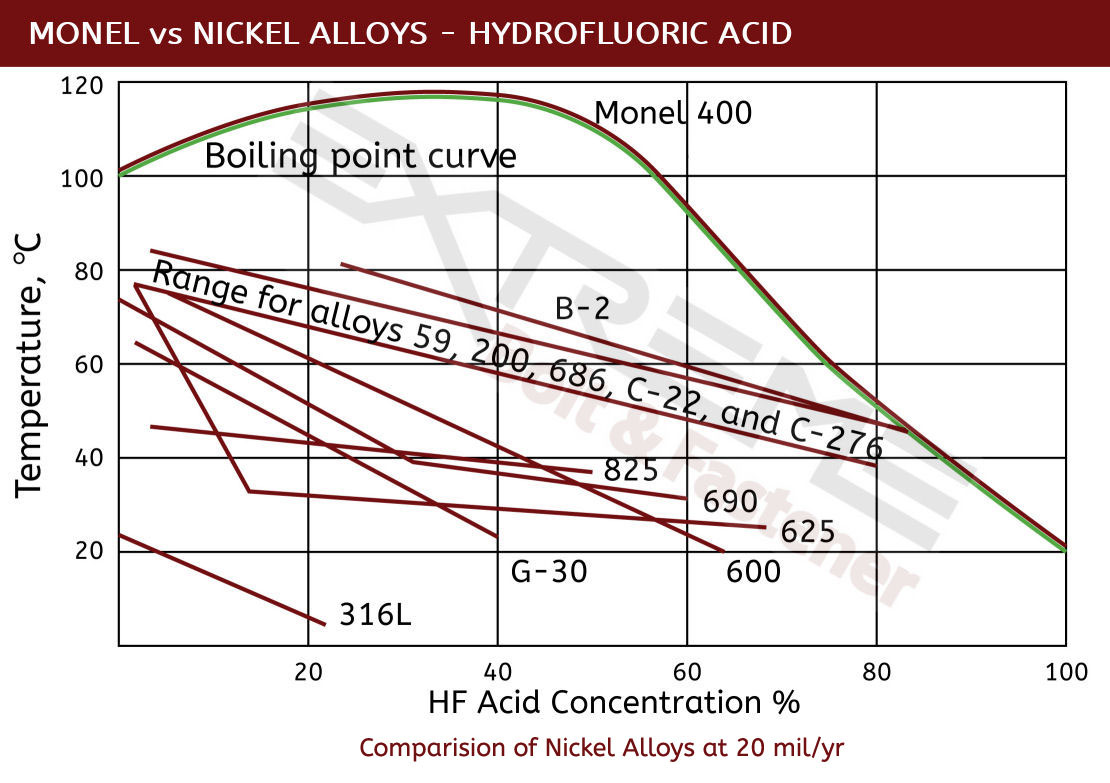
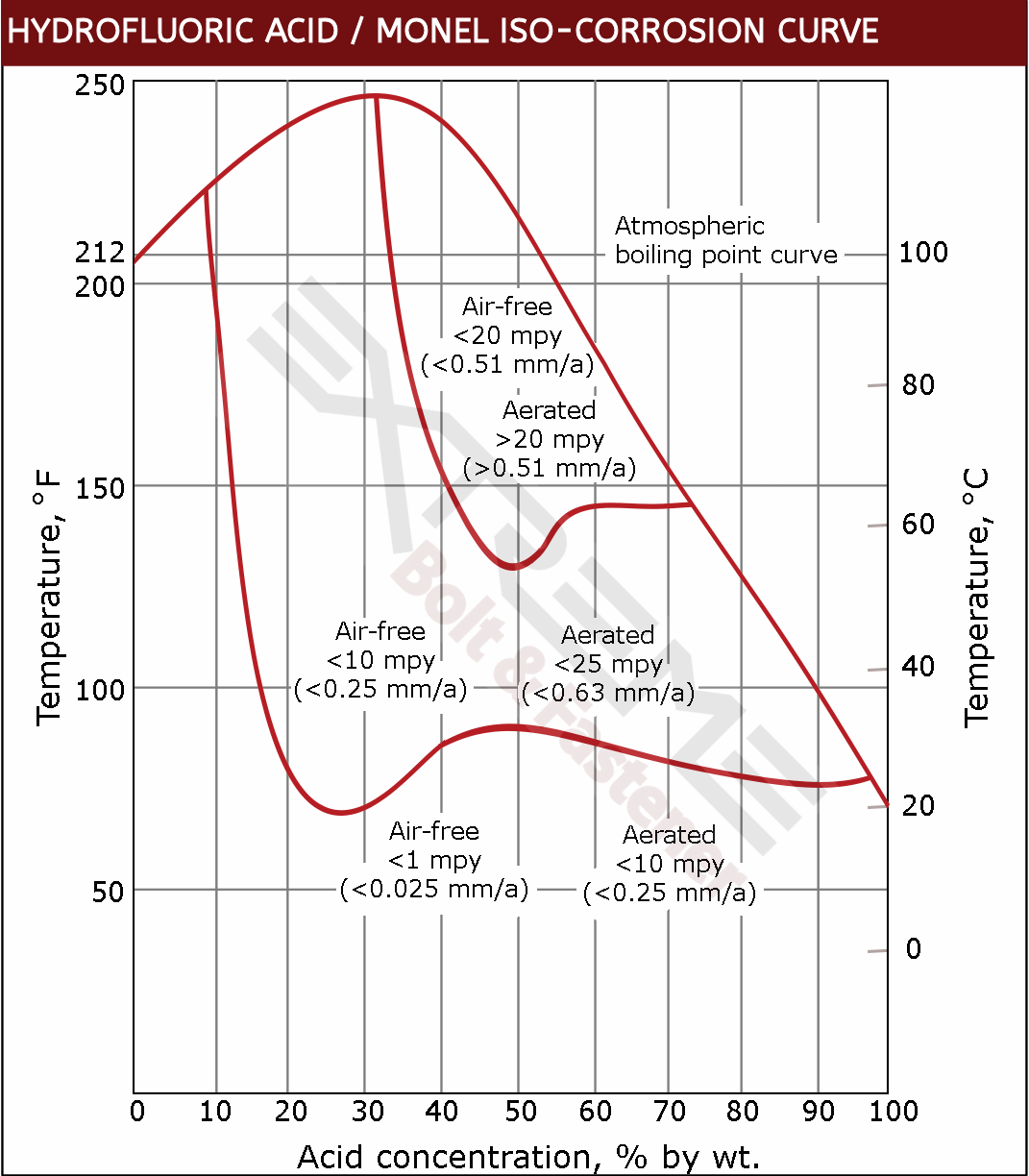
One of the most outstanding characteristics of Monel socket head cap screws is that they offer exceptional resistance to hydrofluoric acid (HF), a particularly tough acid to deal with, in all concentrations up to the boiling point. For hydrofluoric acid applications Monel screws are perhaps the most resistant of all commonly used specialty alloys.
The most common grades of Monel flanges are Monel 400 and Monel K500 . Gain more insight on these two nickel alloy grades by accessing our Monel 400 and K500 overviews or by contacting our engineering experts.
Flange Types Available: Blind Flanges, Lap Joint Flanges, Slip On Flanges, Socket Weld Flanges, Threaded Flanges, Weld Neck Flanges
Common Grades of Monel Socket Weld Flanges
Monel 400
Monel 400, UNS N04400 (QQ-N-281), is a nickel-copper alloy with high strength and excellent corrosion resistance in a range of media including sea water, hydrofluoric acid, sulfuric acid, and alkalies. Monel 400 is commonly in marine engineering, chemical and hydrocarbon processing applications.
Monel 400 Specifications: BS3075NA13 (Wire), BS3076NA13 (Bar), ASTM B 164 (Rod, Bar, and Wire), ASTM B 564 (Forgings), ASME SB 164 (Rod, Bar, and Wire), ASME SB 564 (Forgings), AECMA PrEN 2305 (Wire for Rivets), SAE AMS 4675 (Bars and Forgings), SAE AMS 4730 (Wire), SAE AMS 4731 (Wire and Ribbon), DIN 17752 (Rod and Bar), DIN 17753 (Wire), DIN 17754 (Forgings), VdTÜV 263 (Sheet, Plate, Bar, and Tubing), QQ-N-281 (Plate, Sheet, Strip, Bar, Rod, Wire, and Forgings), Werkstoff 2.4360
| Monel 400 | Ni+Co | Cu | Fe | Mn | Si | C | S |
|---|---|---|---|---|---|---|---|
| Min % | 63 | 28.0 | - | - | - | - | - |
| Max % | - | 34.00 | 2.50 | 2.00 | 0.50 | 0.30 | 0.024 |
Monel K500
Monel K500, UNS N05500 (QQ-N-286), is a precipitation-hardenable nickel-copper alloy that combines the corrosion resistance of Monel alloy 400 with greater strength (over 2x as strong) and hardness. It also has low permeability and is nonmagnetic to temperatures as low as -150°F (-101°C).
Monel K500 Specifications: BS3075NA18 (Wire), BS3076NA18 (Rod and Bar), ASTM B 865 (Rod and Bar), DIN 17752 (Rod and Bar), DIN 17753 (Wire), DIN 17754 (Forgings), QQ-N-286 (Rod, Bar, Wire, and Forgings), SAE AMS 4676 (Rod and Bar), ASME Code Case 1192 (Rod and Bar), ISO 9723 (Bar), ISO 9724 (Wire), ISO 9725 (Forgings), Werkstoff 2.4375
| Monel K500 | Ni+Co | Cu | Fe | Mn | Si | C | S | Al | Ti |
|---|---|---|---|---|---|---|---|---|---|
| Min % | 63 | 27.0 | - | - | - | - | - | 2.30 | 0.35 |
| Max % | - | 33.00 | 2.00 | 1.50 | 0.50 | 0.25 | 0.010 | 3.15 | 0.85 |
| Monel K500 | Ultimate Tensile Strength | Yield Strength at 0.2% | Elongation % | Usable Temperature Limit |
|---|---|---|---|---|
| Value | 160 ksi | 110 ksi | 45 | 1100°F / 593°C |
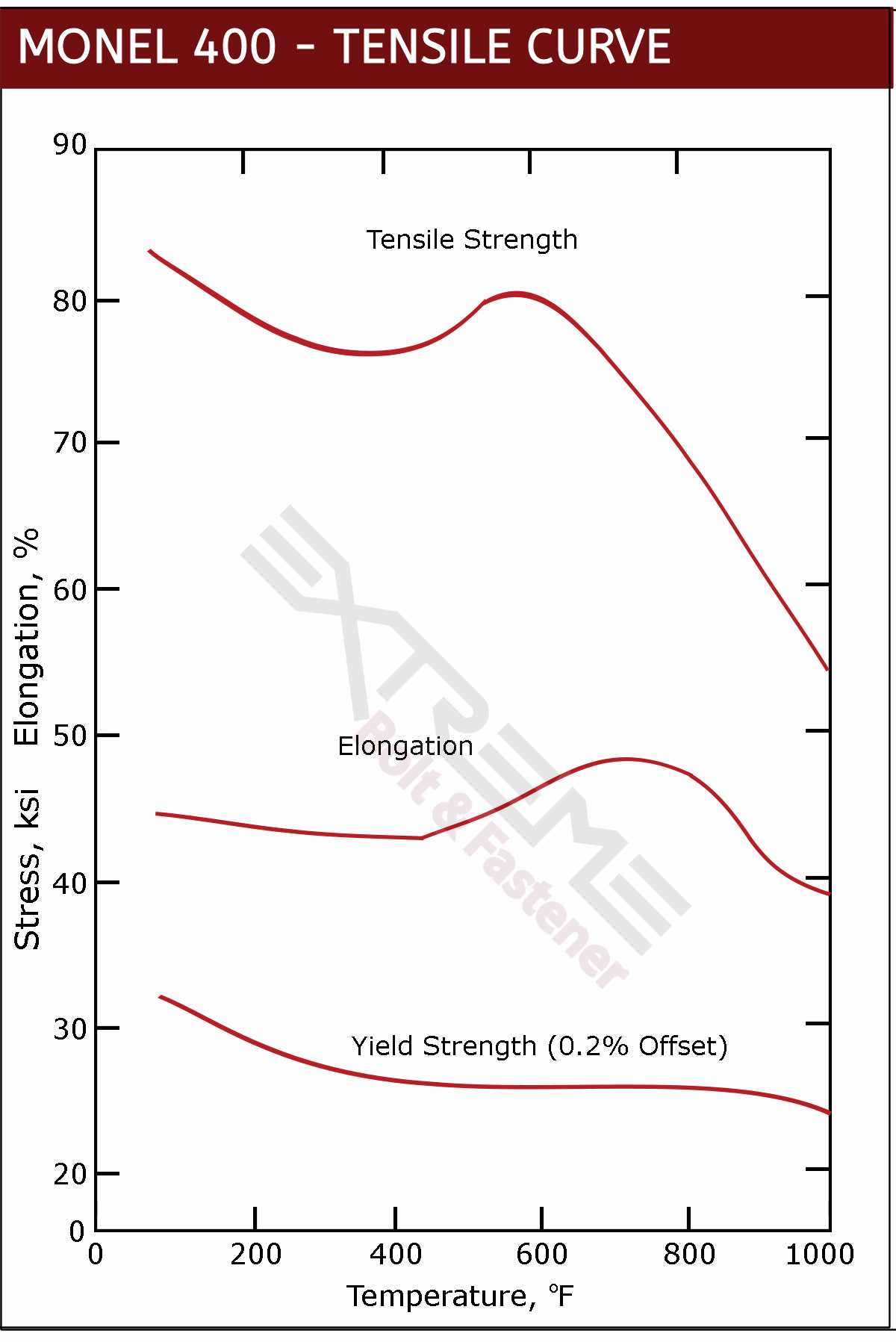
| Temperature (°F) | Ultimate Tensile (ksi) | Yield Strength 0.2% Offset (ksi) | Elongation % |
|---|---|---|---|
| Room Temp. | 83 | 32 | 45 |
| 200 | 79 | 30 | 43 |
| 400 | 77 | 27 | 42 |
| 600 | 80 | 27 | 46 |
| 800 | 68 | 26 | 48 |
| 1000 | 54 | 24 | 40 |
| Temperature (°F) | Ultimate Tensile (ksi) | Yield Strength 0.2% Offset (ksi) | Elongation % |
|---|---|---|---|
| Room Temp. | 160 | 110 | 45 |
| 200 | 150 | 108 | 47 |
| 400 | 147 | 105 | 48 |
| 600 | 142 | 103 | 49 |
| 800 | 125 | 102 | 19 |
| 1000 | 95 | 90 | 8 |
| Nominal Designation | Forgings | Castings | Plates | ||||
|---|---|---|---|---|---|---|---|
| 67Ni 30Cu | B564 Gr. N04400 (1) | ... | B127 Gr. N04400 (1) | ||||
| Working Pressures by Classes, psig | |||||||
| Temp., F | 150 | 300 | 400 | 600 | 900 | 1500 | 2500 |
| 20 to 100 | 230 | 600 | 800 | 1200 | 1800 | 3000 | 5000 |
| 200 | 200 | 525 | 700 | 1050 | 1575 | 2630 | 4380 |
| 300 | 190 | 490 | 655 | 980 | 1470 | 2450 | 4080 |
| 400 | 180 | 475 | 630 | 945 | 1420 | 2365 | 3940 |
| 500 | 170 | 475 | 630 | 945 | 1420 | 2365 | 3940 |
| 600 | 140 | 475 | 630 | 945 | 1420 | 2365 | 3940 |
| 650 | 125 | 475 | 630 | 945 | 1420 | 2365 | 3940 |
| 700 | 110 | 470 | 625 | 940 | 1410 | 2350 | 3920 |
| 750 | 95 | 465 | 620 | 930 | 1395 | 2330 | 3880 |
| 800 | 80 | 460 | 610 | 915 | 1375 | 2290 | 3820 |
| 850 | 65 | 375 | 505 | 755 | 1130 | 1885 | 3145 |
| 900 | 50 | 275 | 365 | 550 | 825 | 1370 | 2285 |
Socket Weld Flange Features & Benefits
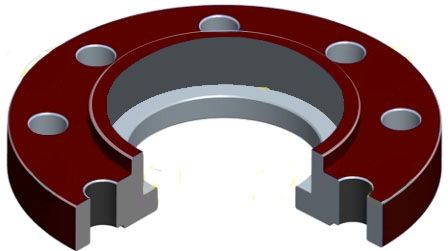
Similar to a slip on flange, an Monel socket weld flange has an added shoulder inside the bore hole. The socket weld flange is designed so that a pipe can be inserted into the socket of the flange until it hits the shoulder of the socket. The pipe is then backed away from the shoulder approximately 1/16 inches before being welded to the flange hub. This internal weld provides this type of flange added strength. In addition, by grinding the internal weld smooth, turbulence and flow restriction are minimized. Monel socket weld flanges are most commonly used on small diameter applications (1/2" through 4") and high pressure piping systems.
Socket Weld Flange Benefits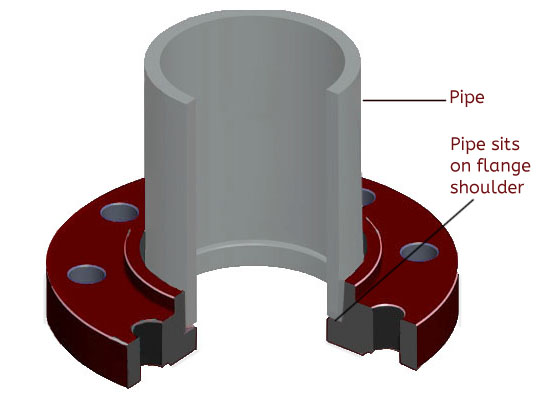
- Best for small size, high pressure applications
- Static strength equal to a slip on flange yet boasts a fatigue strength 1.5 times that of the slip on design
- Employs both a backside hub weld and an internal shoulder weld for increased strength
- Socket weld flanges delivers a lower risk of leakage than threaded flanges
- Socket weld pipes do not have to be beveled for weld preparation
- Butt-welded joints are easily fitted and no special machining
Socket Weld Flange Disadvantages
- The expansion gap and internal crevices left in socket welded systems can promote crevice corrosion.
- Socket weld flanges have two welds which makes them stronger yet more labor intensive to install. Due to the increased welding, it has become the practice to weld only at the hub of the flange, which is not recommended.
Installation Tips
The socket weld pipe fittings should allow for expansion gap of 1/16 inch (1.6 mm) between pipe and the shoulder of the socket.