
Ceramic Alumina Hex Head Bolts
Last updated
A superb combination of corrosion resistance, temperature stability and non-conductivity

Need help choosing a material?
- Exceptional temperature resistance up to 3000°F (1650°C)
- Outstanding corrosion resistance to acids, solvents, salts, and organics
- Excellent electrical & thermal insulator
- High purity
- Ceramic Alumina hex head bolt features and benefits
- Alumina ceramic datasheet
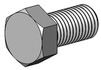
Alumina ceramic hex head bolts are one of the most thermally resistant bolts available. Due to their outstanding thermal resiustance, alumina ceramic bolts are geared for the most demanding high temperature applications. Alumina ceramic bolts also have outstanding corrosion resistance and are highly chemically resistant to acids, solvents, and salts. Additionally, alumina ceramic hex head bolts find many uses in high voltage applications due to their non-conductive electrical properties.
Alumina ceramic hex head bolts are available in both metric and standard sizes. Please contact us if you have any questions about the properties or availability of our ceramic fasteners.
Hex head bolts made from customer specified ceramic grades or custom dimensions are available upon request.
Ceramic Alumina Hex Head Bolt Features and Benefits
It is important to differentiate between a alumina hex head bolt and hex head cap screw. Often people assume they are the same, but they are actually very different fasteners in terms of how they are manufactured, as well as from an application perspective. Regardless of your choice, alumina hex heads offer strong, stable joints because of their large head service.
The Hex Comparison
|
Hex Head Bolts |
Hex Head Cap Screw |
|
|
Common Ceramic Grades
Alumina 99.8%
Alumina ceramic or Aluminum oxide (Al203) is the most common grade of alumina ceramics and is designated as being 99.8% pure. Alumina is most known for high temperature stability and has a usable temperature limit of 3000°F (1650°C). Alumin has the greatest balance of economy, mechanical and thermal properties.
Various other compositions of alumina ceramic are available upon request.
Alumina and Zirconia Properties
| Property | ASTM or UL Test | Alumina | Zirconia |
|---|---|---|---|
| PHYSICAL | |||
| Density (lb/in³) (g/cm³) | D792 | 0.141 (3.89) | 0.220 (6.1) |
| Water Absorption, 24 hrs (%) | D570 | 0 | 0 |
| MECHANICAL | |||
| Strength/Weight Ratio | Tensile Strength / Density (g/cc) | 7700 | 12300 |
| Tensile Strength (psi) | D638 | 30,000 | 75,000 |
| Tensile Modulus (psi) | D638 | 43,500,000 | 30,000,000 |
| Tensile Elongation at Break (%) | D638 | 0 | - |
| Flexural Strength (psi) | D790 | 55,000 | 100,000 |
| Flexural Modulus (psi) | D790 | 54,000,000 | - |
| Hardness, Rockwell, R/M Scale | D785 | A88 | A80 |
| IZOD Impact Notched (ft-lb/in) | D256 | - | - |
| THERMAL | |||
| Coefficient of Linear Thermal Expansion (x 10-5 in./in./°F) | D696 | 0.5 | 0.6 |
| Heat Deflection Temp (°F / °C) at 264 psi | D648 | none | none |
| Melting Temp (°F / °C) | D3418 | - | - |
| Max Operating Temp (°F / °C) | - | 3000/1650 | 4350/2400 |
| Thermal Conductivity (BTU-in/ft²-hr-°F) | C177 | 242.0 | 15.0 |
| Flammability Rating | UL94 | non-flammable | non-flammable |
| ELECTRICAL | |||
| Dielectric Strength (V/mil) short time, 1/8" thick | D149 | 230 | 50 |
| Dielectric Constant at 1 MHz | D150 | 10 | 28 |
| Dissipation Factor at 1 MHz | D150 | 0 | - |
| Volume Resistivity (ohm-cm) at 50% RH | D257 | 1x10¹⁴ | > 1012 |
| APPROVALS | |||
| Approval | FDA | YES | - |
| Approval | USDA | NO | - |
| Approval | NSF | NO | - |
| Approval | 3A DAIRY | NO | - |
| Approval | USP CLASS VI | Medical Grades Available | - |