17-4 PH Lap Joint Flanges
Last updated
An extremely strong precipitation hardened stainless steel

Need help choosing a material?
- Well suited for high strength applications
- Up to 4x stronger than 316 stainless steel
- Maintains its mechanical strength up to 600°F
- 17-4PH Chemistry & Specifications
- Lap joint flange features and benefits
- 17-4PH Datasheet
17-4 PH lap joint flanges are made from a precipitation hardened stainless steel most known for its exceptional strength and its ability to maintain its mechanical properties to 600°F. Compared to 316 stainless steel, 17-4 PH lap joint flanges yield strength is up over 4 times greater. When compared to Duplex 2205 lap joint flanges, the yield strength of 17-4 PH can be up to 2-½ times greater.
17-4 lap joint flanges are available in 8 different aged (precipitation hardened) conditions offering a variety of mechanical properties (see below).
Flange Types Available: Blind Flanges, Lap Joint Flanges, Slip On Flanges, Socket Weld Flanges, Threaded Flanges, Weld Neck Flanges
17-4PH Chemistry & Specifications
17-4PH Specifications: UNS S17400, Werkstoff 1.4542, AISI 630, ASTM A564-630, AMS 5604 Sheet, Strip and Plate, ASTM A 693 Plate
This specification covers bars and shapes (such as fasteners) of age hardened stainless steels such as 17-4PH. It includes hot-finished or cold-finished fasteners that are produced by hot rolling, extruding, or forging. Grade 630 shall be furnished in the solution-annealed or or age-hardened condition.
| 17-4PH | Fe | Cr | Ni | Cu | Mn | Si | Mo | Nb+Ta | C | P | S |
|---|---|---|---|---|---|---|---|---|---|---|---|
| Min % | - | 15.0 | 3.0 | 3.0 | - | - | - | - | - | - | - |
| Max % | Bal | 17.5 | 5.0 | 5.0 | 1.0 | 1.0 | 0.50 | 0.45 | 0.07 | 0.04 | 0.03 |
| Aged Condition | Ultimate Tensile (min. ksi) | Yield Strength 0.2% Offset (min. ksi) | Elongation (min. %) | Hardness (Rockwell C, min.) |
|---|---|---|---|---|
| H900 | 190 | 170 | 10 | 40 |
| H925 | 175 | 155 | 10 | 38 |
| H1025 | 155 | 145 | 12 | 35 |
| H1075 | 145 | 125 | 13 | 32 |
| H1100 | 140 | 115 | 14 | 31 |
| H1150 | 135 | 105 | 16 | 28 |
| H1150-M | 115 | 75 | 18 | 24 |
| H1150-D | 125 | 105 | 16 | 24 / 33 max |
17-4PH Lap Joint Flange Features & Benefits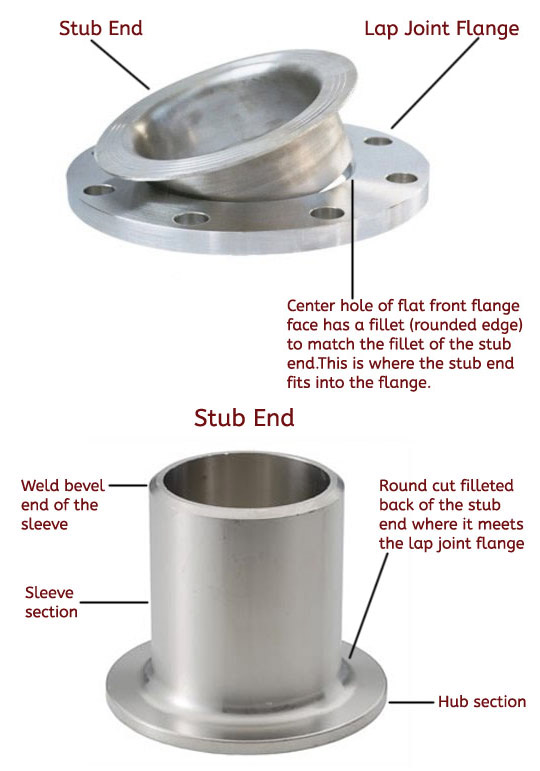
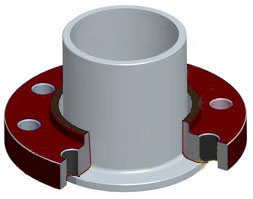
Lap joint flanges are unique in that they are made of two pieces, the flange itself and the stub end.
Flange
- The backside, has a slight shoulder that is square cut at the center or pipe hole
- The front side has a flat face with a filleted (rounded) center hole to match the filleted back face of the stub end. Here the stub end will wrap tightly around the center hole of the flange.
Stub End
- Shaped like a short piece of pipe with a weld bevel on one. This portion of the stub end is also called the sleeve.
- Narrow shoulder on the flange facing end called is the hub. The back face of the hub has a rounded transition (or inside fillet) that joins the hub to the sleeve
Benefits
- Economy
Because a lap joint flange has a two piece configuration, it offers a way to cut cost when piping systems requires - For high cost alloys the only "wetted" part is the stub end. In this situation, it is only required for the stub-end to be made of the higher cost corrosion-resistant material, where the flange itself can be the produced from lower cost steel.
- Ease of Work
By using lap joint flanges, work can be simplified in situations that require frequent and rapid disassemble and assembly during the operation of a plant. The ability to spin that backing flange compensates for misalignment of the bolt holes during assembly.