
Tungsten Hex Nuts
Last updated
Ultra-high density & high temperature / strength stability

Need help choosing a material?
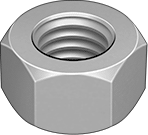
- Very high density of 19.3 gm/cc
- Radiopaque to x-rays and other radiation
- High strength at extreme high temperatures (vacuum)
- Excellent corrosion resistance
- Mechanical properties of tungsten hex nuts
- Tungsten material datasheet
Tungsten hex nuts are known for their extreme high density; because of this unique attribute, they are often used for balancing rotating parts. Tungsten’s high mass also makes these hex nuts radiopaque. This allows tungsten hex nuts to block radiation and show up well on x-rays – even better than lead. Another unique attribute of tungsten is its extrmely high melting point of 3420°C. The high temperature stability of tungsten hex nuts make them ideal for some of the hottest vacuum furnace environments. Beyond their high mass and temperature stability, tungsten nuts are also very corrosion resistant.
Tungsten hex nuts are usually made from tungsten alloys per ASTM B777, and range from 90% to 97% pure tungsten, alloyed with nickel and copper or nickel and iron. Nuts can also be made from Commercially Pure (CP) Tungsten.
Applications
- The aerospace industry depends on the tungsten nuts for their combination of high density and mechanical strength which allows them to reduce the physical size of components, offering greater control of weight distribution for propellers, inertial systems and fluid control systems to name a few.
- The heat treating / furnace industry uses tungsten hex hex nuts in high temperature vacuum furnaces due to tungstens great high temperature strength & stability.
- The oil & gas industry uses tungsten nuts for radiation shielding properties to protect equipment used in oil and gas detection, as well as down hole logging for density and ability to withstand intense hydrostatic pressure
- Tungsten hex nuts also play a role in the medical community for their low magnetic properties as well as their radiopaque properties.
Tungsten Chemistry & Specifications
Tungsten Specifications: ASTM B777, Mil Spec T-21014D
| Tungsten Alloy ASTM-B777 | Class 1 | Class 2 | Class 3 | Class 4 | CP Tungsten |
|---|---|---|---|---|---|
| Material Composition | 90% W 6% Ni 4% Cu | 92.5% W 5.25% Ni 2.25% Fe | 95% W 3.5% Ni 1.5% Cu | 97% W 2.1% Ni 0.9% Fe | 99.95% W |
| Density | 17 gm/cc | 17.5 gm/cc | 18 gm/cc | 18.5 gm/cc | 19.3 gm/cc |
| Mil. Spec. T-21014 D | Class 1 | Class 2 | Class 3 | Class 4 | - |
| Type | Type II & III | Type II & III | Type II & III | Type II & III | - |
| Hardness; Rockwell C | 24.0 | 26.0 | 27.0 | 28.0 | 31.0 |
| Ultimate Tensile Strength; PSI | 94,000 | 110,000 | 94,000 | 100,000 | 142,000 |
| Yield Strength, .2% Offset; PSI | 75,000 | 75,000 | 75,000 | 75,000 | 109,000 |
| Elongation, % in 1” | 2+ | 2+ | 2+ | 2+ | |
| Modulus of Elasticity; PSI | 40 x 10E6 | 47 x 10E6 | 45 x 10E6 | 53 x 10E6 | 58 x 10E6 |
| Coefficient of Thermal Expansion x 10E-6/°C (20°-400°C) | 5.4 | 4.6 | 4.4 | 4.5 | 4.2 |
| Electrical Conductivity; %IACS | 14 | 13 | 16 | 17 | 18 |