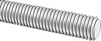
MP35N Threaded Rod
Last updated
One of the highest strength alloys available to industry

Need help choosing a material?
- Extreme high strength properties with a min 260ksi ultimate tensile.
- Good in moderately elevated temperatures of 800°F.
- Moderate corrosion resistance.
- MP35N chemisty, specs, and heat treatments
- Datasheet for MP35N
MP35N threaded rods are known for their extraordinary strength and are the strongest threaded rods we offer at Extreme Bolt. MP35N threaded rods owe their extraordinary strength to a unique alloy combination of nickel, cobalt, chrome and molybdenum. These fasteners have a minimum 260ksi ultimate tensile strength, which typically reaches ~285ksi.
Beyond the strength of MP35N threaded rods, they are also exhibit good corrosion resistance and can resist most mineral acids, hydrogen sulfide, seawater and salt spray environments.
MP35N threaded rods are also resistant to high temperature oxidation and could operate in environments up to 800°F and still maintain much of its strength.
Applications where MP35N threaded rods are often found are: aerospace, defense, marine, chemical processing, oil and gas and medical.
MP35N Chemistry, Spec and Heat Treatments
Heat Treating & Aging: MP35N is usually supplied in heat treated and cold drawn condition AMS 5844. In this state the MP35N can be worked into the desired fastener form and aged to the AMS 5845 specification. Once aged, the MP35N material could achieve it full strength potential.
MP35N Specifications: AMS 5844, AMS 5845, AMS7468, ASTM F562, NACE MR0175
| MP35N | Ni | Co | Cr | Mo |
|---|---|---|---|---|
| Typical % | 35 | 35 | 20 | 10 |
| Guarenteed Minimum Properties | Nominal Properties | |||||||||
|---|---|---|---|---|---|---|---|---|---|---|
| UTS (ksi) | Yield Strength (0.2%) ksi | Elongation (% 4D) | RA (%) | HRC | UTS (ksi) | Yield Strength (0.2%) ksi | Elongation (% 4D) | RA (%) | HRC | |
| MP35N Cold Drawn Full Strength | 260 | 230 | 8 | 35 | 44 min | 285 | 275 | 9 | 45 | 50 |
| Media | Corrosion Resistance | Media | Corrosion Resistance |
|---|---|---|---|
| Nitric Acid | Good | Sulfuric Acid | Good |
| Phosphoric Acid | Good | Acetic Acid | Excellent |
| Sodium Hydroxide | Good | Salt Spray (NaCl) | Excellent |
| Sea Water | Excellent | Sour Oil/Gas | Excellent |
| Important Note: The following 4-level rating scale is intended for comparative purposes only for this materials only. Corrosion testing is recommended; factors which affect corrosion resistance include temperature, concentration, pH, impurities, aeration, velocity, crevices, deposits, metallurgical condition, stress, surface finish and dissimilar metal contact. | |||