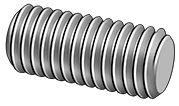
Alloy 230 Threaded Rod
Last updated
One of the most stable & creep resistant alloys at high temperature

Need help choosing a material?

- Extremely oxidation & nitriding resistant
- Ideal material for the highest creep resistance at high temperature
- Great mechanical strength at elevated temperatures
- Stabile up to 2100°F (1149°C)
- Alloy 230 chemistry & specifications
- Rupture strength and mechanical strength charts
- Datasheet for alloy 230
Haynes® 230 fasteners such as bolts, screws, nuts and threaded rods are ideally suited for high temperature environments where creep strength and oxidation resistance are the primary concern. This material really stands out when your operating at temperature is above 1200°F (650°C). Alloy 230 bolts are even capable of surviving at temperatures up to 2100°F (1150°C). These unique capabilities are due to its chemical make up as a nickel-chromium-tungsten-molybdenum alloy.
When comparing the stress-rupture strength of alloy 230 to other high temperature materials, like Inconel 625, Hastelloy X, Incoloy 800H or RA330, Alloy 230 bolts exceed them all when operating at temperatures above 1600F. Click here for a material comparison of Alloy 230's high temperature, stress-rupture strength.
Furthermore, alloy 230 screws can maintain their ductility after long exposures to high temperatures. This demonstrates that this material retains it elongation and does not become brittle, which is a common mode of failure for other alloys when exposed to the effects of high temperature oxidation. Click here to learn more about ductility retention after long term exposure to high temperature.
Alloy 230 Fastener Styles
Alloy 230 Screws
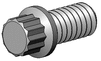
- 12 Point Screws
- Button Head Cap Screws
- Flat Head Screws
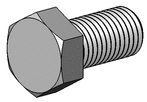
- Hex Head Cap Screws
- Pan Head Screws
- Security Screws
- Set Screws
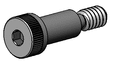
- Socket Head Cap Screws
- Vented Screws
Standards
- DIN 603 / ISO 8677
- DIN 912 / ISO 4762
- DIN 913 / ISO 4026
- DIN 914 / ISO 4027
- DIN 915 / ISO 4028
- DIN 916 / ISO 4029
- DIN 921
- DIN 931 / ISO 4014
- DIN 933 / ISO 4017
- DIN 961 / ISO 8676
- DIN 965 / ISO 7046
- DIN 966 / ISO 7047
- DIN 7991 / ISO 10642
- DIN 7380 / ISO 7380
- DIN 84 / ISO 1207
- DIN 85 / ISO 1580
- DIN 34822
- DIN 34821
- DIN 7504 / ISO 15480
- DIN 7984
- DIN 963 / ISO 2009
Alloy 230 Nuts
Standards
- DIN 439 / ISO 4035
- DIN 934 / ISO 4032
- DIN 985 / ISO 7040
- DIN 986
- DIN 980 / ISO 7042 / ISO 19513
- DIN 6923 / ISO 4161
Alloy 230 Washers
Standards
- DIN 125 / ISO 7089 / ISO 7090
- DIN 126 / ISO 7091
- DIN 127 / ISO 7090
- DIN 9021 / ISO 7093
Alloy 230 Chemistry & Specifications
Specifications: UNS N06230, AMS 5891, SB 572/B 572 B, AMS5878, SB 435/B
| Alloy 230 | Ni | Cr | W | Mo | Fe | C | Mn | Si | Nb | Al | Ti | C | La | B |
|---|---|---|---|---|---|---|---|---|---|---|---|---|---|---|
| Min % | 57 Balance | 22 | 14 | 2.0 | - | - | 0.5 | 0.4 | - | 0.3 | - | 0.1 | 0.02 | - |
| Max % | - | - | - | 3.0 | 5.0 | - | - | 0.5 | - | 0.1 | - | - | 0.015 |
| Hours to Rupture | |||
|---|---|---|---|
| 1400°F (760°C) | 1600°F (871°C) | 1800°F (982°C) | |
| 15.0 ksi (103 MPa) | 4.1 ksi (31 Mpa) | 2.0 ksi (14 Mpa) | |
| Alloy 230 | 8,200 | 65,000 | 5,000 |
| Inconel 625 | 19,000 | 14,000 | 2,400 |
| Hastelloy X | 900 | 5,000 | 2,100 |
| Incoloy 800H | 130 | 1,200 | 920 |
| Inconel 601 | 50 | 1,200 | 1,000 |
| 253 MA | 140 | 900 | 720 |
| Inconel 600 | 15 | 280 | 580 |
| 316 Stainless Steel | 100 | 240 | 130 |
| Alloy 330 | 30 | 230 | 130 |
| 304 Stainless Steel | 10 | 100 | 72 |
1: Measured at fixed conditions (bar and plate) 2: Source: Haynes 230 Brochure | |||
| Test Temperature | 0.2% Yield Strength | Ultimate Tensile Strength | Elogation | |||
|---|---|---|---|---|---|---|
| °F | °C | ksi | Mpa | ksi | Mpa | % |
| 70 | 21 | 55.5 | 383 | 123.6 | 852 | 46.0 |
| 1000 | 538 | 38.1 | 263 | 102.5 | 706 | 53.2 |
| 1200 | 649 | 38.7 | 267 | 98.2 | 677 | 53.0 |
| 1400 | 760 | 37.7 | 260 | 77.2 | 533 | 68.0 |
| 1600 | 871 | 33.9 | 234 | 45.1 | 311 | 94.0 |
| 1800 | 982 | 16.8 | 116 | 24.3 | 168 | 91.2 |
| 2000 | 1093 | 9.1 | 63 | 13.2 | 91 | 92.1 |
1: Tensile measure on plate 2: Source: Haynes 230 brochure | ||||||
| Room Temperature Elongation | ||||
|---|---|---|---|---|
| Alloy 230 | Alloy 188 | Inconel 625 | Hastelloy X | |
| °F | % | % | % | % |
| 1200 | 36.4 | 29.1 | 18 | 19 |
| 1400 | 32 | 10.8 | 13 | 19 |
| 1600 | 36.2 | 22.2 | 26 | 30 |
1: Measured at room temperature after 8000 hour exposure at designated temperature 2: Source: Haynes 230 brochure | ||||
| Alloy | 1800°F (982°C) | 2000°F (1093°C) | 2100°F (1149°C) | 2200°F (1204°C) |
|---|---|---|---|---|
| Metal Loss* (µm) | Metal Loss* (µm) | Metal Loss* (µm) | Metal Loss* (µm) | |
| Alloy 230 | 5 | 13 | 30 | 119 |
| Alloy 188 | 3 | 13 | 218 | 132 |
| Inconel 601 | 10 | 33 | 71 | 112 |
| Alloy 617 | 8 | 15 | 25 | 272 |
| Hastelloy X | 5 | 33 | 91 | - |
| Incoloy 800HT | 13 | 193 | 315 | - |
| 446 Stainless Steel | - | 330 | - | - |
| 316 Stainless Steel | 312 | - | - | - |
* Metal Loss + Average Internal Penetration 1: Measured in in Flowing Air, 1008 Hours 2: Source: Haynes 230 brochure | ||||