
AL6XN Set Screws
Last updated
A mid-ranged corrosion resistant 6Mo alloy with good strength

Need help choosing a material?
- Good corrosion resistance to moderate acids & sea-water
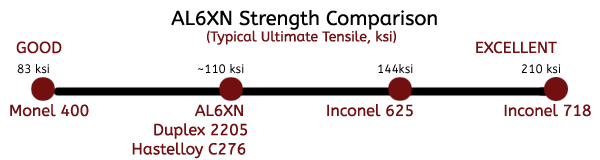
- 50% stronger than stainless steel
- Usable temperature limit of 1000°F
- AL6XN chemistry & specifications
- Set screw features and benefits
- AL6XN Datasheet
Originally developed to combat sea water corrosion, AL6XN has expanded its role as being good mid-range corrosion resistant alloy. AL6XN set screws are a low carbon, high purity, nitrogen-bearing "super-austenitic" stainless alloy. Also considered a 6Moly alloy, AL6XN is similar in chemistry and capabilities to Alloy 926 and SMO 254. With a higher nickel and molybdenum content than Duplex 2205 and Super Duplex 2507, it delivers better corrosion resistance while giving a more cost effective alternative to nickel super alloys like Inconel or Hastelloy in moderately corrosive conditions.
Corrosion Resistance
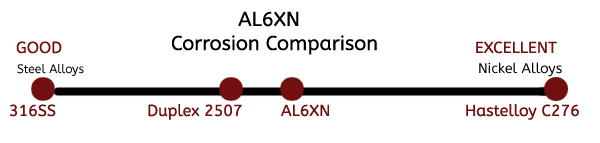
- Moderate general corrosion resistance
- Excellent chloride / salt water protection
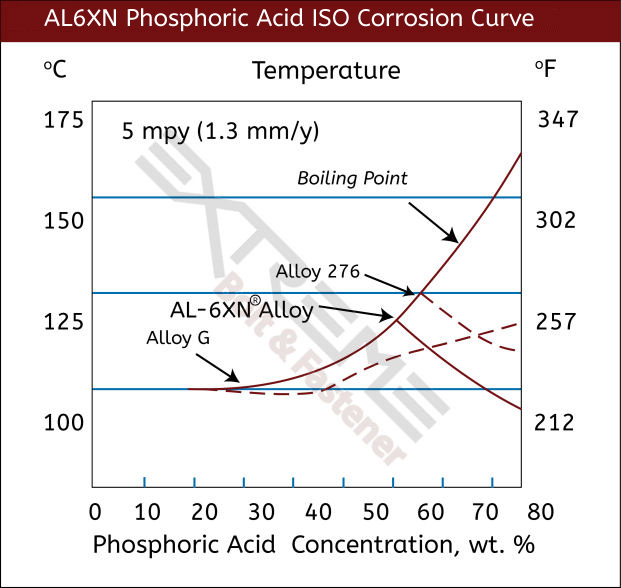
- Good performance in phosphoric acid
- Moderate resistance to nitric acid
Chemical Resistance
In chemical processes which utilize chlorides, such as paper mills and waste water, stress corrosion cracking (SCC) is a common culprit for 316L stainless failures. Duplex alloys will outlast environments that will cause SCC in 316 stainless, but for more severe low PH environments, set screws made from higher nickel content alloys like AL6XN will generally work better. For the most extreme situations, alloys with >45% nickel content like Hastelloy are often considered.
Outstanding Resistance to Salt Water
Seawater is where AL6XN set screws outperform so many alloys providing protection to stress corrosion cracking, pitting and crevice corrosion in a broad range of marine applications. AL6XN set screws contain a minimum of 6% molybdenum content and it is this addition of molybdenum that provides the greatest protection against pitting and crevice corrosion.
Mechanical Properties
Electrical Resistivity: 535 Ohm-circ mil/ft
Ultimate Tensile Strength: 108 ksi
0.2% Yield Strength: 53 ksi
Density: 0.291 lb/in 3
Chemistry
- High molybdenum content provides enhanced corrosion protection in chloride environments.
- Carbon helps to prevent sensitization during welding
- Chromium enhances pitting and crevice corrosion resistance
- The interstitial strengthening effect of nitrogen gives AL6XN set screws good high strength properties
AL6XN Applications
- Desalination plants depend on AL6XN set screws for the salt water corrosion protection
- Pulp bleaching equipment and piping
- The power industry uses AL6XN set screws where salt water and chlorides are present such as steam surface condensers, supercritical, high pressure, feed water heaters, steam surface condensers, flue-gas desulfurization equipment and in nuclear power water piping
- Offshore
- Chemical Processing - processing tanks, vessels and pipes as well as plate and frame heat exchangers.
AL6XN Screw Types: 12 Point Screws, Button Head Cap Screws, Flat Head Screws, Hex Cap Screws, Pan Head Screws, Set Screws, Socket Head Cap Screws, Tamper Resistant Security Screws
AL6XN Set Screw Features & Benefits
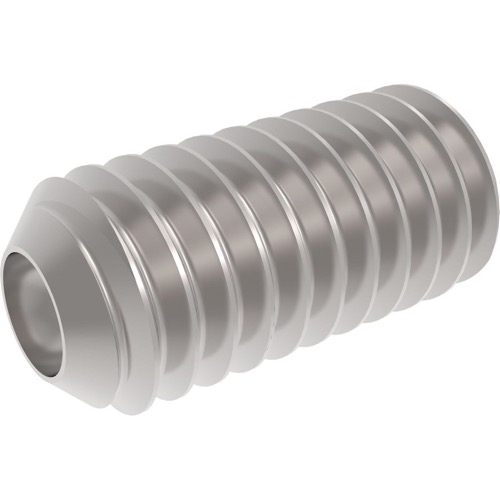
AL6XN set screws are unique in that they have no screw head, meaning that they have no protruding part past the threaded shaft. They are thread only and are available with a socket or slotted driver insert at one end. Set screws are used to secure an object within or against another object. Typically they secure a rotating part such as a gear or shaft. AL6XN set screws are driven through a threaded hole in the rotating part until it is tight against the inner object, preventing from moving relative to the outer object. Set screws are available with various points depending on the application.
Cup Point
This is the most commonly used set screw and is identified by a cup-shaped indentation on one end. AL6XN cup points are typically used for a quick, semi-permanent or permanent applications where it is acceptable to cut the cup point edge of the screw.
Cone Point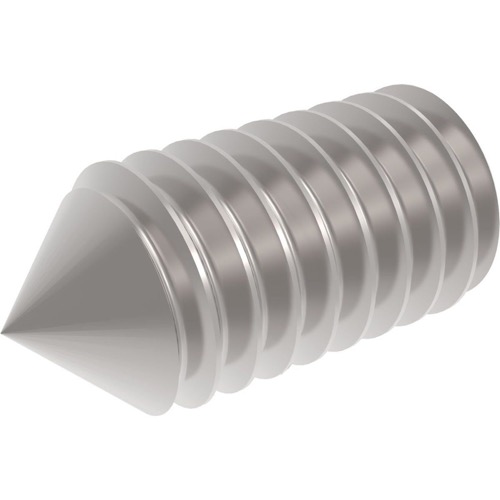
A cone point is easily identifiable by its sharp cone-shaped point – just like an ice cream cone. AL6XN cone point set screws deliver the strongest clamping force due to the deep penetration of the point. As a result they are used for permanent assembly.
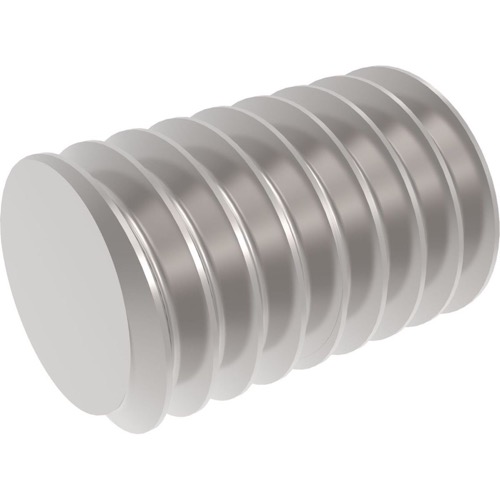 Flat Point
The cheapest and simplest of the set screw point styles, this screw has a flat surface on the bottom of the screw. This type is used when you need the ability to frequently change parts and require minimal shaft deformation.
AL6XN Chemical Composition & Specifications
AL6XN Specifications: ASTM A479, UNS NO8367, ASTM A 240, ASTM B 688, ASME SA-240, ASME SB-688, ASTM B690, ASTM B691, ASTM A240, ASTM B688, ASME SA-240, ASME SB-688
| AL6XN | Fe | Ni | Cr | Mo | Mn | Si | Cu | N | P | C | S |
|---|---|---|---|---|---|---|---|---|---|---|---|
| Min % | - | 23.5 | 20.0 | 6.0 | - | - | - | 0.18 | - | - | - |
| Max % | Bal | 25.5 | 22.0 | 7.0 | 2.0 | 1.0 | 0.75 | 0.25 | 0.040 | 0.03 | 0.030 |
| Temperature (°F) | Ultimate Tensile (ksi) | Yield Strength 0.2% Offset (ksi) | Elongation % |
|---|---|---|---|
| -450 | 218 | 142 | 36 |
| -320 | 196 | 107 | 49 |
| Room Temp. | 108 | 53 | 47 |
| 200 | 100 | 49 | 47 |
| 400 | 90 | 40 | 46 |
| 600 | 86 | 36 | 47 |
| 800 | 87 | 36 | 48 |
| 1000 | 84 | 34 | 50 |
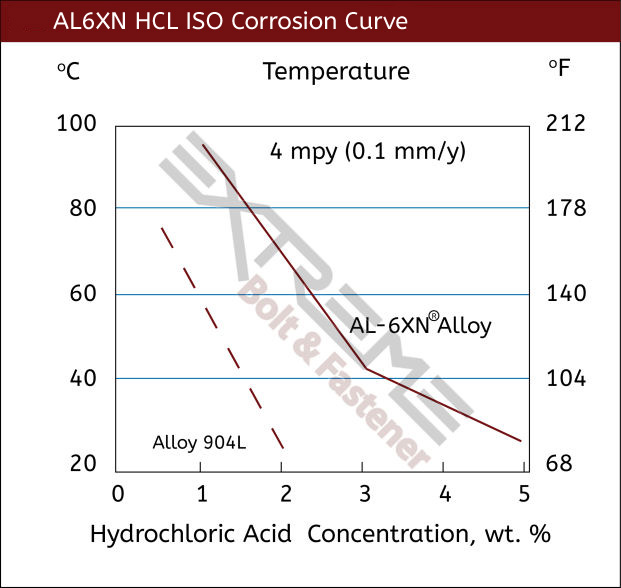
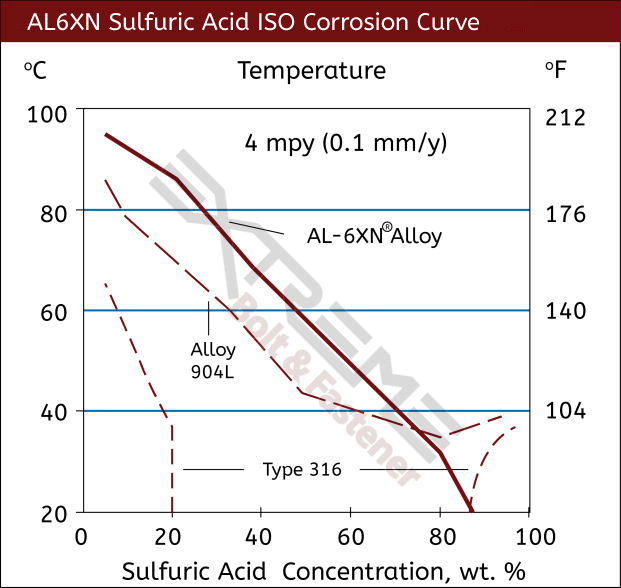
| Media | TYPE 316L | TYPE 317L | ALLOY 904L | AL-6XN | ALLOY 276 |
|---|---|---|---|---|---|
| 20% Acetic Acid | 0.12 | 0.48 | 0.59 | 0.12 | 0.48 |
| -0.003 | -0.01 | -0.02 | -0.003 | -0.01 | |
| 45% Formic Acid | 23.41 | 18.37 | 7.68 | 2.40 | 2.76 |
| -0.6 | -0.47 | -0.2 | -0.06 | -0.07 | |
| 10% Oxalic Acid | 44.9 | 48.03 | 27.13 | 7.32 | 11.24 |
| -1.23 | -1.14 | -0.69 | -0.19 | -0.28 | |
| 20% Phosphoric Acid | 0.60 | 0.72 | 0.47 | 0.24 | 0.36 |
| -0.02 | -0.02 | -0.01 | -0.006 | -0.009 | |
| 10% Sodium Bisulfate | 71.57 | 55.76 | 8.88 | 4.56 | 2.64 |
| -1.82 | -1.42 | -0.23 | -0.12 | -0.067 | |
| 50% Sodium Hydroxide | 77.69 | 32.78 | 9.61 | 11.4 | 17.77 |
| -1.92 | -0.83 | -0.24 | -0.29 | -0.45 | |
| 10% Sulfamic Acid | 124.3 | 93.26 | 9.13 | 9.36 | 2.64 |
| -3.16 | -2.39 | -0.23 | -0.24 | -0.067 | |
| 10% Sulfuric Acid | 635.7 | 298.3 | 100.8 | 71.9 | 13.93 |
| -16.15 | -7.58 | -2.53 | -1.83 | -0.35 | |
| Testing per ASTM G-31 | |||||