Hastelloy C22 Flanges
Last updated
Hastelloy C22 flanges for oxidizing and wet chlorine environments

Need help choosing a material?
C22 nickel alloy offers better overall corrosion resistance to its sister alloy Hastelloy C-276, more specifically, it provides better protection when used in certain saturated wet chlorine environments. In addition, its high chromium content provides C22 flanges much better resistance to oxidizing media that C276. This provides it exceptional resistance to chloride-induced pitting although, in most cases because of its availability, C-276 flanges are a more cost-effective option especially in sizes less than 1/2". Hastelloy C22 flanges are best known for its resistance to pitting and crevice corrosion – which is unmatched in the high performance nickel alloy class. Use of C22 flanges should be limited to temperatures below 1250°F due to the formation of detrimental phases which form above this temperature. Click for detailed chemistry and specifications information on Hastelloy C22 nickel alloy flanges. C22 mechical properties and tensile data is also available.
Corrosion Performance
- Hastelloy C22 Corrosion Data
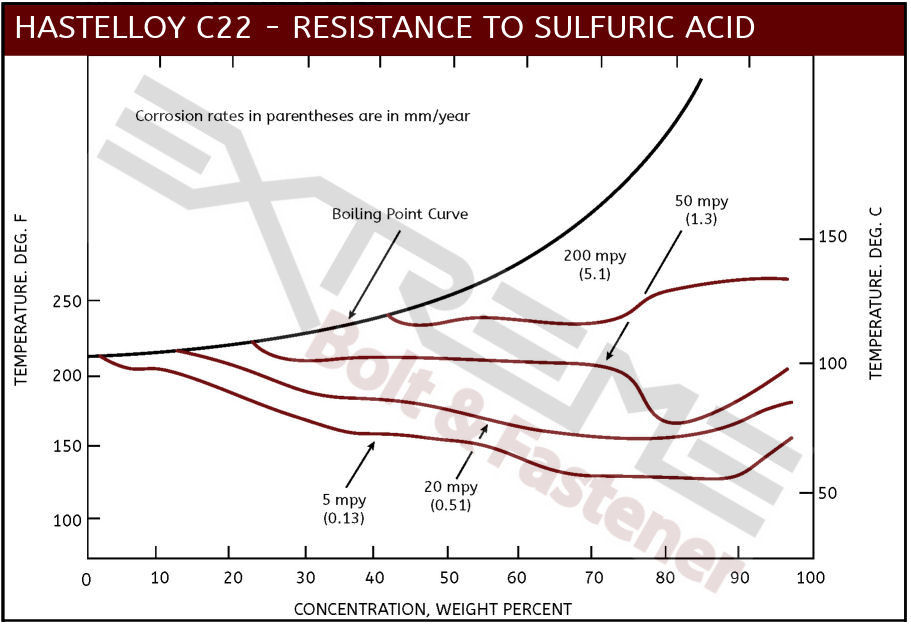
- Sulfuric Acid
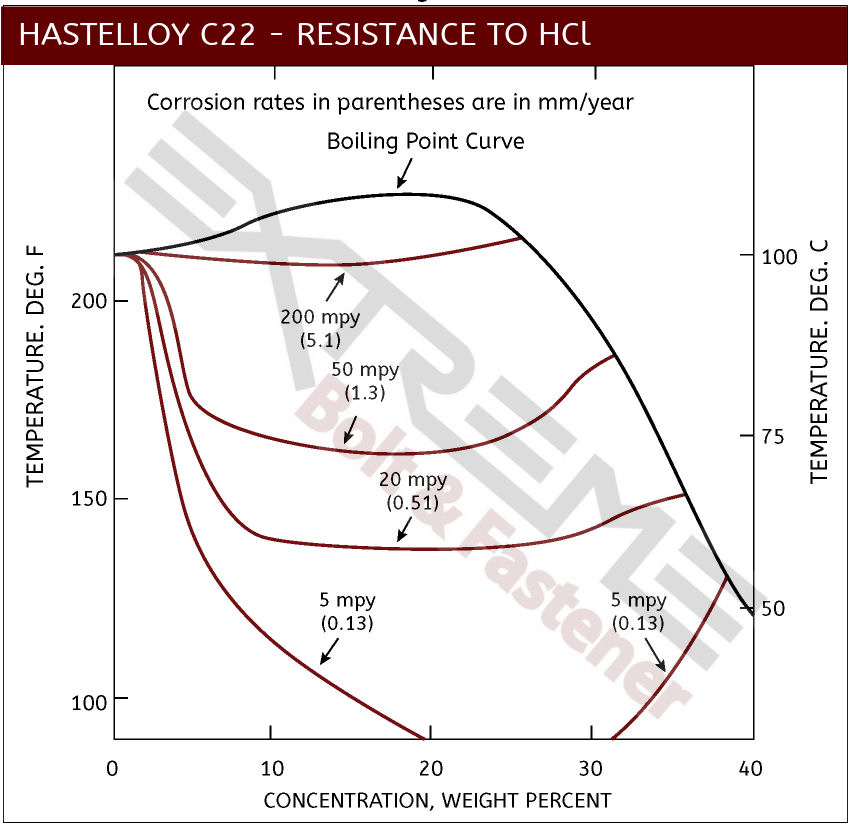
- Hydrochloric Acid
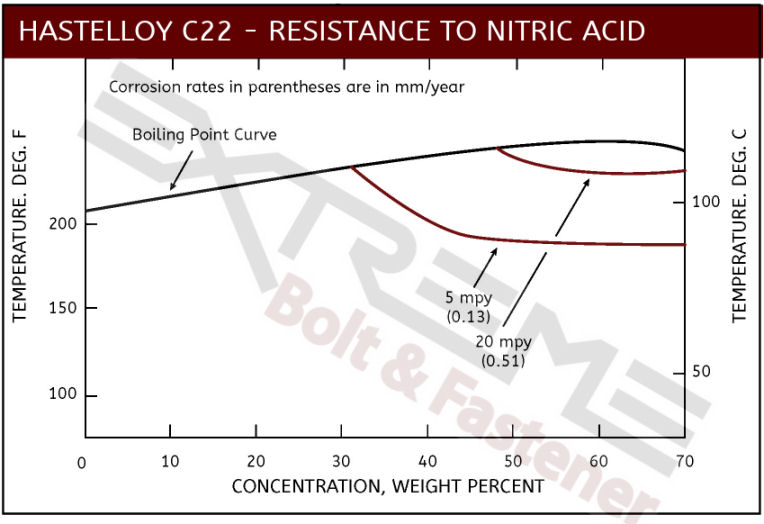
- Nitric Acid
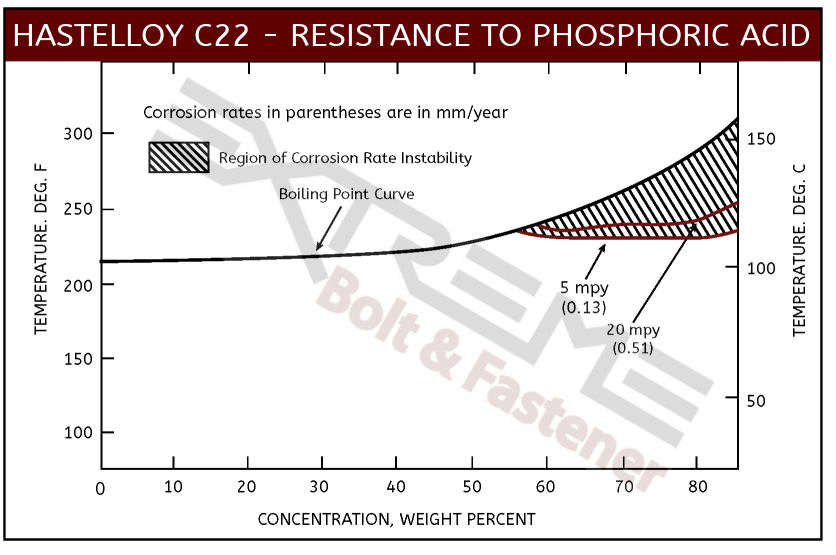
- Phosphoric Acid
Key Benefits
- Alloy C-22 has outstanding resistance to pitting, crevice corrosion and stress-corrosion cracking
- Extremely high protection from wet chlorine environments
- Excellent resistance to a wide variety of chemical process environments including strong oxidizers such as ferric acids, acetic anhydride, hot contaminated media (organic and inorganic), and seawater and brine solutions
- Similar overall corrosion protection compared to C276
- Very ductile, exhibits excellent weldability
Welding
Alloy C22 is considered the best alloy to use as universal weld filler metal to resist corrosion of weldments. These C22 flanges will resist the formation of grain boundary precipitates in the weld heat zone, which make them ideal most chemical process applications in the welded condition.
Uses
- Hastelloy C22 flanges protect extensively against the most corrosive flue gas desulfurization systems and the most sophisticated pharmaceutical reaction vessels
- Chemical process industries depend on C22 flanges for use in equipment like flue gas scrubbers, chlorination systems, sulfur dioxide scrubbers, pulp and paper bleach plants, pickling systems, and nuclear fuel reprocessing
Flange Types Available: Blind Flanges, Lap Joint Flanges, Slip On Flanges, Socket Weld Flanges, Threaded Flanges, Weld Neck Flanges
Hastelloy C22 Flanges Chemistry & Specifications
C22 alloy, UNS N06022, has better overall corrosion resistance in oxidizing corrosives than C-276 and Inconel 625 alloys due to the higher chromium content. Outstanding resistance to localized corrosion and excellent resistance to stress corrosion cracking. This alloy has limited availability and can be made into fastener in larger diameters only (1/2" and greater in size).
Hastelloy C22 Specifications: SB 575/B 575, SB 574/B 574, SB 366/B 366 SB 462/B 462, SB 564/B 564 SB 462/B 462, 17744 No. 2.4602 NiCr21Mo14W, NACE MR0175 ISO 15156, Werkstoff 2.4602
| Hastelloy C22 | Ni | Mo | Cr | Fe | W | Co | Mn | Cu | V | Si | C |
|---|---|---|---|---|---|---|---|---|---|---|---|
| Nominal % | 56 BAL | 13.0 | 22.0 | 3.0 | 3 Max | 2.5 Max | 0.5 Max | 0.5 Max | 0.35 Max | 0.08 Max | 0.01 Max |

| Media | Concentration, Percent By Weight | Test Temperature °F (°C) | Average Corrosion Rate Per Year, mils* | |||
|---|---|---|---|---|---|---|
| 625 alloy | C-22® alloy | C-276 alloy | G-30® alloy | |||
| Acetic Acid | 99 | Boiling | <1 | Nil | <1 | 1 |
| Ferric Chloride | 10 | Boiling | 7325 | 1 | 2 | -- |
| Formic Acid | 88 | Boiling | 9 | <1 | 1 | 2 |
| Hydrochloric Acid | 1 | Boiling | 1 | 3 | 13 | 1 |
| 1.5 | Boiling | 353 | 14 | 32 | -- | |
| 2 | 194 (90) | Nil | Nil | 1 | -- | |
| 2 | Boiling | 557 | 61 | 51 | -- | |
| 2.5 | 194 (90) | 72 | <1 | 12 | -- | |
| 2.5 | Boiling | 605 | 141 | 85 | -- | |
| 10 | Boiling | 642 | 400 | 288 | 2364 | |
| Hydrochloric Acid + 42 g/l Fe2(SO4)3 | 1 | 200 (93) | 238 | 2 | 41 | 803 |
| 5 | 150 (66) | 2 | 2 | 5 | 557 | |
| Hydrochloric Acid + 2% HF | 5 | 158 (70) | 123 | 59 | 26 | 97 |
| Hydrofluoric Acid | 2 | 158 (70) | 20 | 9 | 9 | 10 |
| 5 | 158 (70) | 16 | 14 | 10 | 11 | |
| P2O5 (Commercial Grade) | 39 | 185 (85) | 1 | 2 | 9 | -- |
| 44 | 240 (116) | 23 | 21 | 100 | -- | |
| 52 | 240 (116) | 12 | 11 | 33 | -- | |
| P2O5 + 2000 ppm Cl | 38 | 185 (85) | 2 | 1 | 12 | -- |
| P2O5 + 0.5% HF | 38 | 185 (85) | 9 | 7 | 45 | -- |
| Nitric Acid | 10 | Boiling | <1 | <1 | 7 | <1 |
| 65 | Boiling | 21 | 134 | 888 | 5 | |
| Nitric Acid + 6% HF | 5 | 140 (60) | 73 | 67 | 207 | -- |
| Nitric Acid + 25% H2SO4 + 4% NaCl | 5 | Boiling | 713 | 12 | 64 | -- |
| Nitric Acid + 1% HCl | 5 | Boiling | 1 | <1 | 8 | -- |
| Nitric Acid + 2.5% HCl | 5 | Boiling | <1 | 2 | 21 | -- |
| Nitric Acid + 15.8% HCl | 8.8 | 126 (52) | >10,000 | 4 | 33 | 14 |
| Sulfuric Acid | 10 | Boiling | 37 | 12 | 19 | 31 |
| 20 | 150 (66) | <1 | <1 | <1 | -- | |
| 20 | 174 (79) | <1 | 1 | 3 | <1 | |
| 20 | Boiling | 91 | 33 | 39 | 54 | |
| 30 | 150 (66) | <1 | <1 | 1 | <1 | |
| 30 | 174 (79) | <1 | 3 | 4 | <1 | |
| 30 | Boiling | 227 | 64 | 55 | 60 | |
| 40 | 100 (38) | <1 | <1 | <1 | <1 | |
| Sulfuric Acid | 40 | 150 (66) | 1 | <1 | 1 | <1 |
| 40 | 174 (79) | 35 | 9 | 10 | 2 | |
| 50 | 100 (38) | 1 | <1 | Nil | <1 | |
| 50 | 150 (66) | 25 | 1 | 4 | <1 | |
| 50 | 174 (79) | 58 | 16 | 12 | 10 | |
| 60 | 100 (38) | <1 | <1 | <1 | <1 | |
| 70 | 100 (38) | <1 | Nil | Nil | <1 | |
| 80 | 100 (38) | <1 | Nil | <1 | -- | |
| Sulfuric Acid + 0.1% HCl | 5 | Boiling | 151 | 26 | 33 | -- |
| Sulfuric Acid + 0.5% HCl | 5 | Boiling | 434 | 61 | 49 | -- |
| Sulfuric Acid + 1% HCl | 10 | 158 (70) | 121 | <1 | 11 | -- |
| 10 | 194 (90) | 326 | 94 | 45 | -- | |
| 10 | Boiling | 869 | 225 | 116 | -- | |
| Sulfuric Acid + 2% HF | 10 | Boiling | 55 | 29 | 22 | 53 |
| Sulfuric Acid + 200 ppm Cl- | 25 | 158 (70) | 110 | 11 | 12 | -- |
| 25 | Boiling | 325 | 215 | 186 | 101 | |
| Sulfuric Acid +1.2% HCl + 1% FeCl3 + 1% CuCl2 | 11 | Boiling | 1815 | 3 | 42 | 1227 |
| Sulfuric Acid +1.2% HCl + 1% FeCl3 + 1% CuCl2 (ASTM G28B) | 23 | Boiling | 2721 | 8 | 55 | -- |
| Sulfuric Acid +42 g/l Fe2(SO4)3 (ASTM G28B) | 50 | Boiling | 23 | 40 | 250 | 7 |
*To convert mils per year (mpy) to mm per year, divide by 40 | ||||||